Google Already Made Its AI Comeback. Why Does It Need Another?
Google has been written off in AI before, and came back. In September 2026 it trails on flagship models but leads on reach, cloud and chips. Here is the scorecard.
Is Google falling behind in AI? On the flagship model scoreboard in September 2026, yes: its newest Flash model ranks tenth on one independent index and Gemini 3.5 Pro is still missing. On distribution, cloud and chips, no. Whether Gemini 4 wins back the lead is still unproven.
Quick summary: Google’s model problems coexist with a growing business: on 22 July 2026, it reported 82% annual growth in Cloud revenue. Gemini 4 could change the competitive picture, but public results have yet to establish that it will.
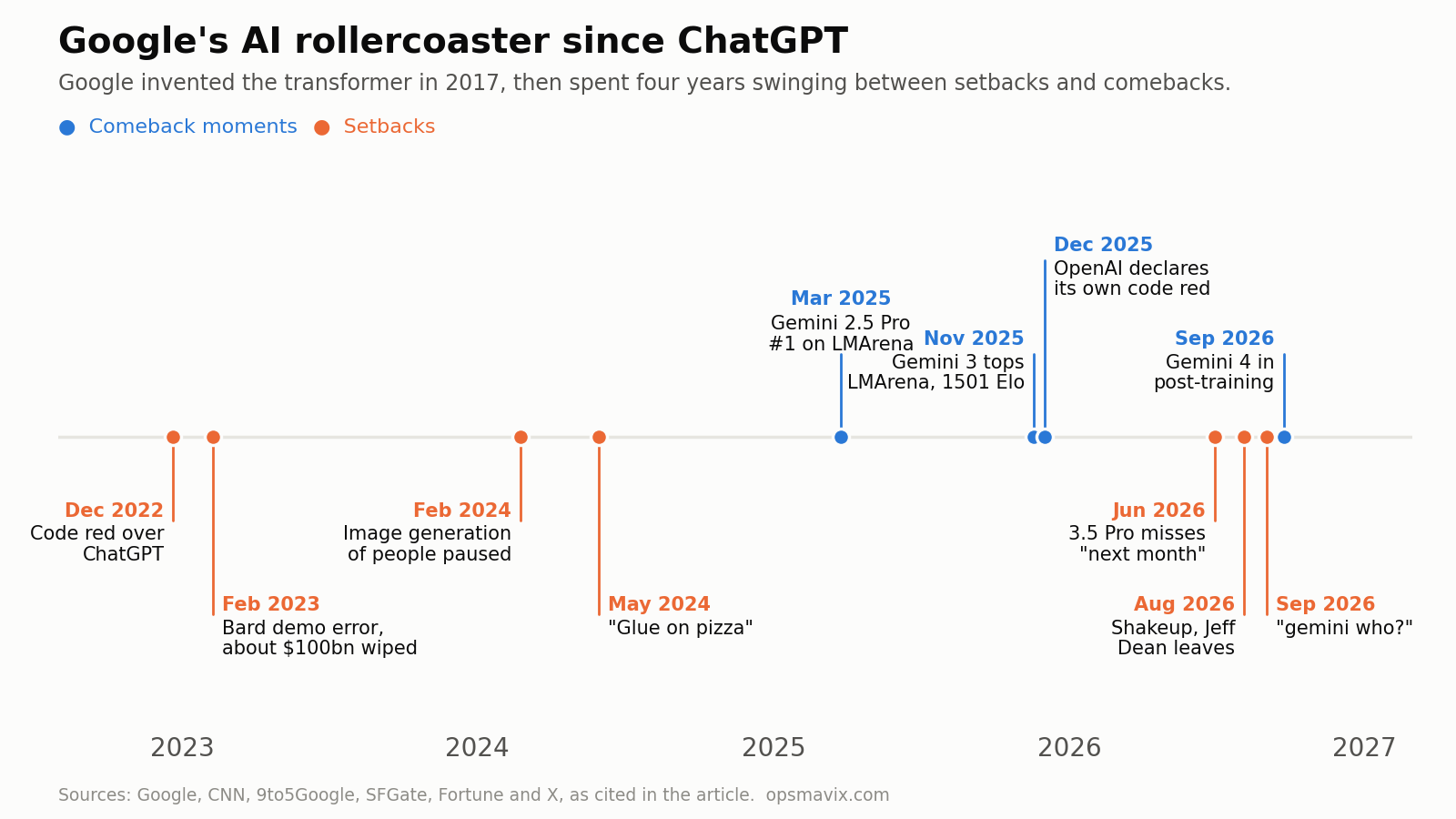
The strangest detail is the emergency that changed sides. Google reportedly declared a code red over ChatGPT in December 2022. By December 2025, OpenAI was reportedly declaring its own, following Gemini 3. Now Google needs to prove itself again. The comeback already happened. It did not settle the race.
Is Google falling behind in AI?
Google is falling behind in AI on the flagship model scoreboard, but not across its business. The Verge noted on 24 September 2026 that OpenAI’s GPT-6 and Anthropic’s Mythos series models “both outperform Gemini 3”, and Google has not shipped a new flagship generation since November 2025.
The other half of the picture points the opposite way. In July, Google reported that the Gemini app had reached 950 million monthly users and that Cloud revenue grew 82% on the year. Those are not the numbers of a company losing its customers.
So the useful question is where Google is behind. A developer choosing a coding assistant, a company buying cloud capacity and someone asking Search a question are making different choices, and no single leaderboard answers all three.
How did Google fall behind in the first place?
Google fell behind in the first place because its research achievements did not translate into the early consumer breakthrough that ChatGPT delivered. Having the intellectual foundations of a technology gives a company an opportunity; it does not automatically produce the product people choose.
On 12 June 2017, researchers at Google submitted Attention Is All You Need, introducing the transformer architecture. That makes the later panic particularly striking. Google helped establish the technical foundations of the competition, then found itself responding to someone else’s success.
By 21 December 2022, 9to5Google was reporting the New York Times account of Google’s code red. The challenge had moved beyond research capability. Google needed a convincing public response to a chatbot that was changing expectations about finding answers online.
On 8 February 2023, CNN reported that Bard’s promotional demo misidentified an exoplanet imaging milestone. Alphabet fell 7.7%, losing roughly $100 billion in market value. That was a market reaction during a troubled launch, not a precise invoice for one incorrect answer.
The credibility problems continued. On 23 February 2024, Google explained its pause on generating images of people. On 30 May 2024, it acknowledged AI Overviews advising glue on pizza. Distinct products had supplied memorable reasons to doubt Google’s judgement about deploying AI.
Google’s first comeback changed who was panicking
The Google AI comeback acquired measurable substance on 25 March 2025, when Google announced Gemini 2.5 Pro Experimental at number one on LMArena. This was stronger evidence than an executive promising improvement: a released model had reached the top of a public comparison.
On 18 November 2025, Google reported Gemini 3 Pro topping LMArena with 1501 Elo. The company’s launch announcement gave the comeback a concrete result. Its earlier mistakes remained part of the history, but they could no longer explain its current position by themselves.
On 27 November 2025, CNBC described Google’s AI comeback. On 2 December, SFGate reported OpenAI’s code red. The company Google had scrambled to answer was now responding to pressure itself. That reversal is why declaring either side permanently finished looks premature.
The market’s reversal was dramatic too. CNBC’s 31 December 2025 review recorded an 18% first-quarter decline and a 65% gain across the full year. These describe different measurement periods, not percentages to add together. Investor confidence had changed; permanent model leadership had not been established.
Why is Google so behind in AI again?
Google is behind in AI again because its flagship release schedule has failed to sustain the momentum of its earlier wins, while competitors have progressed. Frequent updates demonstrate useful engineering progress without resolving the question of whether Google’s strongest model remains competitive.
On 19 May 2026, Google said Gemini 3.5 Pro was already in internal use, adding: “we look forward to rolling it out next month.” The expected June arrival became a credibility problem when customers were still waiting for a broad release in September.
Fortune reported four Flash releases in 106 days on 3 September 2026; Gemini 3.8 Flash ranked tenth on Artificial Analysis. The distinction is between a busy release schedule and progress at the frontier. Counting launches alone cannot establish the latter.
The coding gap also attracted internal attention. On 21 April 2026, Capital Brief relayed The Information’s reporting on a coding strike team. Researchers reportedly considered Anthropic’s tools stronger. That supports a specific concern about coding, rather than a blanket judgement about every Gemini capability.
Google does not dispute the gap. Its 5 August 2026 leadership announcement said the company is “super focused on the areas where we need to improve”, which is an unusually direct admission for a company of its size.
A missing broad release does not establish that Gemini 3.5 Pro was cancelled. The evidence supports a missed expectation and continued uncertainty. Treating every delay as proof of disaster makes the same mistake as assuming that silence guarantees a breakthrough.
Google’s infrastructure advantage survives the model gap
Google’s strongest counterargument sits across its products and infrastructure. It can develop models, design chips, sell cloud capacity and reach customers through services they already use. That combination gives it routes to commercial success even during a period of weaker flagship releases.
This scorecard is our reading of dated evidence, not a universal ranking. “Advantage” here means an asset the specialist model labs do not have, not a claim that Google runs the biggest cloud or makes the best chips.
| Area | Behind or ahead | The evidence |
|---|---|---|
| Frontier models | Behind on cited assessments | SemiAnalysis, 7 August 2026: Gemini ranked eighth or ninth. This was its assessment. |
| Coding | Reported gap | 21 April 2026 reporting identified concern about Anthropic’s stronger tools. |
| Distribution | Structural advantage | Google, 22 July 2026: 950 million Gemini app monthly users. |
| Cloud | Commercial strength | Google, 22 July 2026: $514 billion backlog; nearly 90% of Fortune 100 companies using Gemini Enterprise. |
| Chips | Ownership advantage | Google announced TPU 8t for training and TPU 8i for inference on 22 April 2026. |
The scale is hard to overstate. In the same July update, Google said AI Mode had passed 1 billion monthly users and its model APIs were processing about 22 billion tokens a minute. Reach is not answer quality, but it is what a comeback model gets plugged straight into.
The share price is another separate signal. Reporting on the 23 September 2026 session recorded Alphabet closing 3.8% lower and linked the selling to competition from Meta’s Muse. Reading that move as a verdict on Gemini 4 would overstate what the evidence establishes.
The people deciding Google’s comeback
Sundar Pichai
Sundar Pichai has to square Google’s commercial momentum with a model line that has slipped. On the July earnings call he pushed back: “We’ve had clearly frontier models. There are many attributes on which we are still at the frontier; there are areas where we’ve acknowledged we need to improve” (Reuters via Yahoo Finance). He also confirmed Gemini 4 was in training. The comeback now depends on turning that confidence into a release customers can rely on.
Koray Kavukcuoglu
Koray Kavukcuoglu became senior vice president of Google DeepMind in the August reorganisation, overseeing Gemini development, frontier research and its app and developer teams. That puts delivery at the centre of his role. For readers tracking the comeback, his importance is practical: responsibility for the model and its routes to users now sits together. Whether that arrangement improves execution remains something future releases must demonstrate.
Demis Hassabis
Demis Hassabis became chair of Google DeepMind and Alphabet chief scientist in the same announcement, writing that he would “hand over my day-to-day operational responsibilities” at Google DeepMind. Describing that as leaving Google would misrepresent the change. His continuing strategic role matters to the longer research programme, while the immediate comeback question concerns the products customers can access. A revised leadership structure is evidence of organisational change, not proof that the underlying model gap has closed.
Sergey Brin
Sergey Brin’s involvement makes the coding effort more consequential than a routine product update. The April reporting described the Google cofounder and Kavukcuoglu as directly involved with the strike team. That is the evidence behind talk of Brin driving Google’s next AI comeback. Founder attention signals urgency. It does not mean a stronger coding model already exists, or that one person can guarantee delivery.
Jeff Dean
Jeff Dean’s departure was confirmed in Google’s August announcement: after 27 years, he was launching an independent public benefit corporation with Sanjay Ghemawat. That makes talent retention a legitimate part of the comeback discussion. It does not reveal the quality of unreleased Gemini models. Google now has to deliver through a significant personnel transition, and one departure proves neither decline nor a breakthrough.
“Cooked” or “cooking”: what the AI crowd is saying
SemiAnalysis
SemiAnalysis’s 7 August 2026 assessment separated Gemini’s difficulties from Google Cloud’s strength and placed Gemini eighth or ninth, depending on the comparison. Its criticism targeted organisational culture as well as model performance. That is an analyst interpretation, not an established forecast. The useful contribution is the distinction between the businesses; the stronger claim that Google cannot recover requires evidence that today’s rankings cannot supply.
Alexandr Wang
Meta’s Alexandr Wang supplied the more memorable version. In his 2 September 2026 post, he asked “gemini who?” It captured how quickly the mood around Google had changed after its earlier comeback. But a competitor’s taunt is evidence of competitive positioning. It should prompt readers to inspect the underlying comparison, rather than treat the person delivering the joke as an independent judge of the whole industry.
Logan Kilpatrick
Logan Kilpatrick offered the opposite mood in his 7 August 2026 reply: “Gemini team is cooking” and “I could not be more bullish!” The optimism is real; the result it anticipates remains unproven. Insider confidence may explain why people keep waiting, but customers still need something they can evaluate. That standard should apply equally to Google’s defenders and the competitors announcing that it has fallen behind.
What would make Gemini 4 a real comeback?
Gemini 4 would make a real comeback if it restored competitive flagship performance, addressed the coding weakness and reached users on dependable terms. Those are our proposed tests, not results Google has already achieved. An impressive announcement would only begin the assessment.
At The Information’s AI Agenda Live on 23 September 2026, Kavukcuoglu said Gemini 4 had entered post-training and would launch “much earlier” than year end. He admitted Google “took a little bit of a step back” to focus on Flash, then added: “In my mind, it’s a certainty that we are always gonna be at the frontier” (The Verge).
Pichai had already set the bar in July: “For the next generation of frontier, you’re going to need much larger base models. We are now training Gemini 4, and we’re being very ambitious with it” (CRN). The confidence is on the record. The results are not, yet.
For Gemini 4 vs GPT-6, the evidence is asymmetric. The Verge says GPT-6 and Anthropic’s Mythos series outperform Gemini 3. There is no public Gemini 4 benchmark in the verified record. Assigning its unreleased successor a winning score would therefore be speculation.
There is also a difference between a compelling demonstration and dependable performance. Our examination of GPT-6 Astra playing Minecraft explores that distinction. The same scrutiny belongs here: what conditions produced the result, what failed, and can an independent evaluator reproduce the useful behaviour?
Our view is that Google’s next comeback should be judged against the following tests. They deliberately combine model quality with delivery, because a strong result in a research setting helps customers only when it becomes a product they can use.
- Regain independent competitive standing. Show strong results across relevant evaluations, with identifiable model versions and testing conditions. A favourable screenshot from a narrow comparison can start the conversation, but it cannot establish broad capability across the work customers need completed.
- Close the coding gap in actual work. Demonstrate useful changes in existing projects, including understanding requirements, handling mistakes and completing the task. Our preferred measure is the effort left for a human to finish or repair the output, alongside evaluation scores.
- Deliver a flagship customers can evaluate. Make the stronger model accessible under clear terms, with realistic expectations about availability. Improvements to efficient models remain valuable, but customers waiting for greater capability need evidence that the promised step forward has actually arrived.
- Sustain the improvement. Keep competing as rival releases arrive, rather than treating a launch-day position as a permanent victory. The earlier comeback shows why this matters: recovering the lead and maintaining a dependable development programme are separate achievements, both worth testing.
For when Gemini 4 will come out, our separate release-date article covers the timing. The decision here is simpler: keep the possibility of a better model open without treating an anticipated launch as a capability already available to your team today.
For business buyers, compare the tools available against the job that needs doing. A safety stock calculation needs trustworthy inputs and a defined method. Choose the cheapest approach that meets the requirement, including ordinary software where a model adds little useful value.
Frequently Asked Questions
Is Google behind in AI?
Google is behind in some recent assessments of flagship models and has faced reported coding weaknesses. Its infrastructure and distribution remain substantial strengths. Whether that matters to you depends on the task, the product available and the evidence from testing it yourself.
Did Google lose the AI race?
Google has not permanently lost the AI race. Its previous recovery shows that positions can change, although another recovery is not guaranteed. Calling the race finished confuses a current performance gap with a prediction about future research, products and customer choices.
Why is Google lagging behind in AI?
Google’s delayed flagship release and reported coding weaknesses help explain why it is lagging behind on parts of the current model competition. Analysts also criticise its organisation. The release gap is observable; assigning the entire outcome to one cultural explanation goes further than the evidence.
Google vs OpenAI: who will win?
There is no evidenced permanent winner between Google and OpenAI. A model provider can win a particular workload while another company benefits through infrastructure or distribution. For a purchasing decision, define the outcome you need and judge the current products against it.
Google DeepMind vs OpenAI vs Anthropic: which should a business choose?
Choose between Google DeepMind, OpenAI and Anthropic by evaluating their available products on representative work. Compare accuracy, completion, cost and the amount of human correction required. Keep your business records portable so a better result from another supplier remains an option later.
Final takeaway
Google has already shown that it can recover from being written off. Its current problem is sustaining that recovery while competitors move. Gemini 4 deserves scrutiny when evidence arrives. Until then, Google’s infrastructure strengths are real, and its next model comeback remains unproven.
Keep the business steady while the models change
Whoever wins the next AI comparison, your business should not need rebuilding around them. Inventory, orders, purchasing, production and reporting need consistent records and rules. A better model should improve a useful part of the operation without forcing everyone to relearn the whole system.
In the systems we build at OpsMavix, AI is a replaceable part and the operational truth lives in an ERP the business owns. We build custom internal systems and full ERPs around those workflows, replacing spreadsheets and disconnected tools where that solves the problem.
See what an ERP built around your business could look like →