
Gemini 4 Is Almost Ready. Here Is the Likely Release Window.
No official date yet. DeepMind's chief says Gemini 4 is in post-training and aimed for "much earlier" than year end. Google's release rhythm and Polymarket point to late October or November.
Gemini 4 has no official release date yet, but Google’s own release rhythm and live prediction markets both point to late October or November 2026. On 23 September, Google DeepMind’s new chief, Koray Kavukcuoglu, said the model is in post-training and should ship “much earlier” than the end of the year.
Dates, quotes and market prices checked on 24 September 2026.
Quick summary: If Gemini 4 follows the 342 to 371 day gap between the last two whole-number versions, it lands between 26 October and 24 November 2026, and Polymarket traders price a 71.5% chance of release by 31 October (Polymarket). The only official timing signal is DeepMind’s aim to release an early post-training version “as soon as possible” (The Verge).
Stage promises are a weak guide to Google’s timing. Google said Gemini 3.5 Pro would roll out in June, and it still has not launched broadly. Its calendar is a better guide: the last two whole-number Gemini versions arrived 371 and then 342 days apart.
When is Gemini 4 coming out?
Gemini 4 will probably come out in late October or November 2026, but Google has not given a public release date. The most specific official signal is Kavukcuoglu’s statement, made at The Information’s AI Agenda Live summit on Wednesday 23 September, that Google aims to launch it “much earlier” than the end of 2026 (Windows Report).
No single signal below is proof, but most point at the same few weeks, and the two outliers lean later rather than earlier.
| Signal | What it points to | Source |
|---|---|---|
| DeepMind chief, 23 Sep 2026 | “Much earlier” than the end of 2026 | The Verge |
| Gemini version rhythm | 26 October to 24 November 2026 (our arithmetic) | Google’s own launch posts |
| Polymarket, 24 Sep 2026 | 71.5% by 31 October, 92% by 30 November | Polymarket |
| 9to5Google, July 2026 | November or December | 9to5Google |
| Gemini app code, August 2026 | Around December | TestingCatalog |
The Verge’s subheading goes further, reading the statement as meaning the model “should arrive long before the end of 2026”. That is the newsroom’s reading, not Google’s wording, and it fits the rhythm and the markets.
What did Google DeepMind actually say about Gemini 4?
Kavukcuoglu said Gemini 4 is in post-training and that Google wants to release an early version as soon as it can. As quoted by The Verge, citing The Information: “Our intention is to, like, as soon as possible, to release an early post-training output because we see the results and we are excited.”
It was his first media appearance since taking over Google’s DeepMind division, and The Information’s Laura Bratton reported it first (Techmeme). He added that Google would “continue the fast-paced iterations”, and when asked whether Google had fallen behind, answered: “In my mind, it’s a certainty that we are always gonna be at the frontier.”
Who is Koray Kavukcuoglu?
Koray Kavukcuoglu is the Senior Vice President of Google DeepMind, reporting directly to Sundar Pichai. Google announced the change on 5 August 2026, moving Demis Hassabis to Chair of Google DeepMind and Chief Scientist of Alphabet (Google).
His remit covers “Gemini model development, Frontier AI research, and the Gemini app and developer teams”, so he oversees the teams that build and ship the model. Hassabis, in the same announcement, wrote: “I’m excited about the great progress we’re making with our new models including Gemini 4.”
What “early post-training” means in plain English
Training a frontier model happens in two broad stages. Pre-training teaches the model from an enormous body of data and has traditionally been where most of the compute goes. Post-training shapes that raw model into something useful and safe to release.
Being in early post-training means the expensive part is done but the model is not finished. Google confirmed pre-training was under way by 21 July 2026, which is 64 days before Kavukcuoglu spoke. An “early post-training output” suggests a preview or experimental label first, which fits Google’s habit of shipping early and polishing in public.
What is Gemini 4?
Gemini 4 is the next whole-number generation of Google’s Gemini family of AI models, the successor to the Gemini 3 series launched in November 2025. Google calls its training run “our most ambitious pre-training run yet” (Google), but has not published any benchmark, context window, price or feature list.
What Google has explained is why it needs a new generation at all. On Alphabet’s second-quarter call, Pichai said: “For the next generation of frontier, you’re going to need much larger base models. We are now training Gemini 4, and we’re being very ambitious with it” (CRN).
He framed the target as a moving one: “We want to compete at the frontier level of where the frontier will be when Gemini 4 comes out” (9to5Google). And he closed with a promise rather than a date: “I’m confident that people will be pleased when we are putting it outside.”
What is rumoured, and why to treat it carefully
Several specific Gemini 4 claims are circulating. None comes from Google, and none has been confirmed. They are listed here because they are what people are searching for, not because they are likely to be true.
| Claim | First circulated | Status |
|---|---|---|
| Gemini 4 Pro benchmark “leak” with a 1.5 million token context | 12 August, X | Unconfirmed |
| Internal codename “argon” and a 256K output limit | 14 September, a single X account | Unconfirmed |
| An anonymous model on LMArena is secretly Gemini 4 Pro | 17 September | Unconfirmed, no identifier |
| A 10 million token context window | AI rumour sites | Unconfirmed |
| Release in late September | Community estimates | Now very unlikely (2.5% on Polymarket) |
The one hard artifact is different in kind. In August, TestingCatalog found a Gemini desktop app build showing Google “preparing internally for Gemini 4” (TestingCatalog). That confirms preparation, not a date or a spec.
Every Gemini release so far, and the gaps between them
Google has announced a new major or half-step Gemini version roughly every two to ten months since December 2023. The dates below are the publish dates of Google’s own announcement posts, and several of these models launched as experimental or preview versions first.
| Model | First announced | Days since previous version |
|---|---|---|
| Gemini 1.0 | 6 December 2023 | First release |
| Gemini 1.5 | 15 February 2024 | 71 |
| Gemini 2.0 (Flash experimental) | 11 December 2024 | 300 |
| Gemini 2.5 (Pro experimental) | 25 March 2025 | 104 |
| Gemini 3 (3 Pro, in preview) | 18 November 2025 | 238 |
| Gemini 3.1 Pro (preview) | 19 February 2026 | 93 |
| Gemini 3.5 Flash | 19 May 2026 | 89 |
| Gemini 4 | Not yet released | 310 days since Gemini 3, and counting |
Sources for the anchor dates: Gemini 1.0, Gemini 3 and Gemini 3.5, all on Google’s official blog. The day counts are simple subtraction between those publish dates.
The whole-number rhythm
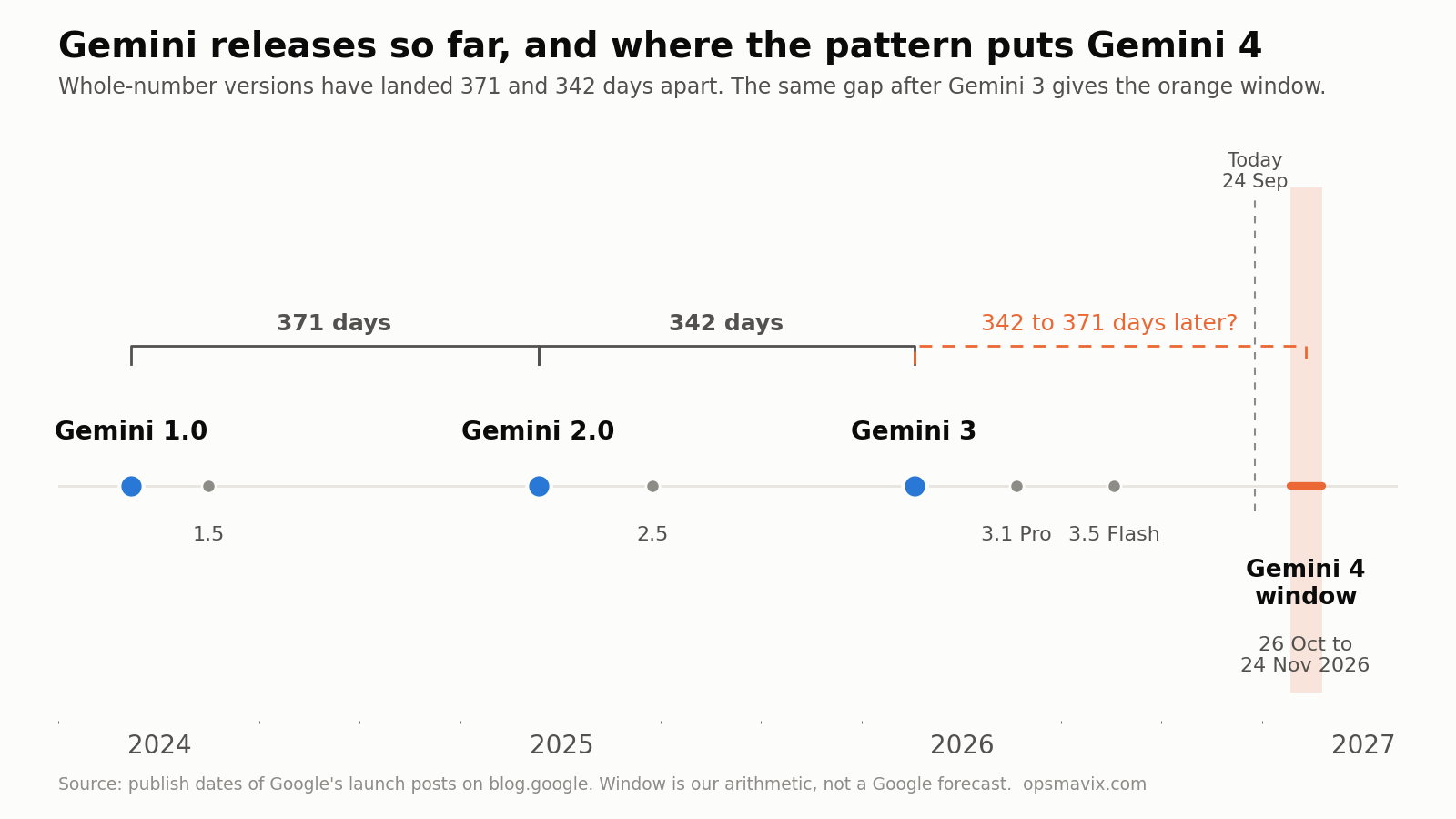
The big versions have arrived roughly a year apart. Gemini 1.0 to Gemini 2.0 took 371 days. Gemini 2.0 to Gemini 3 took 342 days. Two data points are not a law, but they come from the same lab and sit within a month of each other.
The half-step releases in between
The half-step releases have been far less predictable: 71 days after 1.0 for Gemini 1.5, but 104 days after 2.0 for Gemini 2.5. Since Gemini 3 the pattern has shifted again. Gemini 3.5 arrived in May as a Flash model, with its Pro version still unreleased, alongside a stream of point releases.
What the pattern predicts for the Gemini 4 release date
If Gemini 4 follows the same 342 to 371 day spacing as the last two generations, it lands between 26 October and 24 November 2026. That is our arithmetic on Google’s published dates, not a forecast from Google, and it assumes the cycle has not changed.
Two things push towards the early end of that window. Kavukcuoglu’s “as soon as possible” suggests Google may ship an early post-training version rather than wait for a polished one. And the last two generations both debuted with a pre-release label: Gemini 2.0 Flash as “experimental” and Gemini 3 Pro “in preview”.
One thing pushes the other way. At I/O in May, Google said Gemini 3.5 Pro would roll out “next month”, and The Verge reports it “was never rolled out” (The Verge). A lab that is now almost three months past one stated date can miss another.
That is why the window matters more than any single day. If you need a planning assumption: probably a preview in late October or November, with a full rollout possibly weeks after that. Anyone quoting a precise date right now is guessing.
What do prediction markets say about Gemini 4?
Polymarket traders give Gemini 4 a 71.5% chance of being released by 31 October 2026 and 92% by 30 November, based on prices checked on 24 September. The market for release by 30 September sits at 2.5%, so traders see almost no chance of a release this week.
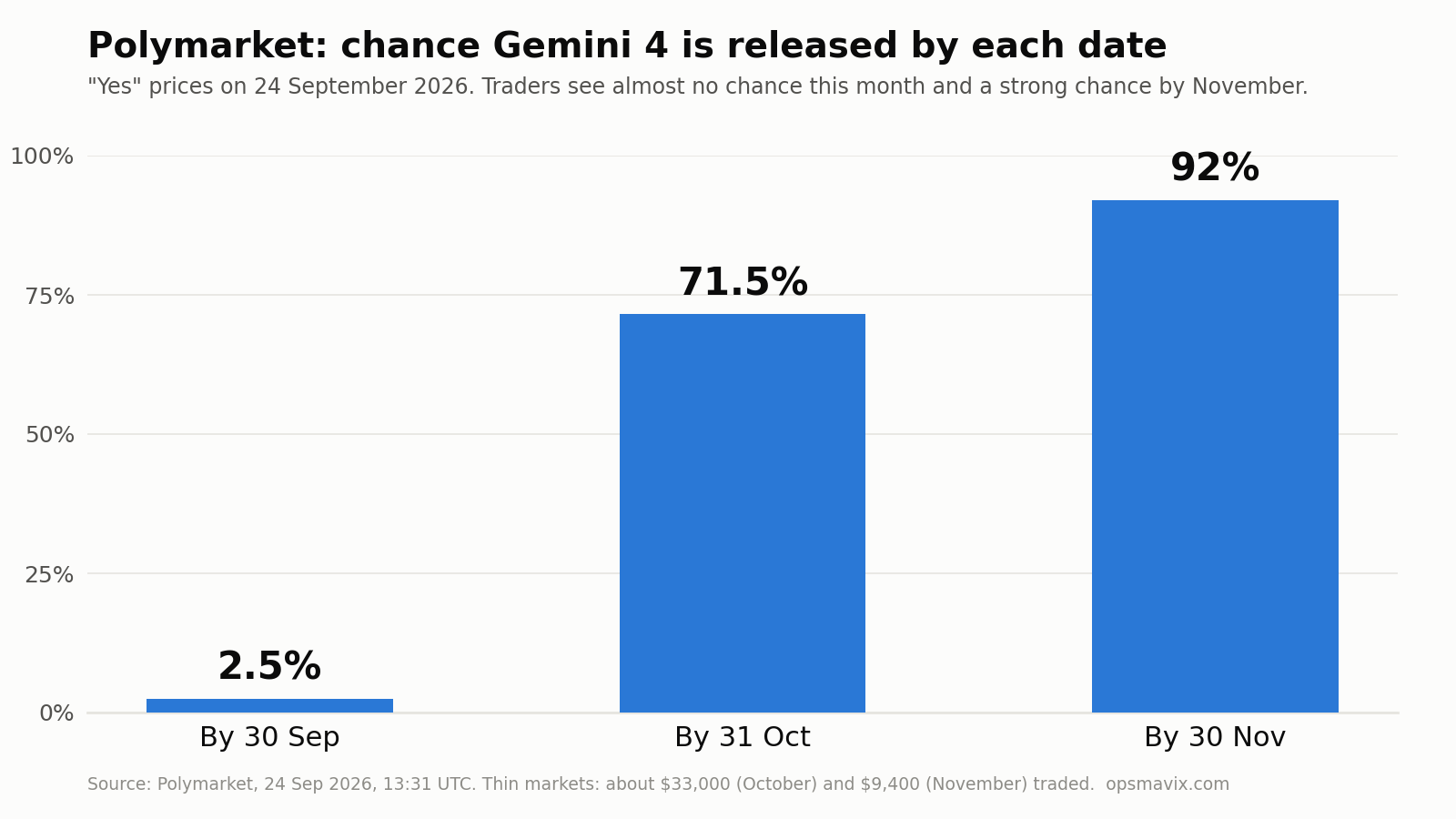
Two caveats. The October and November markets are thin, with roughly $33,000 and $9,400 traded, so a few large bets can move them.
The market rules are also loosely worded. The opening line names “Google’s Gemini 4.0 Flash model”, while the definition counts any product named Gemini 4.0 or recognised as Gemini 3’s successor. Open betas count and closed betas do not, so a public preview would probably resolve it, but a Pro-only debut could be disputed.
How will you know when Gemini 4 is out?
You will know Gemini 4 is out when Google publishes a launch post and the model appears under its own name in Google’s products. “Release” usually happens in stages, and the first stage is not always the one you can use.
A launch can reach up to four places, often weeks apart: an announcement on Google’s blog, availability in the Gemini app, availability to developers in Google AI Studio and the Gemini API, and finally enterprise access through Vertex AI.
The quickest places to check are Google’s blog, the Gemini app release notes and the model list in Google AI Studio. The next dated Google event is Google Cloud’s Gemini at Work on 8 October. Google has not said Gemini 4 will appear there, so treat it as a date to watch, not a prediction.
Why has Google been quiet at the top end?
Google has been quiet at the top end because, in Kavukcuoglu’s words, it “took a little bit of a step back” to focus on faster Flash models. No new flagship generation has shipped since Gemini 3 in November 2025, and The Verge notes that “OpenAI’s GPT-6 and Anthropic’s Mythos series models have launched since then. Both outperform Gemini 3.”
The Gemini 3.5 Pro that missed its date
At I/O on 19 May 2026, Google said Gemini 3.5 Pro was “already being used internally, and we look forward to rolling it out next month.” It did not roll out. In July, CNBC reported that it had fallen short of internal performance goals, particularly in coding.
Google’s own line since then has been that 3.5 Pro is “currently testing with partners” and will be broadly available “as soon as it’s ready”.
The Flash treadmill
Instead, Google shipped Flash models at pace: 3.6 Flash on 21 July (63 days after 3.5 Flash), 3.7 Flash on 13 August (23 days later) and 3.8 Flash on 2 September (20 days later). Google called that the “third Flash release in only six weeks” (Google).
The competition that moved
OpenAI launched GPT-6 Astra on 3 September, and we looked at what it did with 21 hours of Minecraft. It followed with GPT-6 Sol and Luna on 22 September (TechCrunch). Anthropic released Claude Opus 5.5 the same day (Anthropic).
So Gemini 4 arrives into a crowded top tier, where each lab is measured against the others within days of launch. For how researchers measure that progress over months rather than days, see our piece on p(doom) and METR.
Will Gemini 4 Pro and Gemini 4 Flash launch together?
Google has not said whether Gemini 4 Pro and Gemini 4 Flash will launch together, and past launches point both ways. Gemini 2.0 and Gemini 3.5 led with Flash. Gemini 2.5 and Gemini 3 led with Pro, and Gemini 3 Flash followed 29 days after Gemini 3 Pro.
Our read is that a staggered launch is more likely than a single-day release, given how heavily Google has leaned on Flash since the spring.
For a Gemini 4 Pro release date specifically, the best estimate is the same late October to November window. The first model to ship, though, could be an experimental Pro or a Flash rather than the finished Pro.
Will Gemini 4 be free?
Google has not said whether Gemini 4 will be free, and it has published nothing on pricing or access tiers. The precedents differ: Gemini 3 Pro reached everyone in the Gemini app on day one (The Verge), while Google launched Gemini 3.8 Flash in the app for AI Pro and Ultra subscribers.
For developers, the most recent reference point is Gemini 3.8 Flash, priced at $0.75 per million input tokens and $3.75 per million output tokens until 31 December 2026, then $1.50 and $7.50. A new frontier model is unlikely to be cheaper than Flash, though that is our inference rather than anything Google has said.
Reach clearly matters to Google: the Gemini app has passed 950 million monthly users, according to Google’s August leadership announcement. Our guess is that some version of Gemini 4 reaches free users quickly and the strongest version sits behind a subscription.
Frequently Asked Questions
When will Gemini 4 be released?
Probably late October or November 2026, but Google has not confirmed a date. DeepMind’s chief said on 23 September that Google aims to launch it “much earlier” than the end of the year, Google’s past release gaps point to 26 October to 24 November, and Polymarket prices 71.5% by 31 October.
Has Google confirmed a Gemini 4 release date?
No. Google has confirmed that Gemini 4 exists, that its pre-training run was under way by July 2026, and that it is now in post-training. The most specific statement is Kavukcuoglu’s aim to release an early post-training version “as soon as possible”.
What is the Gemini 4 Pro release date?
There is no separate Gemini 4 Pro date. Past launches have sometimes led with Pro and sometimes with Flash, so the first Gemini 4 model could be either. The best estimate for any Gemini 4 release is late October to November 2026, possibly as a preview first.
Will Gemini 4 be free to use?
Google has not said. Gemini 3 Pro was available to everyone in the Gemini app on day one, but Google launched its latest Flash model in the app for paying AI Pro and Ultra subscribers. A free version of some kind is plausible, but the strongest tier may need a subscription.
Is Gemini 4 the same as Gemma 4?
No. Gemini 4 is Google’s next flagship AI model and has not been released. Gemma 4 is a separate family of open models from Google DeepMind that developers can download and run themselves. NASA’s Gemini 4, confusingly, was a crewed spaceflight in 1965.
Is Gemini 4 better than GPT-6?
Nobody can say yet, because Gemini 4 has not been released or independently benchmarked. The Verge reports that GPT-6 and Anthropic’s Mythos models both outperform Gemini 3, and Google has said it is building Gemini 4 to compete where the frontier will be when it launches.
Should I wait for Gemini 4 before building with AI?
Usually not. A new model arrives every few weeks, so waiting for any one of them means waiting forever. Build so that the model is easy to swap, with your data and rules kept outside it, and Gemini 4 becomes an upgrade rather than a rebuild.
Final takeaway
Google has not set a Gemini 4 release date, but its own rhythm points to 26 October to 24 November and Polymarket prices 71.5% by the end of October. Expect a preview or experimental label first, and treat any precise date or leaked spec as a guess until Google publishes it.
Models change every few weeks. Your ERP should not.
Google alone has announced more than ten Gemini models since November 2025, and OpenAI and Anthropic are also shipping quickly. The model will keep changing. Your stock, orders, purchasing and production should not have to change with it.
In the systems we build, the AI is a replaceable part and the truth lives in an ERP your business owns. Rules like a safety stock calculation stay plain logic you can audit, so when Gemini 4 lands, plugging it in is a configuration change rather than a rebuild.
See what an ERP built around your business could look like →
Not sure where your real data lives today? Book a free Operations Leak Audit and we will show you.