
How to Build One Source of Truth for Your Business
When business information is spread across spreadsheets, emails, and tools, teams lose trust in the data and decisions become slower.
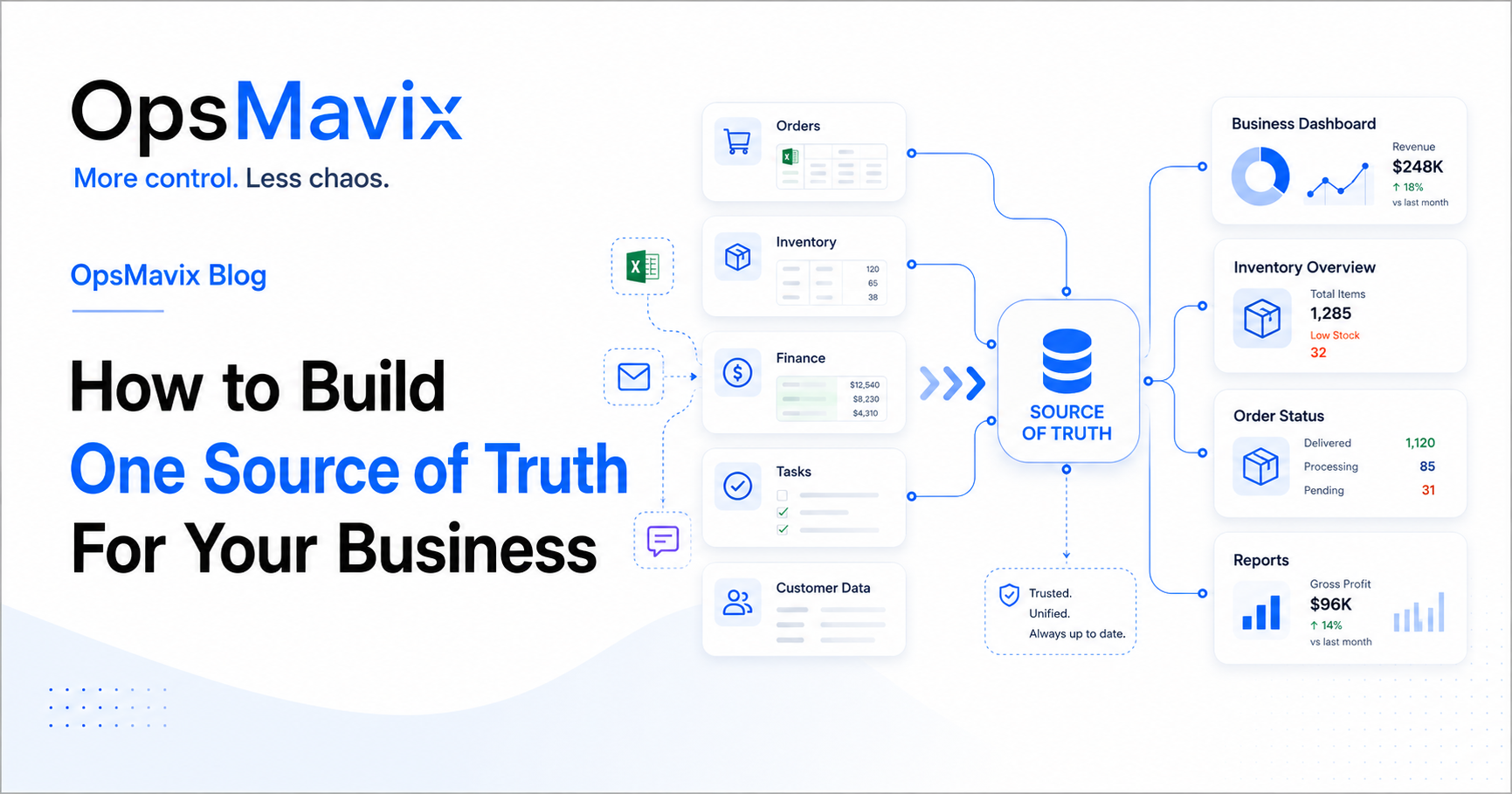
A growing business needs one source of truth for your business so the team can trust the information they use every day.
At the beginning, information is easy to manage. The team is small, the owner knows what is happening, and most updates can be tracked in spreadsheets, emails, messages, or simple tools.
But as the business grows, information starts spreading across too many places. Orders are in one file, stock is in another, tasks are in messages, finance has separate reports, and customer updates are stored somewhere else.
This is when confusion starts. People stop trusting the data, decisions take longer, and the business becomes harder to control.
1The Problem Starts When Information Is Spread Everywhere
Many businesses do not lose control all at once. It happens slowly.
First, one spreadsheet is created. Then another team creates their own version. Then updates move into WhatsApp, email, notebooks, or another tool. After a while, no one is fully sure where the correct information lives.
Common signs include:
-
Sales has one version of the order status
-
Warehouse has a different stock number
-
Finance reports do not match operations
-
Managers ask people for updates instead of checking a system
-
Customers wait longer because the team is checking information manually
When information is spread everywhere, the business starts depending on memory and manual confirmation.
2Different Versions Create Different Decisions
When each department uses different information, decisions become inconsistent.
Sales may promise a product because their spreadsheet says it is available. The warehouse may know the item is not actually there. Finance may report numbers that do not match the operational reality.
This creates problems such as:
-
Wrong customer updates
-
Delayed orders
-
Stock mistakes
-
Duplicate work
-
Slow reporting
-
Lack of trust between teams
The biggest issue is not only the mistake itself. The bigger issue is that the team starts losing trust in the data.
Once trust is lost, people stop using the system and start asking each other for confirmation. That creates more interruptions and more manual work.
3Reporting Becomes Slow and Reactive
A clear business should not need hours of manual work just to understand what is happening.
But when data is spread across spreadsheets, tools, emails, and messages, reporting becomes a manual process. Someone has to collect the information, clean it, check it, and prepare it before the owner or manager can make a decision.
By the time the report is ready, the information may already be outdated.
This makes the business reactive. Instead of seeing problems early, the team reacts after delays, mistakes, or customer issues have already happened.
A project operations dashboard can help bring important business information into one clearer view, so owners and managers can see what needs attention faster.
4Start by Choosing What Information Must Be Trusted
Building one source of truth does not mean putting everything into one giant system immediately.
The first step is to decide which information the business must trust every day.
This usually includes:
-
Order status
-
Stock levels
-
Customer information
-
Tasks and responsibilities
-
Delivery updates
-
Finance and invoice status
-
Reports and KPIs
Once these areas are clear, the business can decide where each type of information should live.
For example, stock should not be updated in three different spreadsheets. Order status should not depend on WhatsApp messages. Reports should not be rebuilt manually every time.
For businesses with stock, an inventory automation system can help make stock data more reliable and easier to use across the team.
5Build the Process Before Choosing the Tool
Many businesses try to fix the problem by buying software first.
But software alone does not create clarity. If the process is unclear, the new tool can simply become another place where confusion lives.
Before choosing or building a system, map the process:
-
Where does the information start?
-
Who creates it?
-
Who updates it?
-
Who needs to see it?
-
What should happen next?
-
What should be automated?
-
What should be reported?
This step is important because the system should support how the business actually works.
For example, if customer orders move from sales to warehouse to finance, the process should show the full journey clearly. A wholesale order management system can help businesses manage this flow in a more structured way.
What To Do Next
If your business information is spread across too many places, start small.
Do not try to fix everything at once. Pick one important process first, such as orders, stock, reporting, or approvals.
Then ask:
-
Where is the correct information today?
-
Who updates it?
-
Who uses it?
-
Which version is trusted?
-
Where do mistakes happen?
-
Which updates are repeated manually?
-
What should be visible in one place?
This gives you a clear starting point.
From there, you can decide what should stay in spreadsheets, what should move into a system, and what can be automated.
How OpsMavix Can Help
OpsMavix helps growing businesses create clearer systems, workflows, dashboards, and automation.
We work with businesses that are outgrowing spreadsheets, manual updates, WhatsApp messages, and disconnected tools.
OpsMavix can help you:
-
Map where your business information currently lives
-
Identify where control is being lost
-
Create one clearer source of truth
-
Build dashboards for better visibility
-
Reduce repeated manual updates
-
Connect disconnected tools and workflows
-
Design internal systems that support the way your business works
If your team is spending too much time checking, asking, and confirming information, OpsMavix can help you build a clearer way to work.