
The Fishbowl Alternative: Inventory Without the Bolt-On
Fishbowl is a capable stock and manufacturing layer sat on top of QuickBooks. But most people hunting for an alternative aren't unhappy with its features — they're tired of running their operation as a bolt-on. Here is the honest build-vs-buy take.
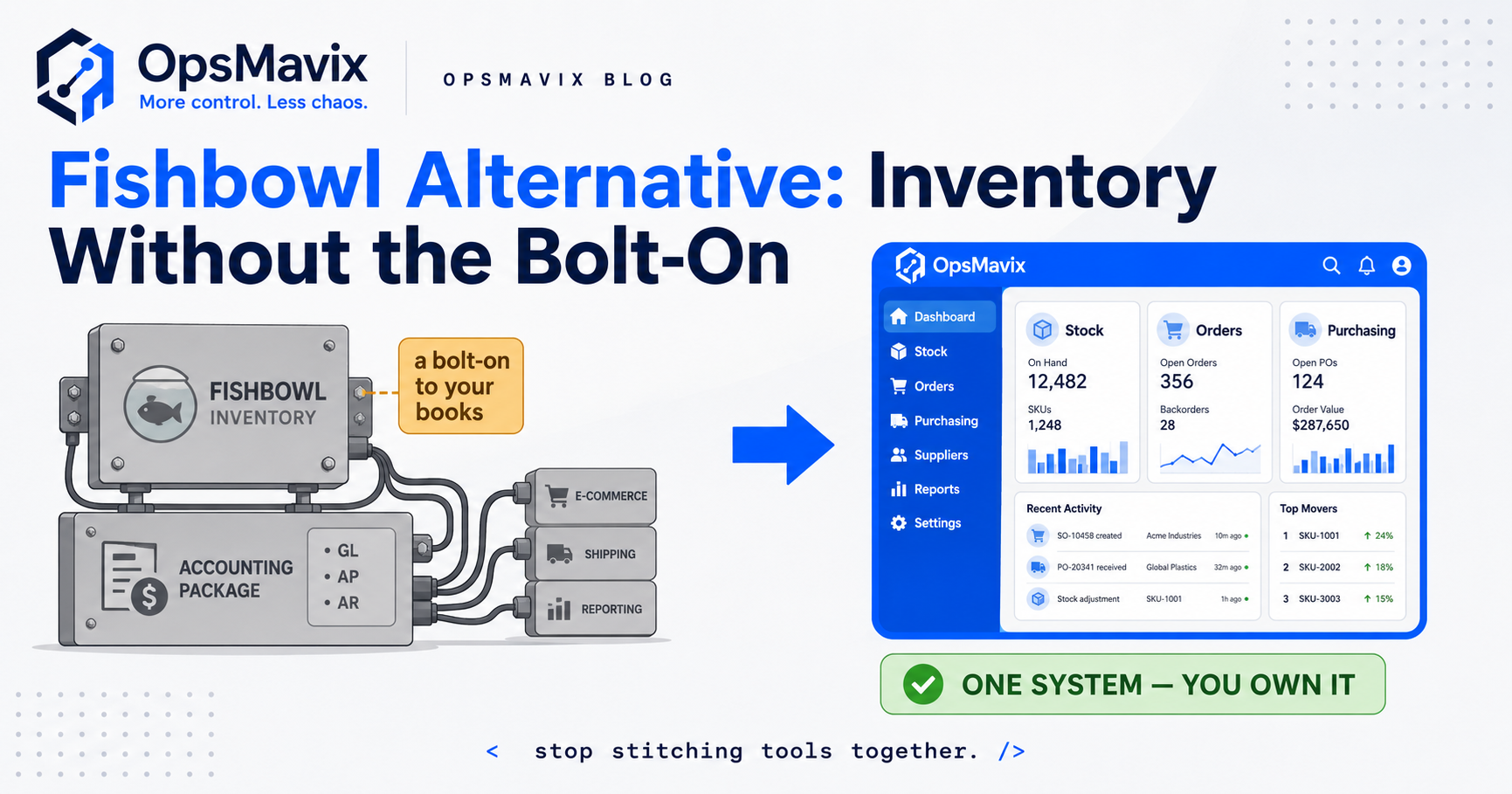
If you are searching for a fishbowl alternative, the most useful answer is probably not another inventory tool. It is one owned operations system shaped to how your business actually runs — stock, orders, production and reporting joined up in a single place — rather than a stock module bolted onto your accounting package. Fishbowl is a genuinely capable product, and for some businesses buying it is the correct call. But the reason most people go looking for something else is rarely a missing feature. It is the shape of the thing.
Most operators typing “fishbowl alternative” into a search bar are not staring at a feature comparison chart wishing for one more checkbox. They are bending their operation to fit a tool built around QuickBooks, paying for parts they never switch on, and stitching the gaps back together with spreadsheets. That is the real complaint. And swapping one packaged tool for another packaged tool usually just moves the same problem sideways.
Key Takeaways
- The best alternative is often not a tool at all. It is one joined-up operations system that fits your process, instead of a process bent to fit the software.
- Fishbowl is an accounting-first design. It grew up as the stock and manufacturing layer for QuickBooks, and that heritage shapes everything about how it works.
- The ceiling is scope, not quality. Fishbowl handles inventory and manufacturing well; the leaks tend to sit in the workflows around it that never fit any module.
- Pricing is quote-based and front-loaded. Historically sold as a perpetual per-user licence with ongoing support, which changes the maths versus a monthly subscription.
- Sometimes buying it is right. A QuickBooks-committed manufacturer with standard workflows may get more value from Fishbowl than from anything built.
- The middle exists. Between a spreadsheet and a full ERP sits a right-sized operations system you own — no bolt-on, no per-seat tax on growth.
What Fishbowl Actually Is
Credit where it is due: Fishbowl has been doing this for a long time and does it competently. It is a US company, based in Utah, that makes inventory and manufacturing software — historically two flagship products, Fishbowl Inventory and Fishbowl Manufacturing, with a more recent cloud offering added to the line-up.
Its defining trait is its relationship with accounting. Fishbowl was built as the operations layer that sits on top of QuickBooks (and later other packages), handling the warehouse, stock and production work that accounting software was never designed to do, then pushing the financial side back into the books. For a QuickBooks shop that has outgrown spreadsheet stock control, that integration is the whole pitch, and it is a real one. You get proper multi-location inventory, bills of materials, work orders, barcode scanning and purchasing without leaving the accounting world you already know.
That is the honest version of Fishbowl: a mature, feature-complete stock and manufacturing layer, engineered around the assumption that your accounting package is the centre of gravity and inventory is the thing attached to it. If that assumption matches your business, it does a solid job.
Where Fishbowl Hits Its Ceiling
The ceiling is not about missing features. It is about scope and shape. A tool built as an inventory-and-manufacturing module is excellent inside that box and silent outside it — and most of a real operation’s daily friction lives outside the box.
Think about the work that never quite fits a stock module: the approval steps before a purchase order goes out, the way a specific customer wants their orders batched, the quality check between two production stages, the handover from the shop floor to dispatch, the report your operations lead rebuilds by hand every Monday. None of that is “inventory” in the software’s sense, so it falls into spreadsheets, shared inboxes and the memory of whoever has been there longest. The tool is not wrong; it simply was never meant to hold that.
The second ceiling is the bolt-on architecture itself. Because Fishbowl is anchored to accounting, your operational data and your financial data live in two systems that talk through a sync. That works until it does not — the reconciliation that drifts, the record that exists on one side and not the other, the awkward question of which system is telling the truth. When the tool that runs your warehouse and the tool that runs your books are structurally separate, someone spends real time keeping them agreed. That reconciliation tax is the classic sign of an operational system stitched onto a finance system rather than one designed together.
The third is fit at the edges. A packaged product gives everyone the same shape. Where your process is genuinely standard, that is fine. Where it is the thing that actually makes you money — the unusual production routing, the specific way you handle stock, the bill of materials logic nobody else uses — you either bend your process to the software or you paper over the difference by hand. Both are leaks.
The Pricing Reality
Fishbowl does not publish a simple price list, so anyone quoting you an exact figure online is guessing. Pricing is quote-based and depends on your product mix, user count and which modules you take.
What matters more than the number is the model. Fishbowl has historically been sold as a perpetual, per-user licence — a larger up-front purchase you own, plus ongoing support and update fees — rather than a low monthly subscription. Its cloud offering shifts some of that toward a recurring model. Because the vendor prices in US dollars, expect a US-dollar quote you would convert to pounds (converted) before comparing it with a UK subscription tool, and factor in exchange and support costs over time.
The practical point: the sticker is front-loaded and the per-user structure means the bill grows as your team grows. Cheap to add one scanner user, less cheap when the whole floor needs access. Model the three-year cost with your real headcount, not the demo team of three.
When Fishbowl Is Genuinely the Right Choice
Sometimes buying it is simply correct, and pretending otherwise would be dishonest. If you are committed to QuickBooks and intend to stay, if your manufacturing and inventory workflows are reasonably standard, and if you want a proven, supported product you can switch on in weeks rather than something shaped to you — Fishbowl is a sensible, low-risk answer. Buying a mature tool beats building one whenever your process is close enough to the average that the tool’s shape does not cost you anything.
The trouble only starts when the tool’s shape and your operation’s shape diverge, and you find yourself paying — in licences, in spreadsheets, in reconciliation time — to hold the two together.
The Right-Sized Middle: One Operations System
Here is the position most people searching miss. The choice is not only “packaged inventory tool” versus “full ERP”. There is a middle: a right-sized operations system you own, built to how your business already runs, that holds stock, orders, production and reporting in one place — no accounting bolt-on, no per-seat tax on growth, no process bent to fit a module.
This is the practical layer for the business that is outgrowing spreadsheets and disconnected tools. Instead of asking your operation to look like the software, the software looks like your operation. The approval step, the batching rule, the quality gate, the Monday report — the things that live in spreadsheets around Fishbowl — become part of the system itself. Stock and finance stop being two systems arguing about the truth. And because you own it, growing the team does not grow the licence bill.
The goal is not more software. It is the specific leak closed — the reconciliation hour, the manual report, the order that fell through the gap between two tools. Whether that lands closest to an inventory automation system, a leaner MRP setup, or a broader operations control system depends entirely on where your money is actually leaking, which is exactly the thing worth measuring before you buy anything.
The Honest Build-vs-Buy Take
Buy Fishbowl when your process is standard, you live in QuickBooks, and you want a proven product now. That is a real, valid answer and there is no shame in it.
Look past it when the recurring problem is not a missing feature but the bolt-on itself — when you are paying to keep two systems agreed, running your real workflows in spreadsheets beside the tool, and bending your operation to fit a shape that was designed around someone else’s accounting. At that point the honest alternative to Fishbowl is not another tool. It is one operations system that fits, that you own, sized to close the specific leaks you can already name.
Keep reading
Getting value from OpsMavix? Add us as a preferred source on Google — you'll see more of our operations content in your AI Overviews, AI Mode and Search.