
When Delivery Robots Get Stuck in Their Own Traffic Jam
Delivery robots jammed themselves on a Chicago sidewalk because nobody gave them a rule for sharing a narrow space. Several Coco food-delivery robots met...
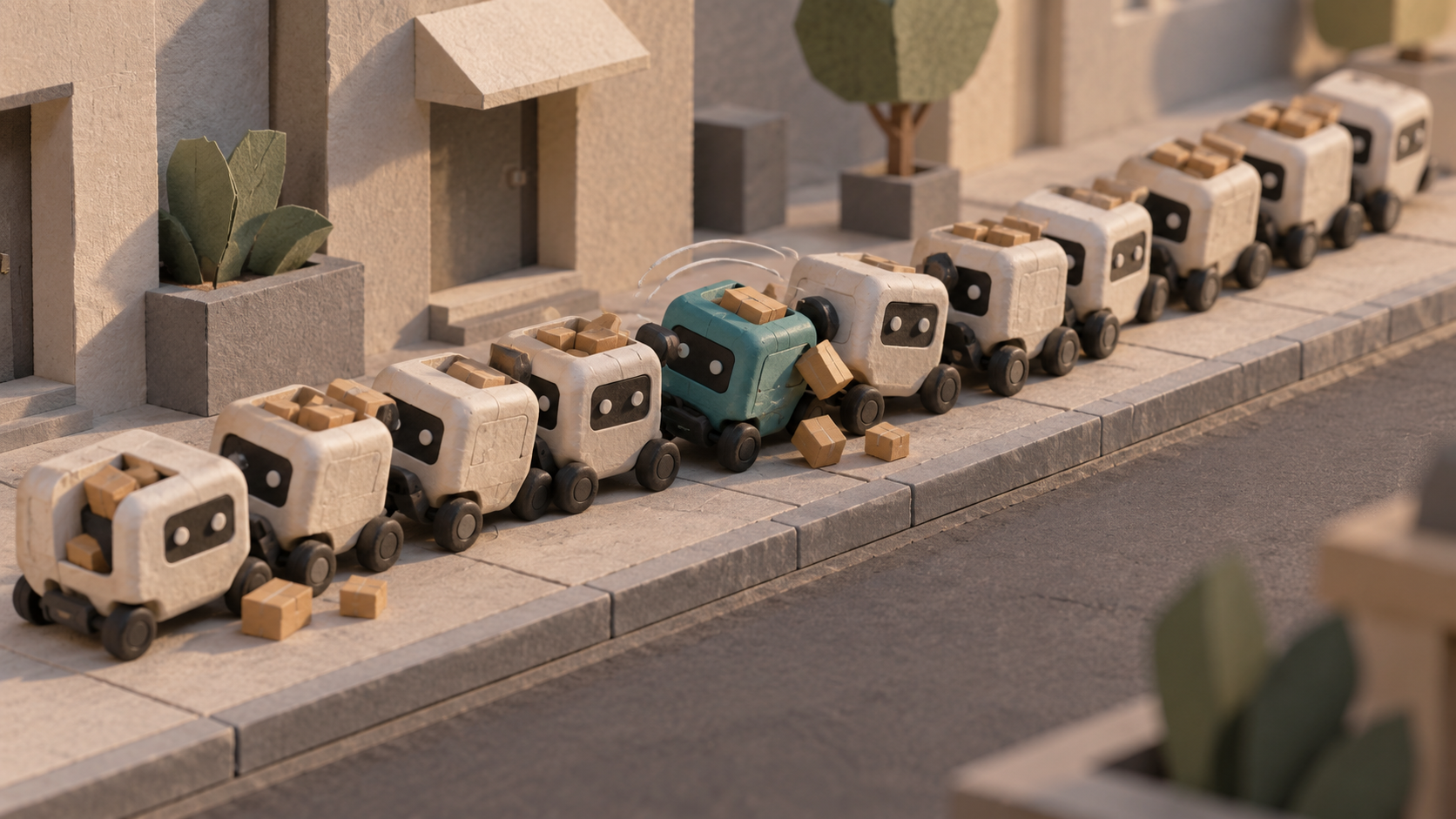
Delivery robots jammed themselves on a Chicago sidewalk because nobody gave them a rule for sharing a narrow space. Several Coco food-delivery robots met each other, had no sequencing and no right-of-way, and deadlocked. Each one waited for the others, so none of them moved. Simple problem, no referee.
What actually happened in Chicago?
In early September 2026, around the 3rd, several Coco food-delivery robots got stuck in a “robot traffic jam” with each other on a Chicago sidewalk. Creator Becca Ostien filmed it, and the clip got picked up by CBS Chicago, Block Club Chicago, ABC7, WGN and Futurism.
Most of the coverage went where you would expect. Residents were annoyed. Some worried about jobs. It was framed as a quirky street-level nuisance, a bunch of little machines being awkward in public. Fair enough. But that framing skips the actual story, which is not about robots at all.
Why did the delivery robots get stuck on each other?
They got stuck because multiple autonomous units shared a narrow space with no coordination rule, and that is a recipe for deadlock. Each unit is trying to do the right thing locally. Move forward, avoid a collision, wait if the path is blocked. Put a few of them nose to nose on a tight sidewalk and every one of them waits for the others to move first.
Nobody is in charge. There is no ordering that says who goes, who yields, who waits. So the polite behaviour that keeps one robot safe becomes the exact thing that freezes all of them together. It is not a hardware failure. It is a missing rule.
Where does the same thing happen in a warehouse?
The same deadlock shows up any time you have several agents sharing a constrained resource without sequencing. In a warehouse it is not cute sidewalk robots, it is pickers, forklifts and orders competing for the same aisles, the same dock, the same stock, with no one slotting the work in order.
You have seen the symptoms. Two pickers sent down the same aisle for different orders. A dispatch queue where everything is “urgent,” so nothing is actually prioritised. Trucks stacked at a dock with no loading sequence. Everyone busy, nothing flowing. It is the Chicago sidewalk, just indoors and more expensive.
How do you stop the jam?
You stop it by adding the coordination layer the robots were missing. Three concepts do most of the work.
Sequencing and right-of-way
Decide, up front, who goes first when two jobs want the same space. A right-of-way rule breaks the standoff. It does not have to be clever, it just has to exist, so that ties get resolved instead of freezing.
A dispatcher that slots jobs in order
Put one thing in charge of ordering the work. A dispatcher takes the flood of “do this now” and turns it into a queue that respects priority, location and capacity. Without it, every job shouts at once and the loudest wins, which is not the same as the right one winning.
Buffering
Give the system somewhere to hold work when a resource is busy, instead of piling everything into the same choke point. A buffer absorbs the surge so the narrow bit does not deadlock. It is the difference between a queue and a pileup.
The real lesson for operations
The Coco robots are a clean, funny picture of a serious and boring truth: autonomy without coordination does not scale, it deadlocks. Add more independent units to a shared space and, past a point, they make each other slower, not faster. The bottleneck is never the individual worker. It is the missing rule about who goes when.
This is precisely the layer we build. When we replace the spreadsheets and the “just shout across the floor” method with a custom operations system, the sequencing is the point. Orders get slotted in a real priority order. Picking routes stop colliding. Dispatch has a queue, not a shouting match. Stock and jobs flow through the choke points instead of jamming in them.
If your floor feels like everyone is busy while nothing actually moves, you probably have a coordination problem wearing a staffing-problem costume. Worth finding before you hire more people to stand in the same jam.
Book a free Operations Leak Audit
If reorder timing is part of your pileup, our inventory reorder calculator is a quick place to start.
FAQ
What happened with the Coco robots in Chicago?
In early September 2026, several Coco food-delivery robots got stuck in a “robot traffic jam” with each other on a Chicago sidewalk. It was filmed by creator Becca Ostien and covered by CBS Chicago, Block Club Chicago, ABC7, WGN and Futurism.
Was it a hardware failure?
No. Each robot behaved sensibly on its own. The failure was coordination: several autonomous units in a narrow space with no sequencing or right-of-way rule can wait on each other until none of them can move.
How is this like a warehouse?
The same way. Pickers, forklifts and orders competing for the same aisles, dock or stock without a dispatcher and a priority order will jam for exactly the same reason, no matter how good each worker is.
How do you actually fix it?
Add coordination: a right-of-way rule so ties get resolved, a dispatcher that slots jobs in order of real priority, and buffering so busy resources do not deadlock. The fix is in the rules, not more units.