
We Let AIs Run a Factory. Only One Kept the Line Moving.
Researchers built the Factorio Learning Environment, a test that drops AI models into the factory-building game Factorio and asks them to plan, build, and...
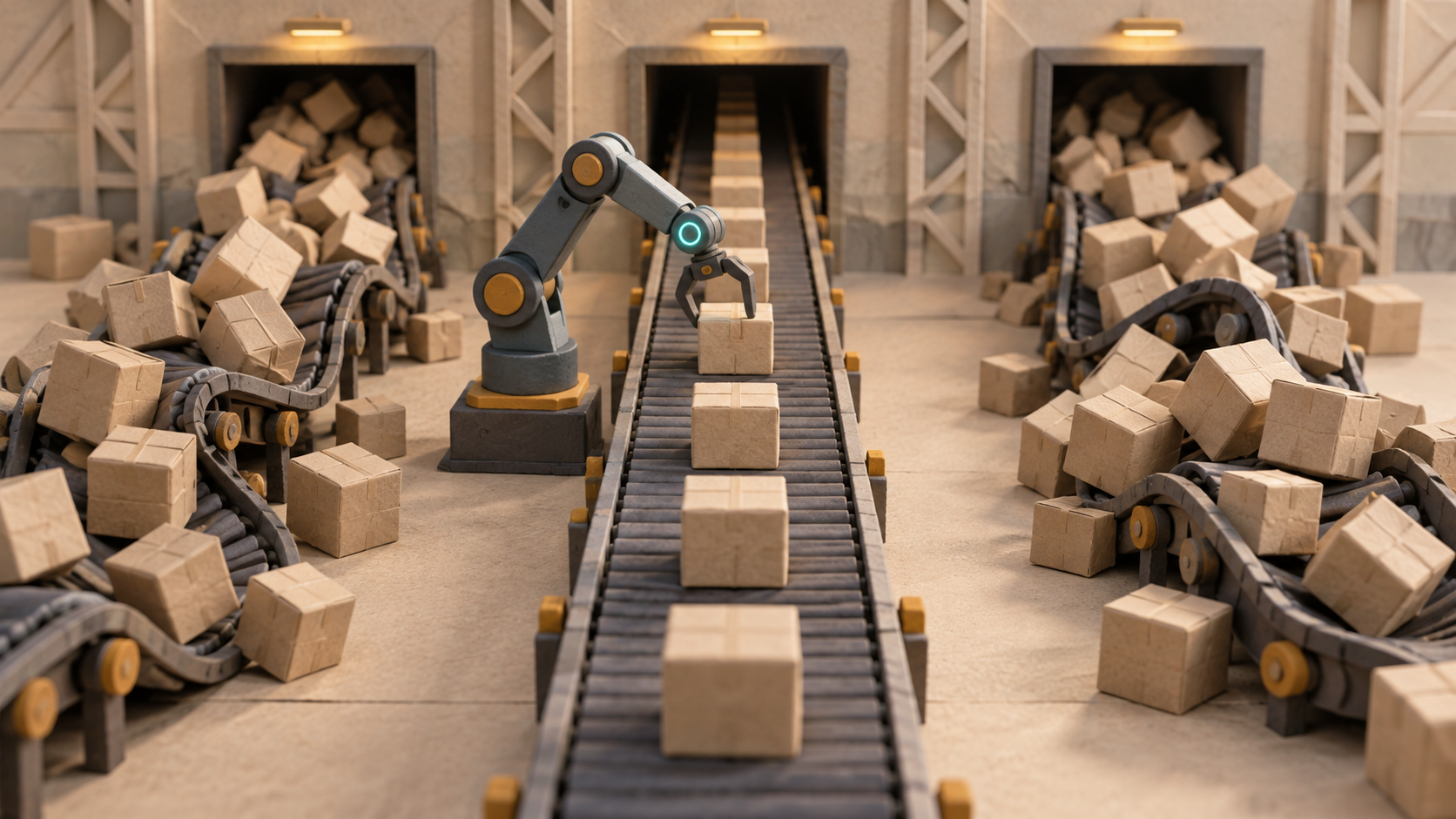
Researchers built the Factorio Learning Environment, a test that drops AI models into the factory-building game Factorio and asks them to plan, build, and run full production and logistics systems. Across the tasks one model kept the line moving better than the rest, and it won by managing flow rather than brute speed.
What is the Factorio Learning Environment?
The Factorio Learning Environment, or FLE, is a research setup that uses the factory-building game Factorio to test how well AI models handle planning and construction of complex production and logistics systems. Factorio is a good stand-in for a real plant: you mine raw materials, feed them through machines, route the outputs along belts, and try to keep every stage supplied without jamming.
FLE runs in two modes. Experiment mode is 24 structured tasks, each a specific thing the model has to build or achieve. Open mode is simpler to state and harder to do well: build the biggest factory you can. One tests whether a model can follow a spec, the other tests whether it can keep scaling without falling over.
Why did one model win?
One model won because it treated the factory as a flow problem, not a race. In experiment mode Claude completed 15 of the 24 tasks, while the other models topped out around 10. In open mode Claude reached a production score of 2456, against GPT-4o’s 1789. Same game, same rules, meaningfully different results.
The gap is the interesting part. Building a factory is not about placing machines quickly. It is about throughput, bottlenecks, buffers, and sequencing: making sure each stage has what it needs before the stage after it starts starving. A model that dumps down machines fast but ignores flow ends up with belts backed up in one place and idle in another. That is the digital version of a warehouse where half the team is waiting and the other half is drowning.
How does a factory actually get built?
A factory gets built in layers, each one feeding the next, and the whole thing only works if the layers stay balanced. Here is roughly how the progression went.
Start with the basics
You cannot build anything complex until the simple inputs flow reliably. The winning model began with basic products and got those moving before reaching for anything ambitious. In a real plant this is the boring foundation: raw materials in, first-stage parts out, consistently.
Build the production chains
Once the basics flow, you chain stages together so one machine’s output becomes the next machine’s input. Claude progressed from those basic products into more complex production chains, which is exactly where most factories, real and simulated, start to seize up. Every added stage is another place flow can stall.
Fix the bottleneck, not the symptom
When output is capped, you find the stage that is actually limiting it and widen that. The model improved its electric drilling to lift iron plate output, because iron plate was gating everything downstream. That is the whole game: more drills somewhere else would have done nothing. You feed the constraint.
The real lesson
Running a factory is a logistics problem, and the model that won did it by managing flow, not by moving fast. That is not a quirk of a video game. It is precisely how real production and inventory systems live or die: on throughput, buffers, sequencing, and knowing which stage is the actual constraint.
Most growing businesses run this in a spreadsheet and a group of tired managers holding it together by memory. Stock counts lag reality, reorder points are guesses, and the real bottleneck is invisible until something backs up and someone shouts. You cannot manage flow you cannot see.
That is what OpsMavix builds: custom internal systems for inventory, orders, production, and purchasing that make the flow visible and act on it. Reorder points that fire on real numbers, not vibes. Production stages you can actually watch. If you want to know where your line is quietly backing up, Book a free Operations Leak Audit. If you just want to sanity-check your stock math first, the inventory reorder calculator is a fast start.
FAQ
Did AIs really run a real factory?
No. This was research using Factorio, a factory-building game, as a controlled test of planning and logistics. The lessons about flow are real, but no physical plant was involved.
Why did managing flow beat raw speed?
Because a factory’s output is limited by its slowest supplied stage, not its fastest one. Placing machines quickly means nothing if belts back up or stages starve. Balancing flow lifts the whole system.
What does this have to do with my business?
If you make, store, or move physical goods, you run a flow system. The same logic applies: your throughput is capped by one real constraint, and most spreadsheets hide where it is.
Do I need AI to fix my operations?
No. You need visibility and sensible rules first: accurate stock, real reorder points, and a view of where work backs up. A custom system gives you that long before anything fancy is worth discussing.