
Brightpearl vs Linnworks: Which Fits a Growing Stock Business?
Brightpearl leans toward a full retail operating system with accounting baked in, while Linnworks is a multichannel order and inventory hub. This guide compares both honestly and shows where each one stops fitting the way you actually run.
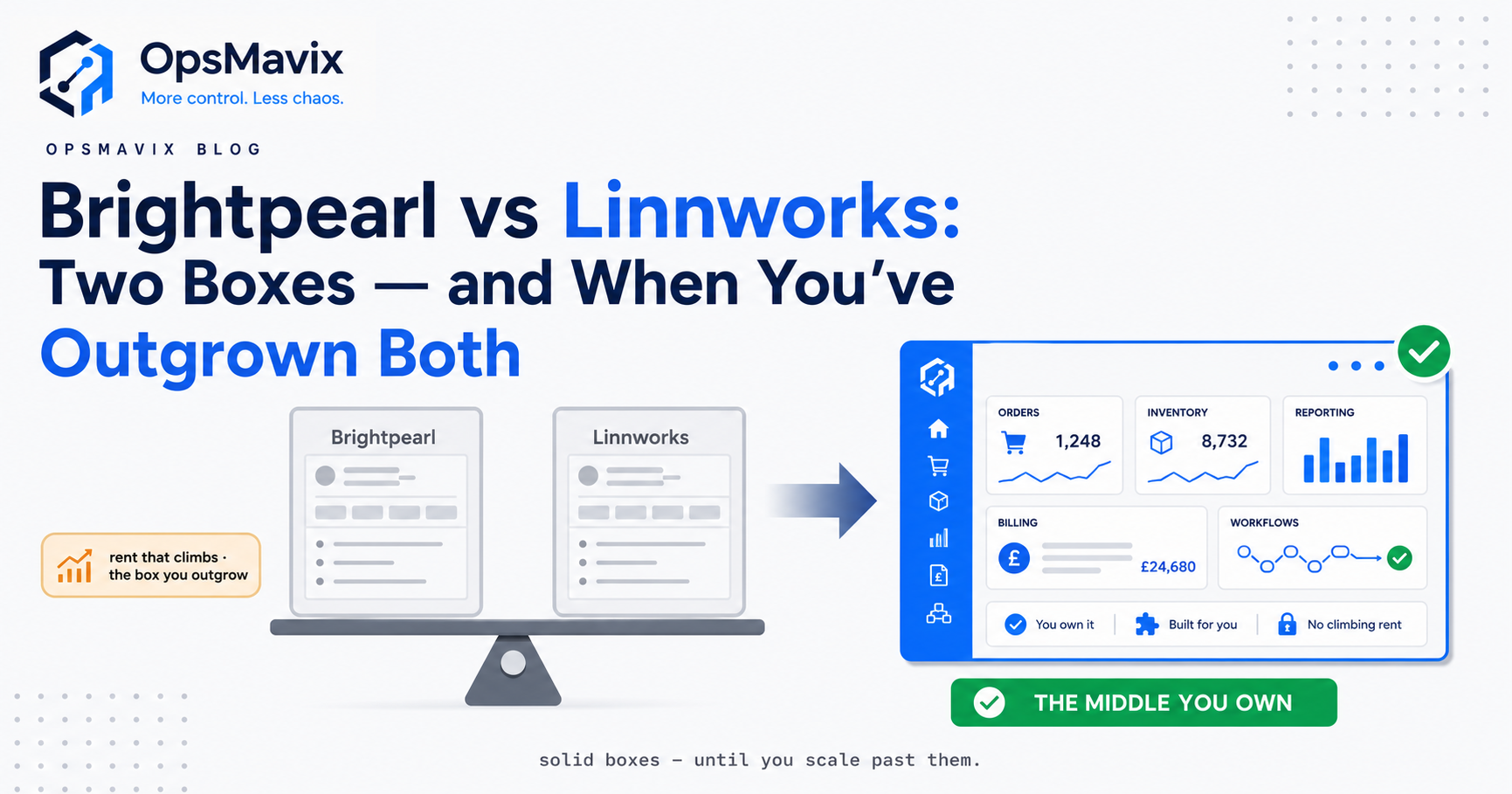
Brightpearl vs Linnworks is a decision about the operating model you need, rather than a simple contest between two stock screens. Both address connected commerce operations. The useful comparison is how each proposed configuration handles your orders, inventory, warehouse work, purchasing and financial records.
A growing stock business should bring its difficult transactions into the demonstration: a partial delivery, a cancelled order, a return and a failed update between systems. This guide uses current supplier descriptions checked on 15 October 2026 alongside practical selection tests. OpsMavix can configure, integrate or build custom systems, so our recommendations are assessments of fit rather than hands-on benchmarks. All worked figures are hypothetical.

The right commerce platform must support the warehouse work behind the customer order. Illustrative photograph, not an OpsMavix client.
Image credit: Nenad Stojković / Shixart1985, CC BY 2.0. Displayed at a reduced size; no additional edits.
Key Takeaways
- Compare the proposed configuration and integrations, not broad product categories alone.
- Establish the role of accounting and financial records in the intended architecture.
- Test stock availability, reservations and channel updates separately from physical on-hand stock.
- Demonstrate partial fulfilment, returns, cancellations and interface recovery.
- Include migration, users, devices, modules and support in the total-cost comparison.
- Consider improving existing tools before replacing them or commissioning custom work.
In this guide:
- 1. Start With the Business Process You Need to Support
- 2. Understand the Published Brightpearl Scope
- 3. Understand the Published Linnworks Scope
- 4. Compare the Proposed Solutions Against the Same Tests
- 5. Work Through Stock and Order Exceptions
- 6. Decide Where Configuration or Integration Is Enough
- 7. Compare Total Cost and Plan the Migration
- 8. Run a Pilot and Make the Decision From Evidence
- Frequently Asked Questions
- How OpsMavix Can Help
1. Start With the Business Process You Need to Support
Identify the pressure point
Your main problem might be inconsistent channel stock, difficult warehouse picking, slow wholesale order entry or disconnected accounts. Those problems can overlap, but they are not solved by the same feature. Identify the records and hand-offs that currently fail.
| Buying problem | Evidence to bring |
|---|---|
| Stock differs between channels | Examples with timestamps and the relevant movement history. |
| Orders need manual repair | A normal order and a difficult exception. |
| Picking is unreliable | Labels, locations, units and a representative busy shift. |
| Purchasing misses demand | Stock, commitments, open supply and supplier constraints. |
| Finance needs re-entry | Shipment, invoice, credit and reconciliation examples. |
Keep requirements separate from habits
A current spreadsheet workaround may represent a genuine business rule, or it may exist only because an old integration was never finished. Document what the operation needs to achieve before asking a supplier to reproduce every existing click.
2. Understand the Published Brightpearl Scope
A retail operating-system proposition
Brightpearl’s current website describes a retail operating system combining inventory, fulfilment, automation and connected operations. Its retail accounting page describes integrated financial functionality. These supplier descriptions establish areas to investigate; they do not prove the suitability of a particular implementation.
For a business reviewing wider retail operations, the financial and operational boundary deserves particular attention. Ask how the proposed architecture handles invoices, credits, tax settings, inventory values and any existing accounting application you intend to retain.
Demonstrate your accounting route
Use a partial shipment followed by a return. Establish where the invoice and credit are created, which application is authoritative and how the stock event reaches the ledger. Confirm that the proposed configuration meets your accountant’s requirements and relevant business processes.
Avoid assuming every business must use the same financial setup. Require the supplier to explain the supported arrangement and any external connections in the actual proposal.
3. Understand the Published Linnworks Scope
Connected inventory and order operations
Linnworks’ inventory management page describes centralised stock and connected fulfilment. Its documentation covers inventory, order processing and channel connections. These are reasons to investigate it when multichannel commerce is central to the buying problem.
Establish the exact warehouse, accounting and purchasing functions included in the intended solution. Do not infer the complete scope from a category name or assume that an available connection supports every field and transaction your business needs.
Check the channel exceptions
Test an amended order after allocation, a cancellation after picking and a return that is not immediately sellable. Ask what stock quantity is sent to each channel and how failures are surfaced. Document any latency assumptions rather than promising instantaneous agreement across every system.
4. Compare the Proposed Solutions Against the Same Tests
Use a practical comparison matrix
The questions below apply to both suppliers. They deliberately avoid assigning a winner before a demonstration and scoped proposal.
| Area | Test for Brightpearl | Test for Linnworks |
|---|---|---|
| Stock | Show locations, status, reservations and units used in your business. | Show the same records and the quantity sent to channels. |
| Orders | Demonstrate amendments, partial fulfilment and customer rules. | Demonstrate the same lifecycle and routing exceptions. |
| Warehouse | Run receiving, replenishment, pick, pack and return on proposed devices. | Run the identical warehouse sample and device scope. |
| Purchasing | Show demand, open supply and short-delivery handling. | Show the equivalent required purchasing process. |
| Finance | Explain the proposed financial master and reconciliation route. | Explain the financial connection and transaction coverage. |
| Integration | Show failures, retries and ownership for each interface. | Use the same failure and duplicate-message tests. |
Record how each requirement is delivered
Mark requirements as standard, configured, an additional module, third-party integration, custom work or unverified. Confirm who supports the complete arrangement. A function spread across several products can work well, but its ongoing responsibilities belong in the comparison.
Keep mandatory requirements visible
If your goods require batch or serial tracking, client-owned stock, complex trade pricing or a specific carrier service, test it directly. A weighted score should not conceal a failed mandatory requirement.
5. Work Through Stock and Order Exceptions
Hypothetical availability example
Suppose a business physically holds 100 units of one SKU. Ten are quarantined and 25 usable units are committed to other orders. Under a simple rule excluding held and committed stock, the uncommitted usable amount is 100 - 10 - 25 = 65 units.
| Position | Units | Meaning |
|---|---|---|
| Physical on hand | 100 | Includes held and committed goods still in the building. |
| Quarantined | 10 | Excluded from sellable stock under this example policy. |
| Existing commitments | 25 | Already promised from the usable stock. |
| Uncommitted usable stock | 65 | Before any channel buffers or other rules. |
This is a hypothetical rule, not a universal formula for either product. Establish the actual stock and channel-publication definitions in your configuration.
Introduce a difficult order
Allocate 20 units to a new order. The remaining uncommitted usable stock becomes 45. Pick the order, then cancel it before despatch. Ask users to demonstrate the reversal, release the reservation and return the goods to the correct location.
Finally, replay a shipment message and submit a return for inspection. Verify that the duplicate does not create another shipment and that a returned item does not become sellable before the agreed disposition.

Channel availability must reflect the agreed stock statuses and commitments behind the physical balance. Illustrative photograph, not an OpsMavix client.
Image credit: FIONASUN, CC0 1.0. Displayed at a reduced size; no additional edits.
6. Decide Where Configuration or Integration Is Enough
Existing tools may need a clearer connection
If the platform already handles stock and order work correctly, a recurring failure may be in field mapping, identifier consistency or error handling. Changing platforms would leave that architectural problem unresolved unless the new project addresses it.
Ask which system owns products, orders, prices, reservations, shipments and financial documents. Changes should move in an agreed direction, with a visible failure queue and a named support owner.
Compare proportionate options
| Option | Appropriate trigger | Obligation to clarify |
|---|---|---|
| Configure current tools | The required function exists but is not used correctly. | Administration, testing and training. |
| Repair or add an integration | The operational gap is between capable applications. | Mapping, retries, monitoring and upgrades. |
| Add a focused custom workflow | A specific rule is inadequately supported. | Scope, maintenance and evidence of fit. |
| Replace a platform | A tested gap remains and a transition is viable. | Data, open work, continuity and total cost. |
| Implement a full ERP | Several core processes need a shared redesign. | Process ownership and phased migration. |
Custom software can be appropriate, but ownership does not make it free to run or inherently better. Packaged tools offer maintained functionality and an established product; custom projects require an accountable design and support arrangement.
7. Compare Total Cost and Plan the Migration
Obtain equivalent written proposals
Include users, devices, sites, orders, channels, modules and integrations. Add implementation, data cleaning, migration, training, support, future changes and exit work. Confirm tax, currency, minimum term and growth assumptions with each supplier.
Avoid publishing entry prices as a like-for-like verdict when scope differs. A valid comparison needs the configuration your business would actually use and the costs of the connected tools it requires.
Protect open work at cut-over
- Clean item identities, barcodes and units before importing stock.
- Map locations, statuses and relevant tracking dimensions.
- Reconcile open purchase orders and unreceived goods.
- Preserve customer orders, reservations, picks and staged shipments.
- Define how late channel messages and duplicates are handled.
- Retain access to required history and financial evidence.
- Agree a continuity plan and who can stop the launch.
A stock total alone does not prove the migration is correct. Compare quantities and commitments by the dimensions used for fulfilment and accounting.
8. Run a Pilot and Make the Decision From Evidence
Let operational users do the work
Give receiving, picking, customer service, purchasing and finance users their own tasks. Use the intended devices and actual labels. A supplier-led happy-path demonstration does not establish whether staff can handle exceptions during a busy shift.
| Pilot outcome | Evidence to retain |
|---|---|
| Stock remains coherent | Checked quantities, statuses and commitments after each event. |
| Orders complete correctly | Amendments, partial shipments, cancellations and returns. |
| Interfaces recover | Failed-message handling and duplicate prevention. |
| Finance reconciles | Correct invoices, credits and agreed ledger relationship. |
| Users can operate it | Task completion, workarounds and required training. |
Define benefits consistently
If a hypothetical pilot reduces 40 confirmed order exceptions to 10 across a comparable 2,000-order sample, the exception rate changes from 2% to 0.5%. It is an example of measurement, not a promised result for either product.
Assess staff time, direct costs and capacity separately. Faster work can create room for growth without reducing payroll. Choose the solution that meets essential requirements with a supportable operating model, rather than the one with the broadest marketing claim.
Frequently Asked Questions
Is Brightpearl or Linnworks better for a growing stock business?
There is no universal winner. Compare the exact configuration against your stock, order, warehouse, purchasing and financial requirements using the same demonstration cases.
Are they simply different inventory screens?
No. Their published offerings cover broader commerce operations. The boundaries and connected products in your proposed implementation matter more than a single stock-screen comparison.
Why does accounting matter in this decision?
Stock movements, shipments, invoices and credits must reach the correct financial records. Establish the financial master and reconciliation route before deciding how the operational platform fits.
Can we keep our current accounting application?
Assess the supported architecture and connector coverage with the supplier. Confirm the required transactions, tax settings, credits and reconciliation rather than assuming a named integration covers everything.
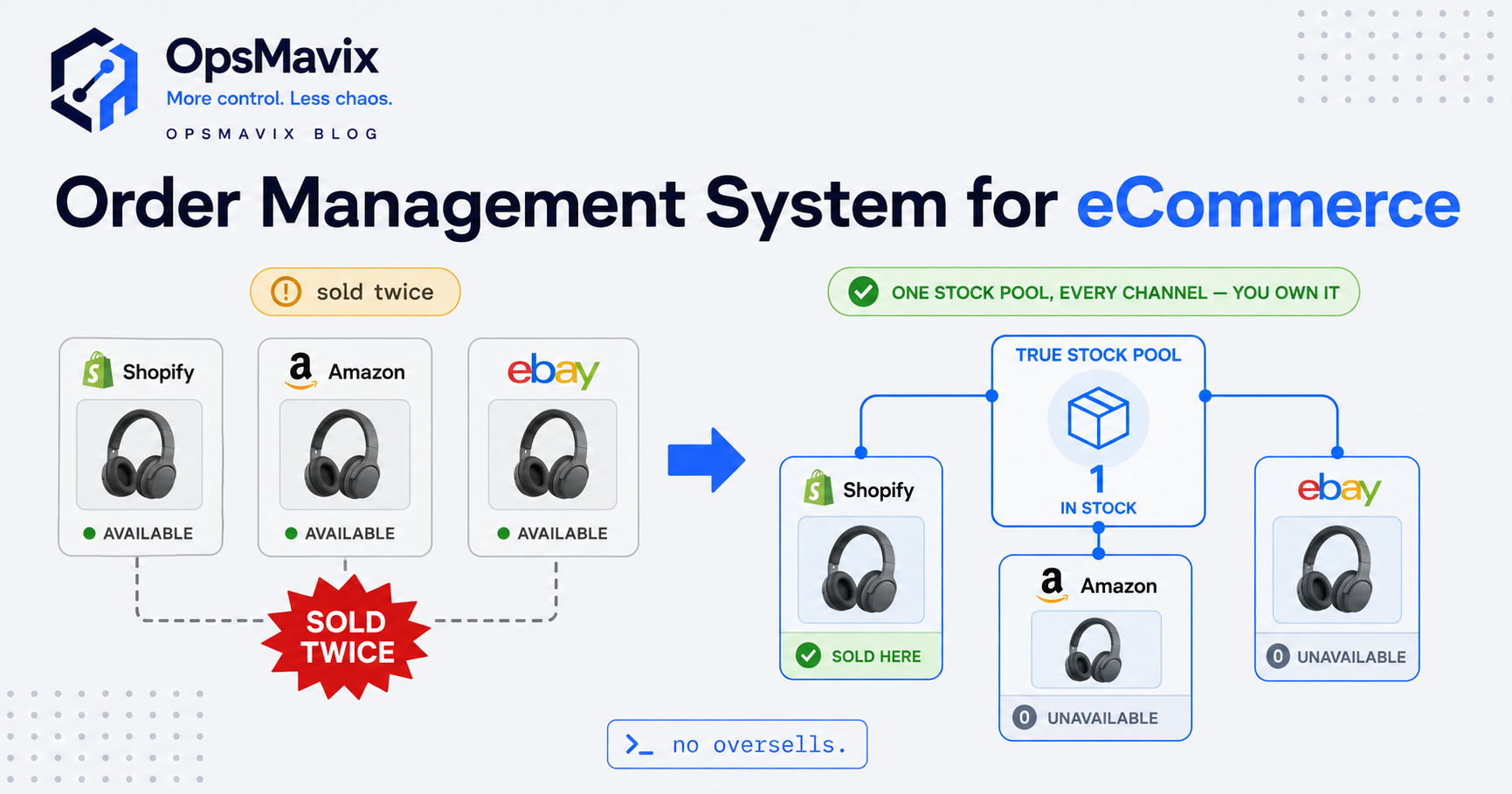
Will either platform stop overselling completely?
Neither should be treated as a guarantee. Stock definitions, reservations, update timing, failed interfaces and process overrides all affect availability. Test your actual channel rules and exceptions.
What should we take to a demo?
Bring representative orders, a short receipt, a cancelled pick, a return, product labels and one integration failure. Include users from the warehouse, office and finance team.
How should we compare costs?
Request equivalent written scopes covering users, channels, modules, devices, integrations, implementation and support. Include growth and exit assumptions and check contractual terms.
When would a custom system make sense?
When a documented process gap remains after configuration and integration have been assessed. Compare the ongoing maintenance and support obligations with suitable packaged tools.
Does this comparison mean we need a full ERP?
No. The right scope could be one workflow or integration. A full ERP is appropriate when broader business processes justify a shared redesign and the migration can be planned responsibly.
How OpsMavix Can Help
OpsMavix can map the hand-offs between channels, orders, warehouse work and finance, configure suitable tools, repair integrations or build a focused custom system. We can also scope a full ERP where the broader operating model warrants it.
Explore our inventory automation and wholesale order management offerings. Contact OpsMavix with one difficult order and your current application map so we can define a practical comparison and pilot.
Keep reading
Getting value from OpsMavix? Add us as a preferred source on Google — you'll see more of our operations content in your AI Overviews, AI Mode and Search.