
The Right Katana Alternative When Your Ops Outgrow a Maker MRP
The best Katana alternative depends on why you are leaving. If Katana feels too rigid for how your shop floor actually works, the answer is usually a right-sized operations system you own, not another MRP with the same ceiling.
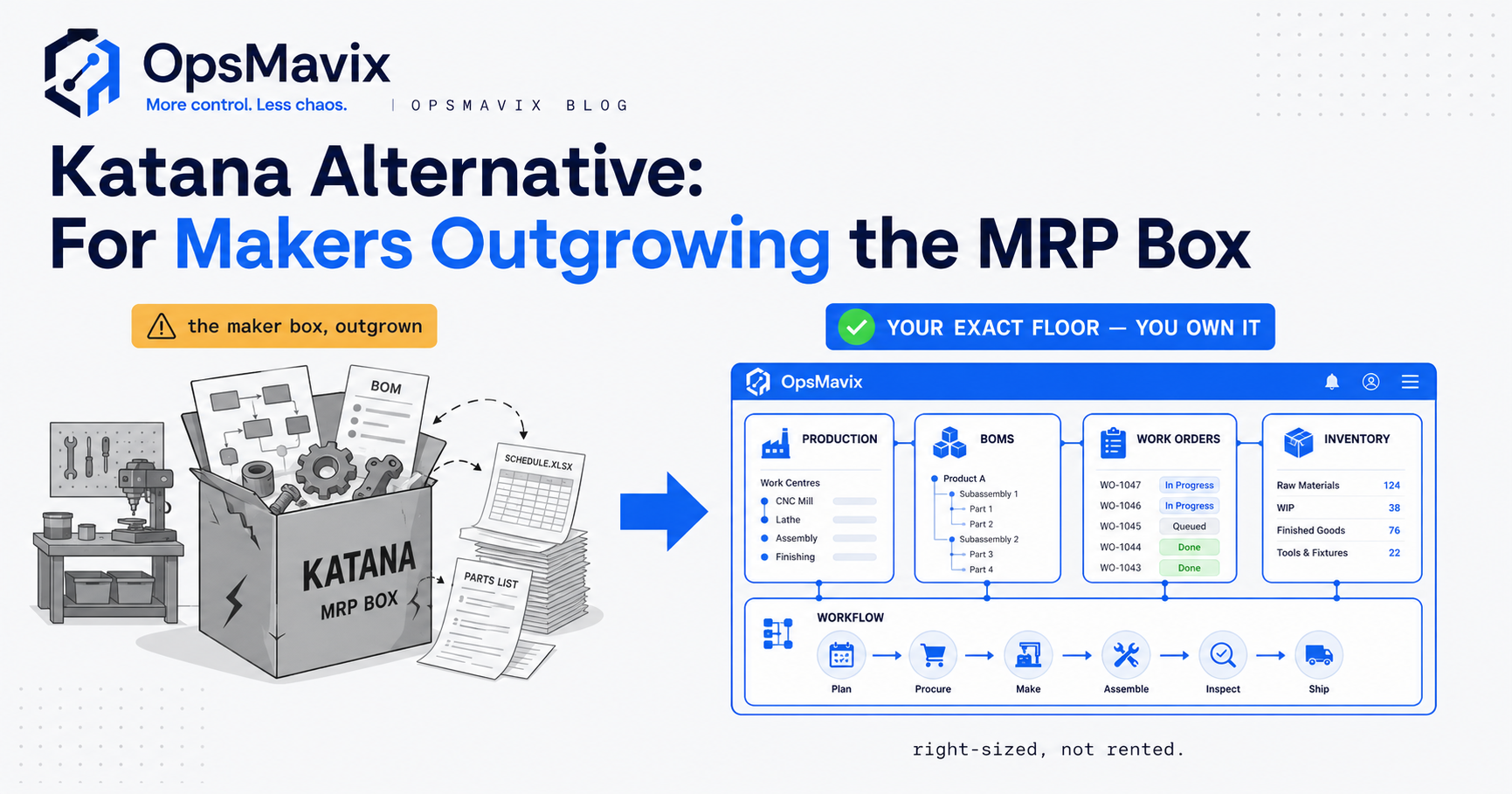
The right Katana alternative is not always another manufacturing MRP. If you are searching for one, you have usually hit a wall where the tool that got your maker business off spreadsheets now dictates how your shop floor has to work, instead of the other way round. That is the real decision: swap one packaged MRP for another with the same ceiling, or move to an operations system shaped around your actual process.
Katana is a genuinely good product for what it is built for. This is not a takedown. It is a guide to knowing when you have outgrown the category it sits in, and what the honest options are when you have.
Key Takeaways
- Katana is cloud manufacturing MRP for small makers and D2C brands, strongest for Shopify-driven businesses that want live inventory, bills of materials and production scheduling in one modern tool.
- Most people search “katana alternative” for one of three reasons: cost creep from add-ons, a workflow that no longer fits the software, or reporting that cannot answer the questions the business is now asking.
- Another off-the-shelf MRP fixes the symptom, not the pattern. If Katana was too rigid, the next packaged tool eventually will be too.
- The middle ground is a right-sized operations system you own — more flexible than a maker MRP, far lighter than a full ERP.
- Cost is not just the subscription. Add-on tiers, per-user pricing and the workarounds your team runs to fit the tool all belong in the total.
- Start from the leak, not the logo. Name the process that is bleeding time or accuracy, then choose the tool that closes it.
What Katana actually is (and where it shines)
Katana (built by the Estonia-based Katana Technologies) is cloud-based manufacturing resource planning aimed at small to medium manufacturers and maker businesses. It brings inventory, order management, purchasing, production scheduling and warehousing into one place, with live inventory that updates as materials get consumed and products are made.
Its real strength is the D2C and e-commerce maker: native Shopify, Xero, QuickBooks and HubSpot connections, drag-and-drop production scheduling, and bills of materials with subassemblies. For a growing brand assembling and shipping physical product, it is a clean, fast-to-implement way off spreadsheets. If that is you and it fits, you may not need an alternative at all.
Pricing is tiered and quoted in US dollars, typically running from a couple of hundred dollars a month on the entry tier up to higher plans, with paid add-ons for things like traceability, extra manufacturing depth and warehouse functionality. Exact figures shift by plan and over time, so confirm current numbers directly with Katana. The pattern worth noticing is the add-on model: the headline price and the real monthly bill are often two different numbers once you switch on what you actually need.
The three reasons people leave Katana
Almost every “katana alternative” search traces back to one of three triggers.
Cost creep. The base plan looked affordable, then traceability, an extra warehouse, more users and the manufacturing add-ons stacked up. The tool still works; the invoice stopped matching the value.
Workflow rigidity. This is the big one. Packaged MRP assumes a particular flow: make-to-stock or make-to-order, a standard BOM, a standard routing. Real shops have exceptions. Split batches, part-finished goods that get rerouted, a subcontract step, a customer who orders in a way the software has no field for. When the tool cannot bend, your team bends around it with side-spreadsheets and notes in the wrong boxes.
Reporting blind spots. As the business grows, the questions get sharper: true cost per finished unit including scrap, which product lines actually make money, where WIP is stuck right now. If the answer lives across the MRP plus three exports plus a manual sheet, you have outgrown the reporting layer.
Why swapping to another MRP often repeats the problem
The instinct is to shop the category: Katana versus MRPeasy versus the next cloud MRP, feature grid in hand. Sometimes that is the right move, especially if the new tool genuinely handles a workflow the old one could not.
But if you left Katana because it was too rigid for how you run, a different packaged MRP is a different set of assumptions you will eventually collide with. Every off-the-shelf tool encodes someone else’s idea of the “right” process. That is exactly what makes them quick to set up and, later, what makes them a ceiling.
This is the same trap businesses hit when they consider jumping from a maker tool straight to a full ERP. We wrote about the wider version of this in our look at why teams leave Linnworks: the fix for an over-rigid tool is rarely a bigger, more rigid tool.
The middle path: an operations system you own
There is a layer between “maker MRP” and “full ERP” that most comparison articles skip, because no single vendor owns it: a right-sized operations system built around your actual process, that you own outright.
Concretely, that means the works order processing your shop actually runs — including the messy subcontract step and the split-batch reroute — modelled as it happens, not forced into a template. It means bill of materials handling that matches how you really structure products, subassemblies and all. And it means reporting that answers your questions, because it was built to.
This is the OpsMavix position, and it is a deliberately unfashionable one: the answer to outgrowing packaged software is usually not more packaged software. It is a system sized to the operation, that bends when the operation does.
Here is the honest limit. This path costs more up front than a monthly subscription, and it only makes sense once the operation is complex enough that the flexibility earns its keep. A three-SKU Shopify brand should stay on Katana. A shop with real routing complexity, subcontracting, or multi-line reporting needs is where owning the system starts to pay back.
A £-cost way to think about it
Do not compare a subscription to a build. Compare total cost of the current situation to total cost of the fix.
The current situation is the licence plus add-ons, plus the hours your team spends in workaround spreadsheets, plus the decisions made on numbers that were an hour of manual reconciliation out of date. It is common for an inventory lead to lose the best part of a day a week just reconciling what the MRP says against what is physically on the shelf. Put a price on that day, annualise it, and the “expensive” build often looks like the cheaper option over a two-to-three-year horizon.
How to choose without churning tools twice
Before you shortlist anything, write down the one or two processes that are actually leaking. Not “we want better software” — the specific thing: production scheduling that ignores your subcontract step, stock counts that are always wrong, costing you cannot trust.
Then test each option against that named leak, including the option of staying on Katana with a bolt-on. If a packaged MRP genuinely closes the leak and you can live inside its assumptions, take it; it is cheaper and faster. If the leak exists precisely because your process does not fit any packaged assumption, that is your signal to look at a system you own.
The failure mode to avoid is churning from tool to tool, paying a migration tax each time, without ever fixing the underlying mismatch between how the software thinks and how you work.
Build, buy, or own — the honest take
Buy (stay on Katana or move to another MRP) when your process fits the tool’s assumptions and you value speed and low upfront cost over flexibility. For a lot of makers, this is genuinely the right call, and it would be dishonest to push you off it.
Own a right-sized operations system when the reason you are leaving is that no packaged tool fits how you actually run, and the cost of working around that has become a real line item. This is the OpsMavix lane: the practical layer between a spreadsheet and a full ERP, shaped to your operation.
Do not reach for a full ERP just because the maker MRP ran out of room. That is trading one poor fit for a heavier, more expensive one.
Whichever way you lean, start by naming the leak, not the logo. The best alternative is the one that closes the specific gap Katana left open — and sometimes, honestly, that is Katana with one thing fixed.
Keep reading
Getting value from OpsMavix? Add us as a preferred source on Google — you'll see more of our operations content in your AI Overviews, AI Mode and Search.