
The renewables installer whose stock lives in vans
Solar, battery, EV charging and heat pumps, with a warehouse, a fleet of vans and no single view of either.
- Sector
- Renewables installation
- Where
- Northern Ireland
- Size
- Installer covering domestic, commercial and new build
Where the business was
An installer running solar PV, battery storage, wind, EV charging, heat pumps, off-grid and insulation across domestic, commercial, new build and community work.
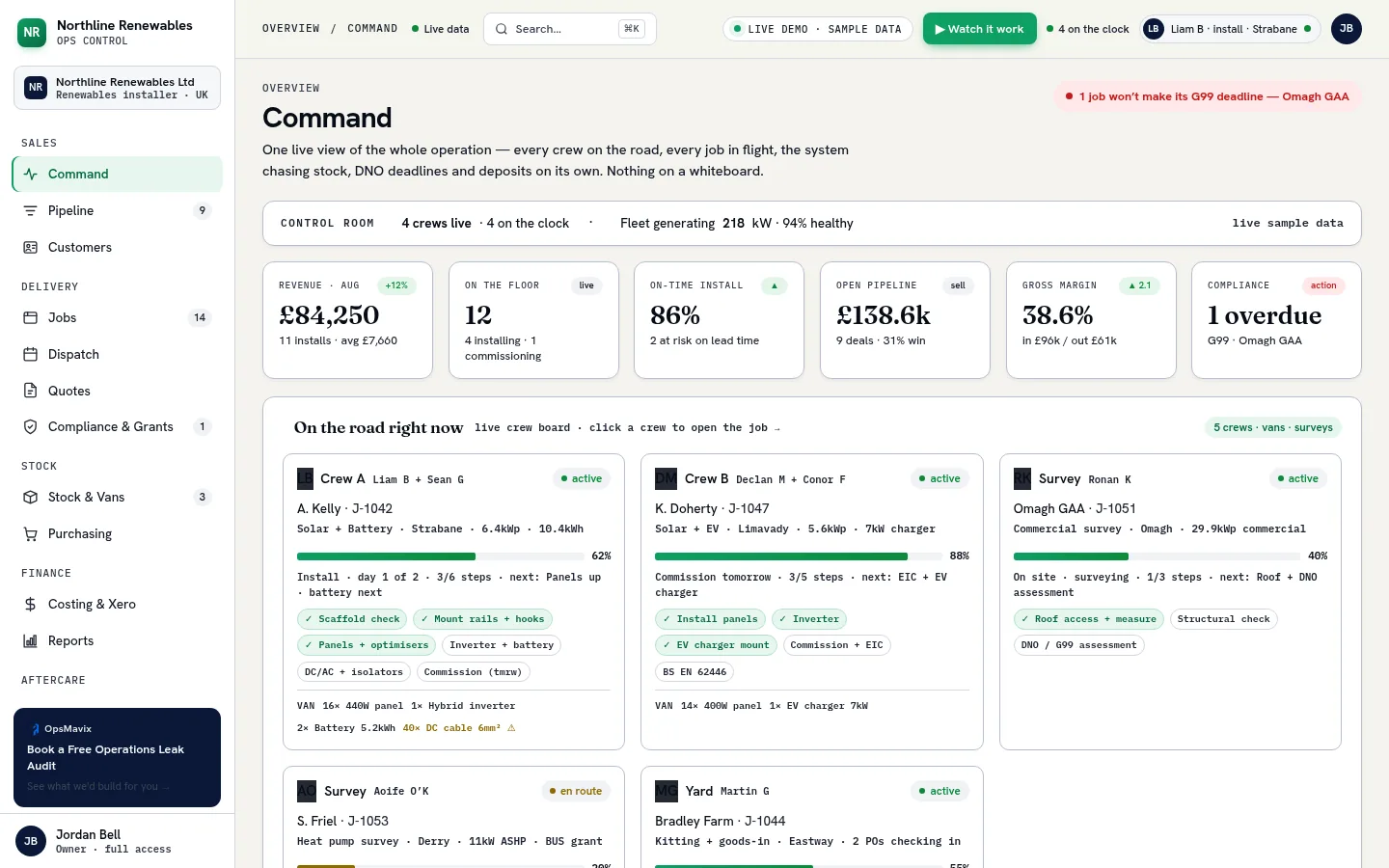
They came with an unusually specific brief: CRM and sales pipeline, job management, stock across warehouse and vans with product codes, allocation to jobs, low-stock alerts, purchase orders, holiday tracking, a job record with photos, and a dashboard with cashflow, job costing and margin.
One line in the brief mattered more than the rest: no back doors. No hidden fees, no lock-in, and a clear answer on who can get into the system.
What discovery surfaced
The things that decided the shape of the system. Most of them were not on the original wish list.
A renewables job is a compliance pipeline wearing a job card
Between sold and paid sit a network application, a scaffolding sub-contract, a commissioning test regime and a certification handover. A generic job tracker models none of that, so the stages have to be the real ones.
Adding a battery can change the paperwork
A network connection that qualified as a simple notification can become one needing prior approval once storage is added, and that shifts the timeline by weeks. The system has to know which route a job is on.
Van stock is the stock that goes missing
Material sitting in a van is real inventory doing real damage when it is invisible. Warehouse-only stock control quietly ignores most of where the material actually is.
Lead times drive the schedule
Panels, inverters and batteries all arrive on different clocks. Promising an install date without those in view is guessing.
Margin per job, not revenue per month
They asked for job costing and margin by job and by department, because monthly revenue was already visible and was not the number that told them anything.
What we built
Pipeline through the real lifecycle
Enquiry, survey, design and quote, sold, network application, procurement, scaffold, install, commissioning, handover. The stages a renewables job actually has.
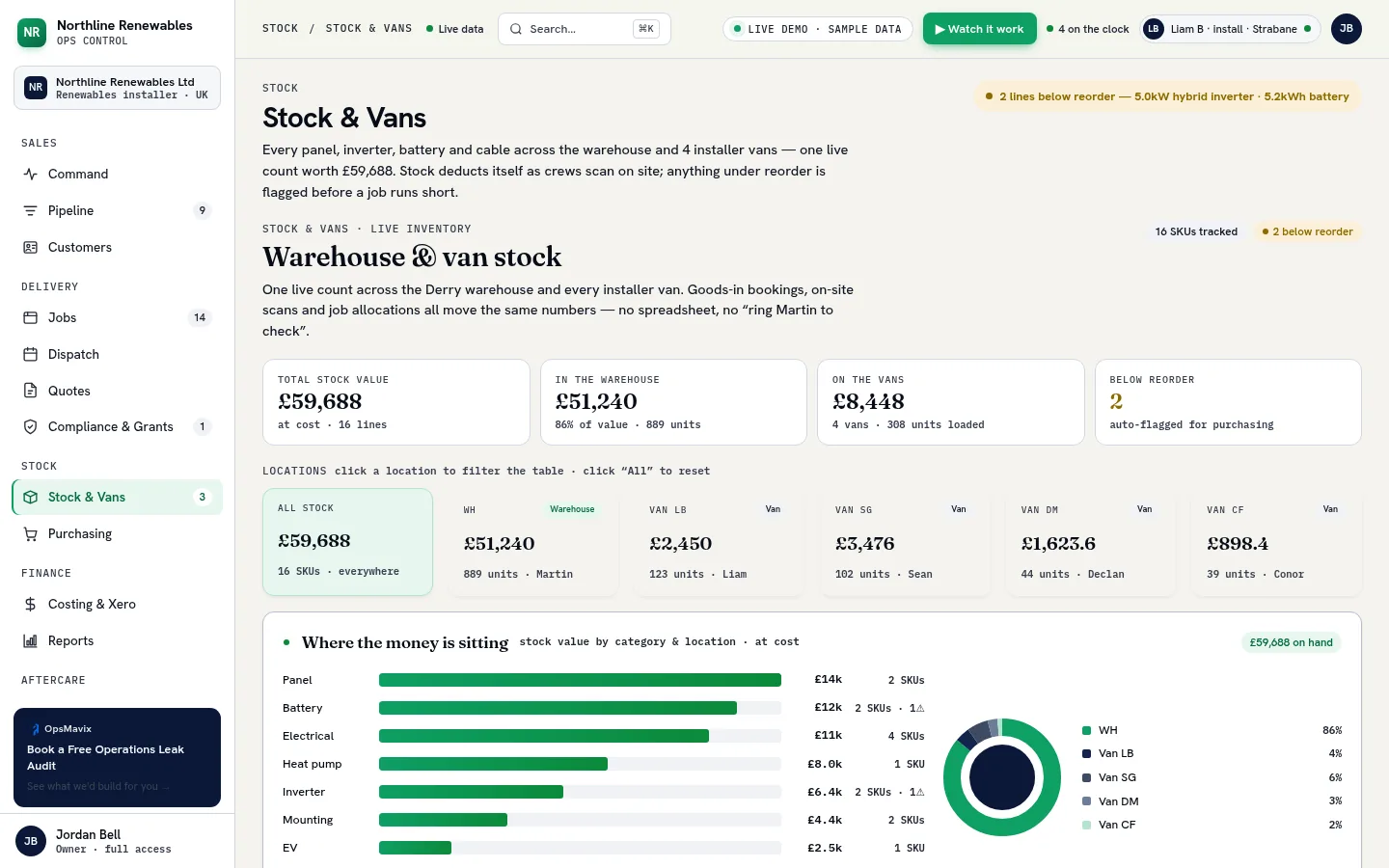
Stock across warehouse and vans
Product codes, per-location quantities including each van, allocation to a job, movement between locations and low-stock alerts.
Purchase orders tied to the job
A PO per supplier carrying the job reference, with goods-in matched against the delivery note.
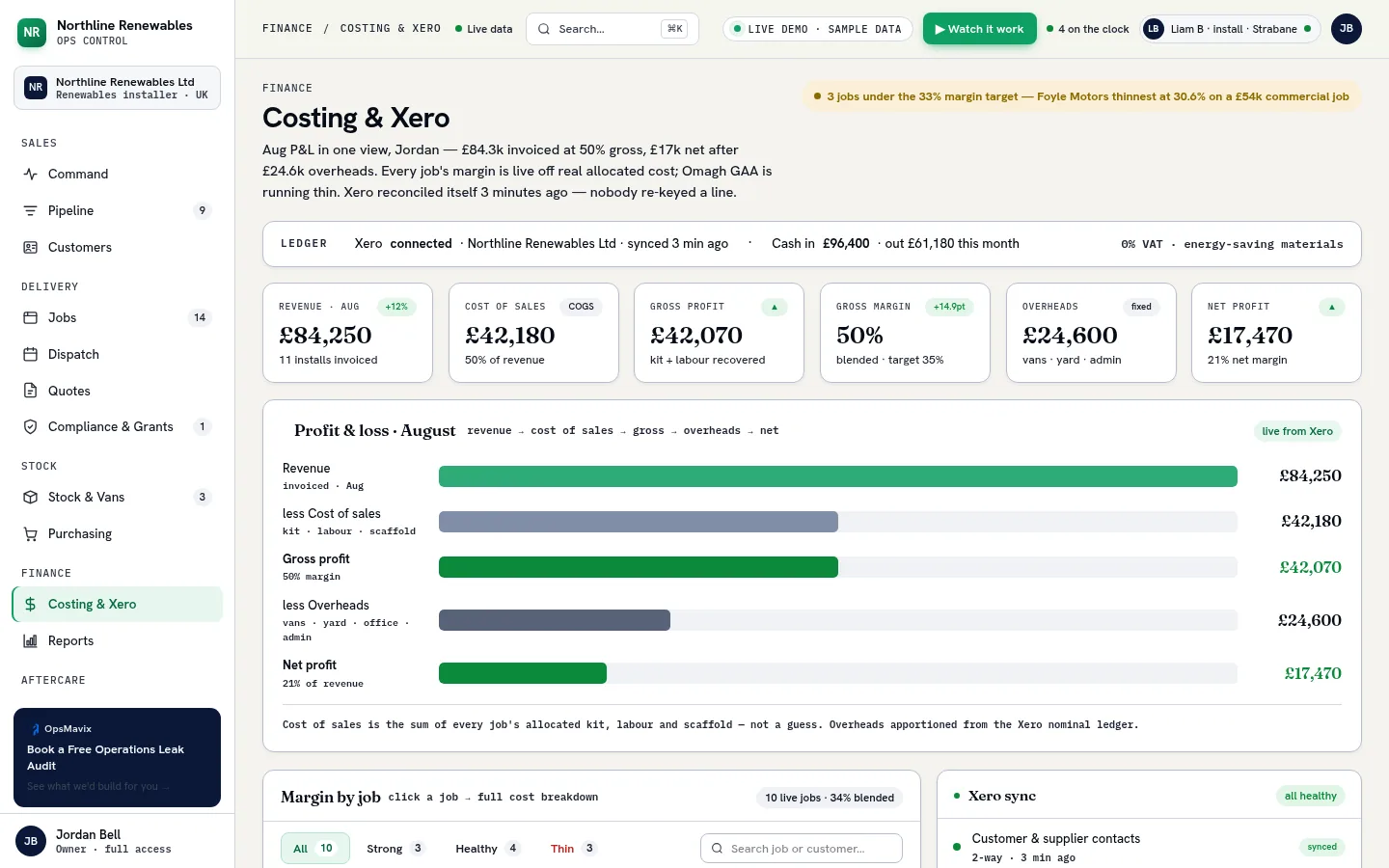
Job costing and margin
Cost against the job as it accrues, with margin by job and by department rather than a monthly total.
Certification and handover pack
Test data, certificates and the handover documents attached to the job record, where an installer or a customer can find them later.
Role-based access
Owner, management and install staff see different things, with an explicit answer to who can get in.
Renewables Control Room
The system described above, running. Click through it yourself.
The system that was built
Real screens from the working system, not mockups. You can open the whole thing yourself.
Scope, as agreed
- Lifecycle
- Enquiry, survey, design and quote, sold, network application, procurement, scaffold, install, commissioning, handover
- Stock
- Warehouse and every van as separate locations, with allocation to jobs and movement between them
- Purchasing
- A purchase order per supplier carrying the job reference, matched against the delivery note on goods-in
- Money
- Cost against the job as it accrues, with margin by job and by department rather than a monthly total
- Access
- Owner, management and install staff see different things, with an explicit answer to who can get in
- Their words
- "No back doors." No hidden fees, no lock-in, and a clear answer on access
The reality it had to respect
A system that ignores any of these is a system this business cannot actually run on.
- Network connection routes and approval timelines
- Installation and commissioning certification
- Scaffolding sub-contract sequencing
- Component lead times driving install dates
What is missing from this page, and why
A case study usually carries four more things. Here is exactly why each one is absent, so you are not left wondering.
- The client's name. This is a live commercial conversation and we do not have written consent to name them. Consent, then the name goes on, not before.
- A customer quote. Same reason. We will not write one on their behalf.
- Before-and-after numbers. Nothing has launched, so there is no measured after. Any percentage here would be invented, and invented numbers are the thing this industry has too much of already.
- Time-saved and accuracy figures. These need a real baseline captured at day zero and re-measured after launch. That is our own process, and it has not run its course here yet.
When one of these launches with real baselines and written consent, this page gains an outcomes section. Until then it stays as it is.
Want the same treatment
Every one of these started with a conversation about how the business actually runs, not a feature list. If your operation has a version of these problems, that is the conversation to have.
Book a free 30-min call →