
The group closing three companies on three different packages
Invoices approved by email chase, payment runs checked by hand, and a month-end close that lived in one person's spreadsheet.
- Sector
- Multi-company finance
- Where
- United Kingdom
- Size
- A three-company group: one on Xero, one on Sage, one on QuickBooks
Where the business was
The finance team of a three-company group, each company on its own accounting package: Xero, Sage and QuickBooks.
Supplier invoices were approved by chasing people over email. Payment runs were checked by hand against the bank.
Month-end close, intercompany and the group consolidation were held together by spreadsheets and one person who knew the order of things.
What discovery surfaced
The things that decided the shape of the system. Most of them were not on the original wish list.
The ledgers were never the problem
Three packages, all fine as books. The gap was everything between them: approvals, payment control, the close and the group view.
Approval by email is approval by memory
An invoice waiting on someone who is on holiday is late, and nobody knows until the supplier calls.
Payment fraud arrives as a changed bank detail
A duplicate invoice or a new bank detail had to be caught before money left, not after.
The close had no owner per step
Who is blocking it, and since when, was the question every month.
What we built
Invoice inbox with coding and matching
Invoices read, coded and matched to the order and delivery.
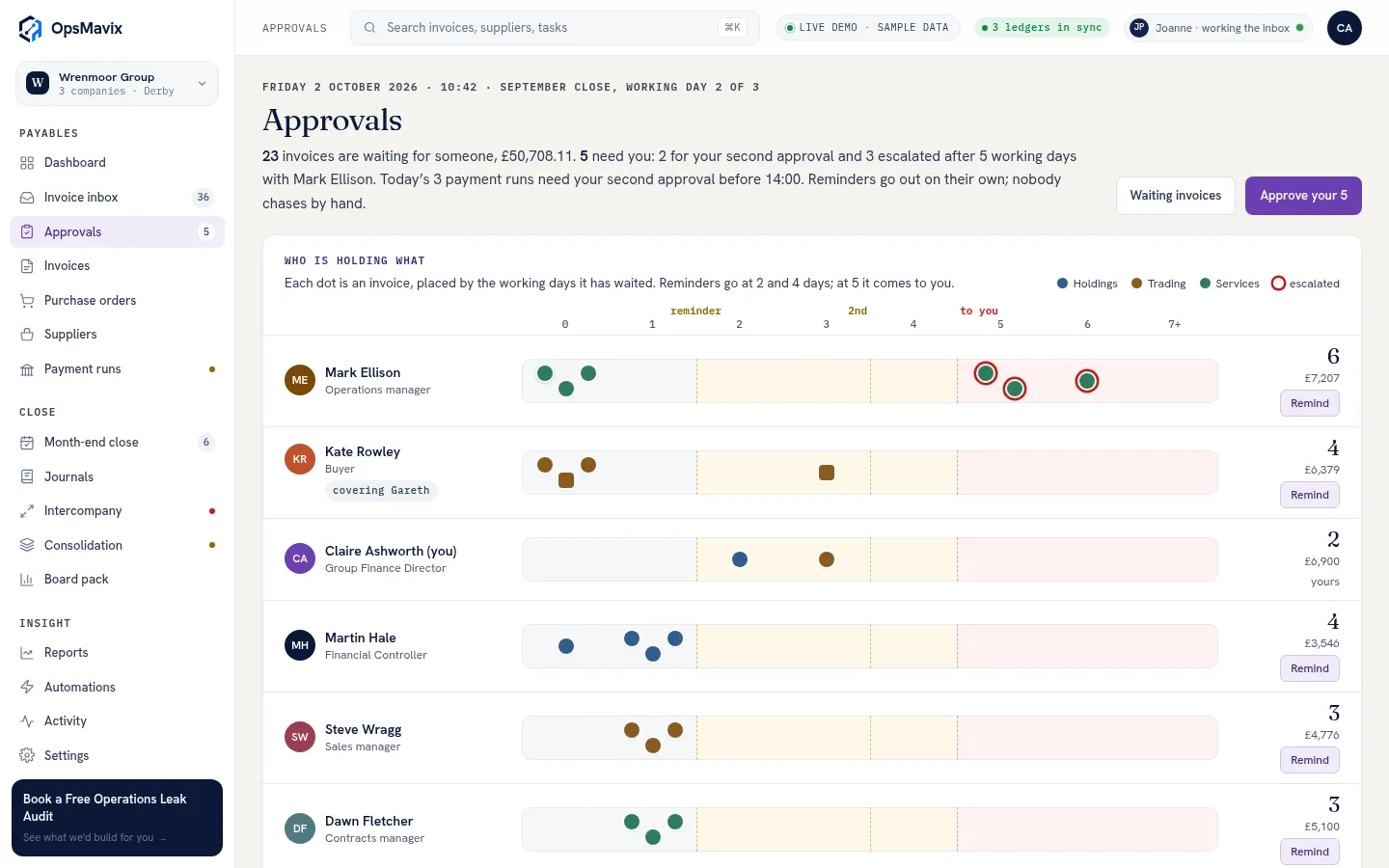
Approval routes with reminders
The right approver per invoice, with chasers the system sends.
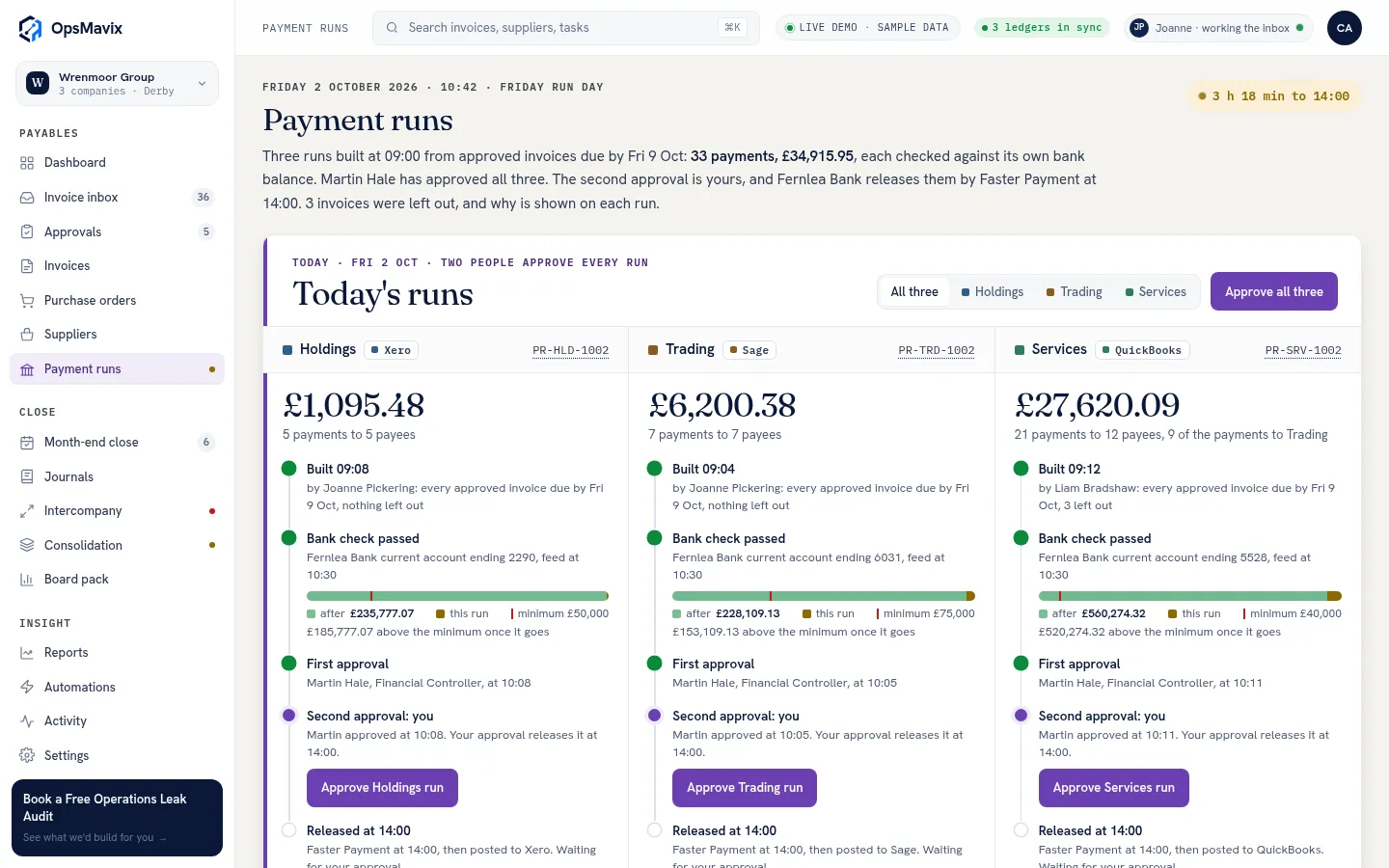
Controlled payment runs
Duplicates and changed bank details caught, each run checked against the bank balance and approved by two people.
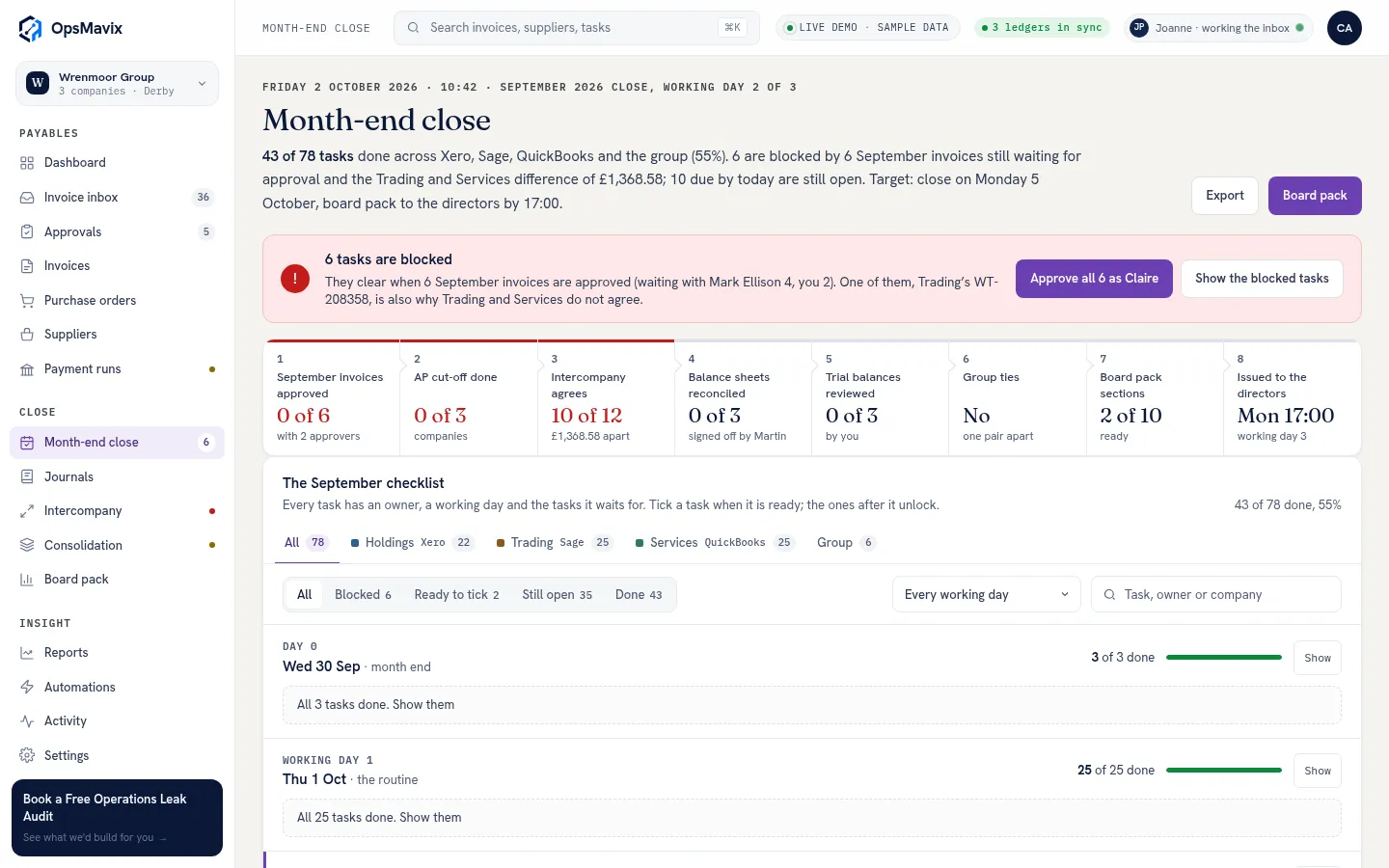
Month-end close checklist
Per company, with owners, working days and what is blocking it.
Intercompany, consolidation and board pack
Intercompany pairs that must agree, a group consolidation that ties, and a board pack built from the numbers.
Finance Control Room
The system described above, running. Click through it yourself.
The system that was built
Real screens from the working system, not mockups. You can open the whole thing yourself.
Scope, as agreed
- Companies
- Three, on Xero, Sage and QuickBooks
- Payables
- Invoice capture, coding, matching and approval routes
- Payments
- Payment runs with two-person approval and bank-detail checks
- Close
- Checklist per company, intercompany, consolidation, board pack
- Accounting
- Integrates with the existing packages. Replacing them was never in scope
The reality it had to respect
A system that ignores any of these is a system this business cannot actually run on.
- Accounts payable controls
- Segregation of duties on payments
- Intercompany reconciliation
- Group consolidation
What is missing from this page, and why
A case study usually carries a few more things. Here is exactly why each one is absent, so you are not left wondering.
- The client's name. We do not name a client without their written consent.
- A customer quote. Same reason. We will not write one on their behalf.
- Before-and-after numbers. These need a baseline measured before go-live and consent to publish. Without both, any percentage here would be invented.
When one of these launches with real baselines and written consent, this page gains an outcomes section. Until then it stays as it is.
Want the same treatment
Every one of these started with a conversation about how the business actually runs, not a feature list. If your operation has a version of these problems, that is the conversation to have.