
The food producer scaling out of the kitchen
Three words on an enquiry form: stock count, online orders, production flow. Every one of them had to be visibly solved.
- Sector
- Specialty food production
- Where
- London, England
- Size
- Small maker moving from side-line to scaling
Where the business was
A small London specialty food producer at the point where the spreadsheet and the notebook stop coping: about to scale, not yet a plant.
The three pains came straight off the enquiry form in their own words. Stock counts, online orders, production flow. Not "we need an ERP".
The demo was deliberately built as a general specialty food producer rather than a portrait of their business, so that what was on screen was the vertical's reality and not guesses about their revenue, staff or product range.
What discovery surfaced
The things that decided the shape of the system. Most of them were not on the original wish list.
A food business does not have stock, it has batches
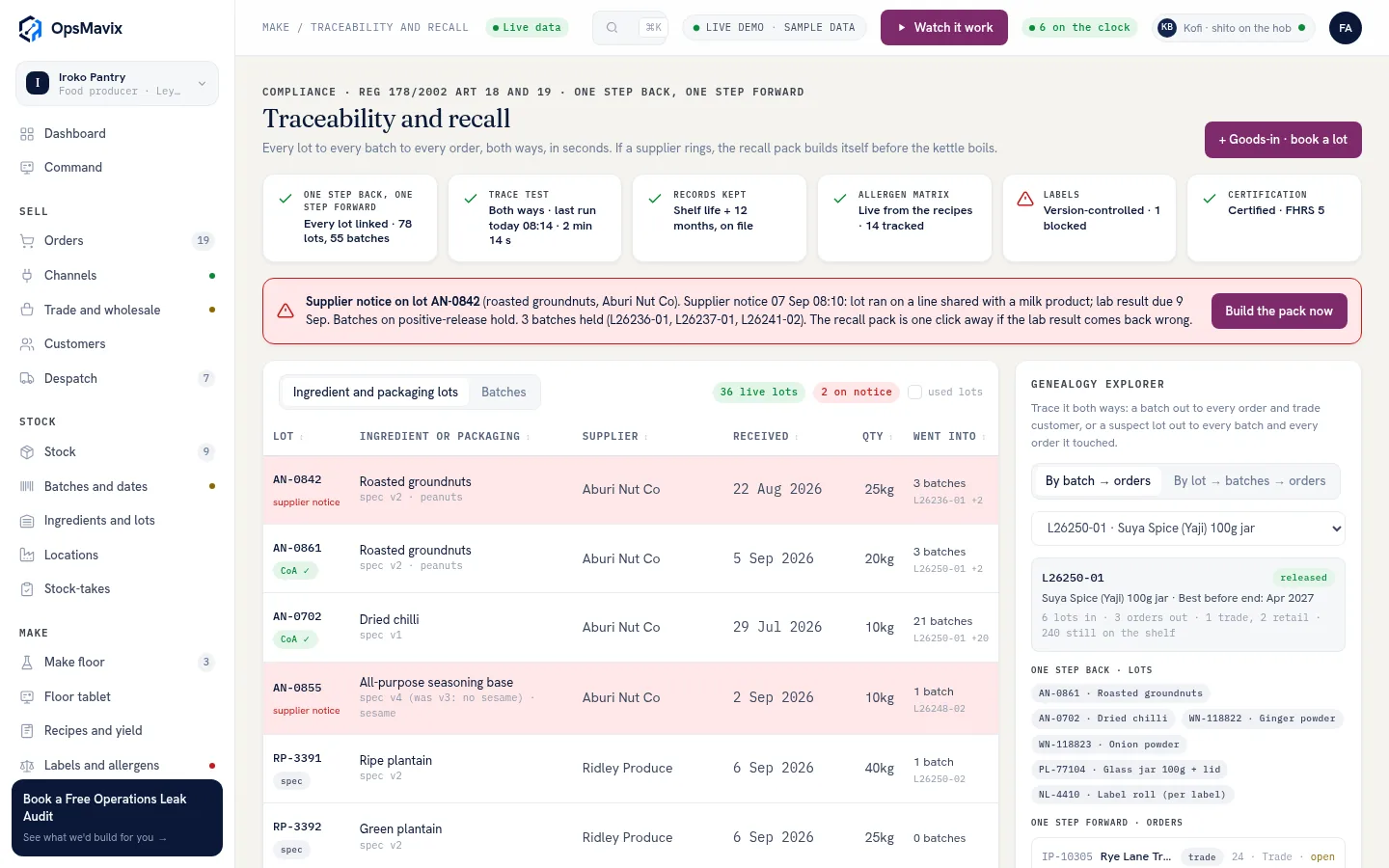
Ingredients arrive in lots with their own expiry. Those lots become a make, the make becomes finished units with a durability date. A generic inventory count cannot express that, and it is exactly what a recall or an audit asks for.
Allergens are a data model problem, not a label
The allergen set of a finished product is inherited from its ingredients. If that is typed by hand on the label it will eventually be typed wrong, and in food that is not a rounding error.
The day is a make schedule, not a task list
Production is stations and time: what is on which station, when it comes off, what is waiting. That is the shape the screen had to take.
The floor is not a desk
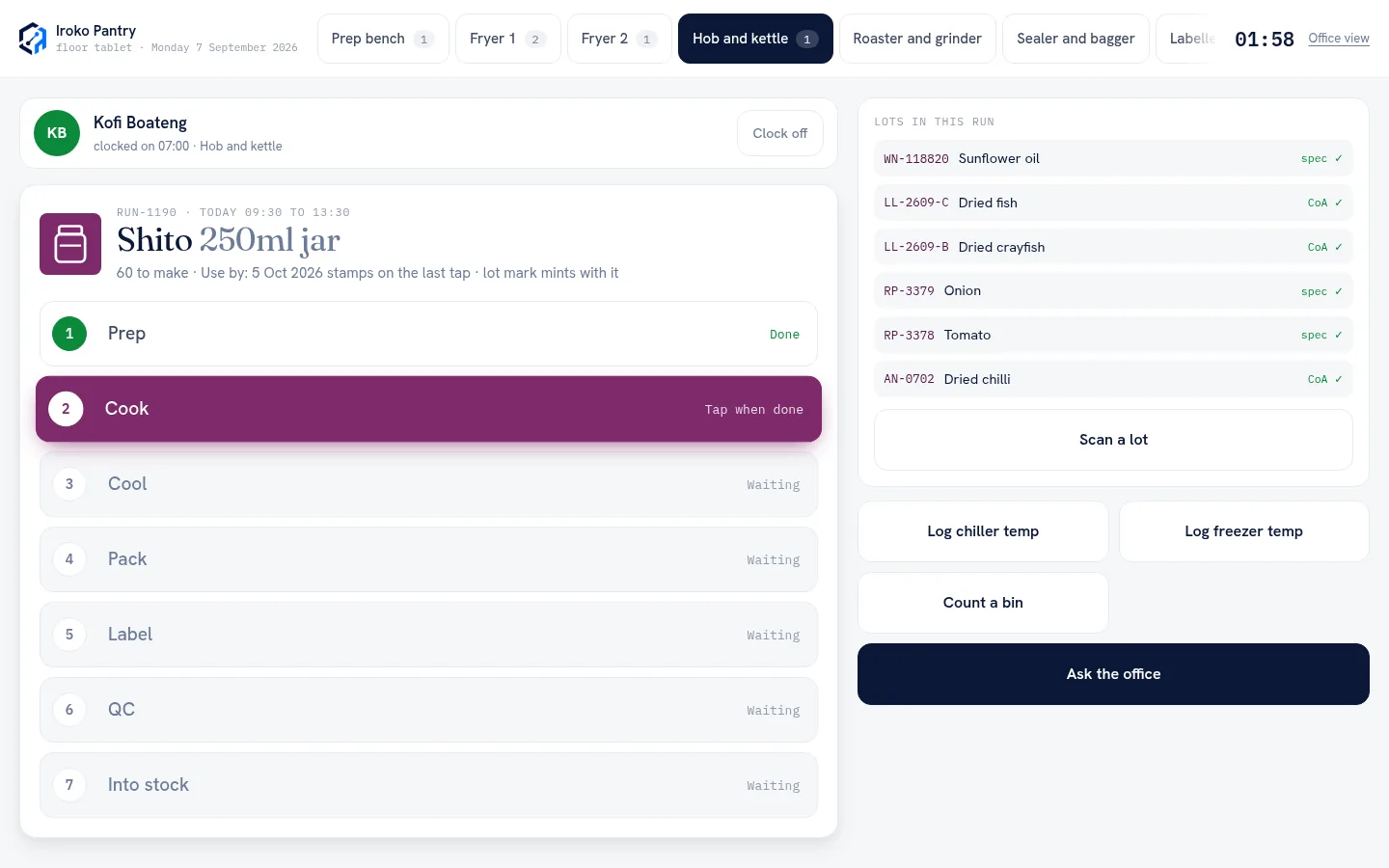
The people doing the making have wet hands and no time. That needed a separate stripped-back tablet view with large tap targets, not the office screen shrunk.
What we built
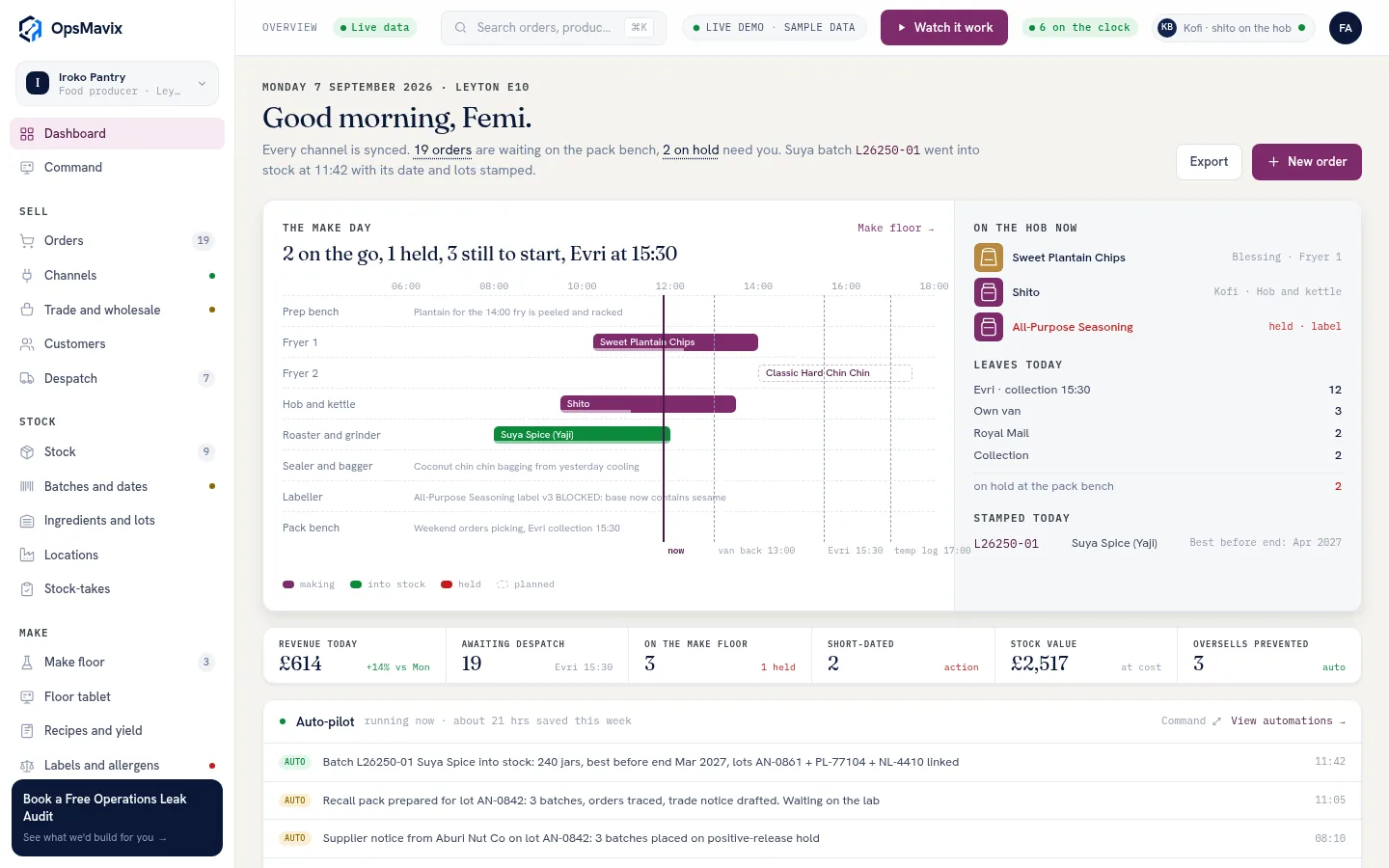
Make-day timeline
Today's production across every station as a time-based lane view, so the schedule is legible at a glance rather than derived from a table.
Batch and lot traceability
Ingredient lot to make to finished batch, forwards and backwards, with durability dates carried through.
Floor tablet
A chromeless station view with large tap steps and a keypad, built for the making, separate from the office system.
True cost per unit
Recipe cost, yield and channel fees, so the margin shown per product is the margin after the channel has taken its cut.
Channels and orders in one queue
Online orders landing in the same place as everything else, with stock that moves when they do.
Iroko Pantry
The system described above, running. Click through it yourself.
The system that was built
Real screens from the working system, not mockups. You can open the whole thing yourself.
Scope, as agreed
- Traceability
- Ingredient lot through to finished batch, both directions, with durability dates carried through
- Allergens
- Inherited from the recipe rather than typed onto the label by hand
- Two interfaces
- An office system and a separate stripped-back floor tablet, not one shrunk to fit both
- Costing
- Recipe cost, yield and channel fees, so margin is what is left after the channel takes its cut
- Channels
- Online orders into the same queue as everything else, with stock that moves when they do
- Deliberately general
- Built as a specialty food producer, not a portrait of their business, so nothing on screen assumed facts we did not have
The reality it had to respect
A system that ignores any of these is a system this business cannot actually run on.
- Lot and batch traceability for withdrawal and recall
- Allergen inheritance from ingredient to finished unit
- Durability and shelf-life dating
- Yield and true cost per unit
What is missing from this page, and why
A case study usually carries four more things. Here is exactly why each one is absent, so you are not left wondering.
- The client's name. This is a live commercial conversation and we do not have written consent to name them. Consent, then the name goes on, not before.
- A customer quote. Same reason. We will not write one on their behalf.
- Before-and-after numbers. Nothing has launched, so there is no measured after. Any percentage here would be invented, and invented numbers are the thing this industry has too much of already.
- Time-saved and accuracy figures. These need a real baseline captured at day zero and re-measured after launch. That is our own process, and it has not run its course here yet.
When one of these launches with real baselines and written consent, this page gains an outcomes section. Until then it stays as it is.
Want the same treatment
Every one of these started with a conversation about how the business actually runs, not a feature list. If your operation has a version of these problems, that is the conversation to have.
Book a free 30-min call →