
The Warehouse Management System in the Supply Chain: Where It Sits and Why It Matters
A warehouse management system in the supply chain is the point where physical stock and digital records are meant to agree, and where the truth for every stage upstream and down is decided. This guide shows where the WMS sits in the end-to-end chain, why it is the accuracy hub, and how a right-sized owned system fixes it for businesses that have outgrown spreadsheets and disconnected tools.
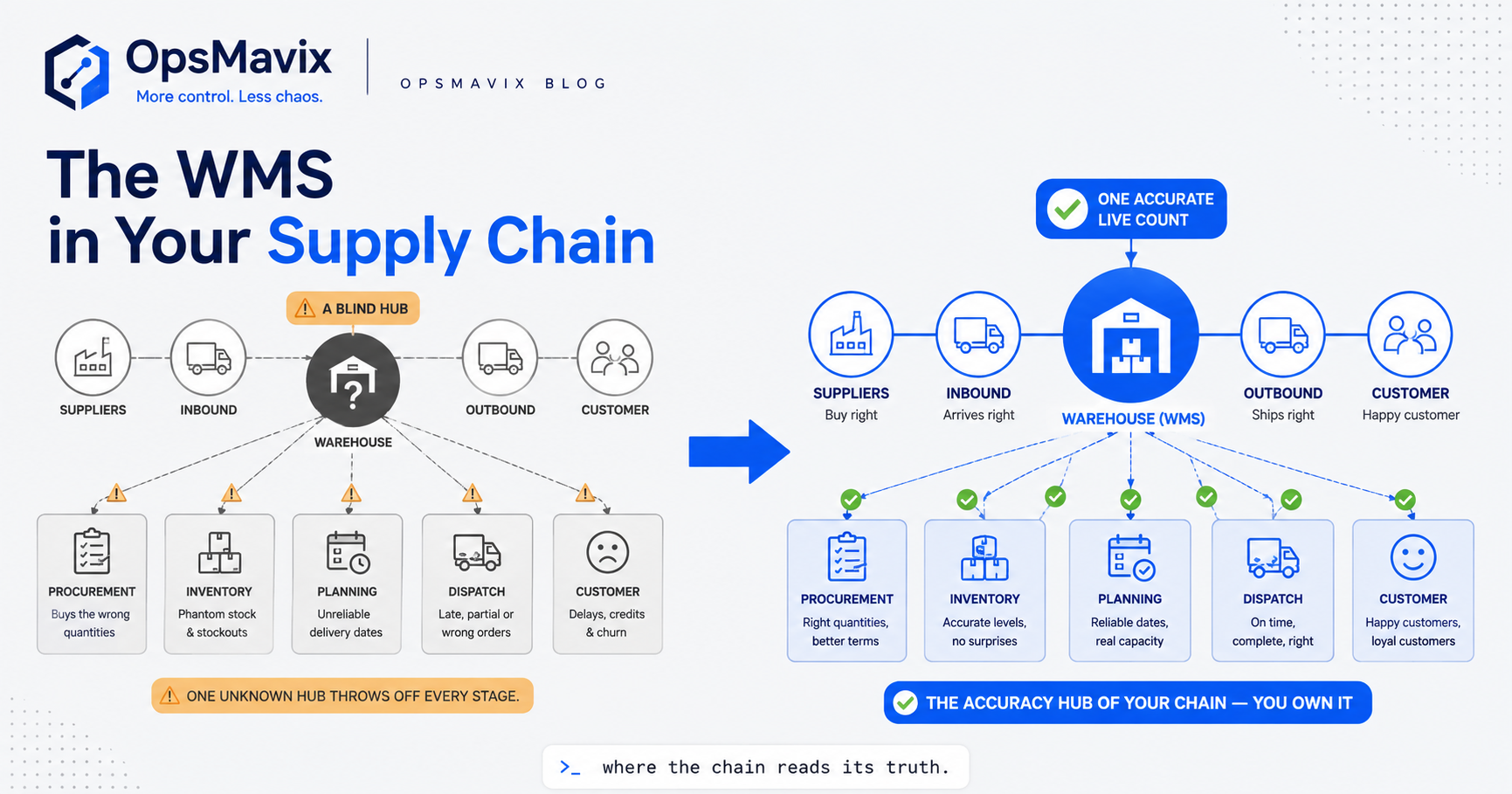
A warehouse management system in the supply chain is the software that runs everything happening inside your four walls: what arrives, where it goes, what is picked, and what leaves. On its own that sounds like a stock-cupboard problem. It is not. The warehouse is the one place in the whole chain where the physical world and the digital record are supposed to meet and agree, which makes it the point that decides whether every other stage is working from a true number or a guess.
Here is the pain most owners feel before they go looking for one. Purchasing buys against a stock figure that turns out to be wrong. Sales promises against the same figure and oversells. The floor picks against a location that is empty. Finance values stock that has already gone out the door. None of those teams is being careless. They are all reading from a warehouse that has quietly drifted out of sync with reality, and the errors ripple outward from there into every link the warehouse touches.
Quick summary: Nearly half of UK businesses, 47%, saw supply chain disruption rise over the previous year, and 60% now say their chains feel more fragile than ever, according to Ivalua’s survey of 300 UK supply chain and procurement decision-makers (Ivalua). When the chain is this volatile, the last thing you can afford is a warehouse handing wrong numbers to every stage around it. Accuracy at the hub is what keeps the fragility from turning into lost orders and dead cash.
Contents
Where the warehouse sits in the supply chain
Picture the end-to-end chain as a line. Suppliers sit at one end, your customer at the other, and between them runs a sequence: procurement raises purchase orders, goods arrive inbound, they are stored, they are picked and packed outbound, transport moves them, and the customer receives them. The warehouse is not a stage tucked away at the back. It sits in the middle, and almost every other stage either feeds it or draws from it.
That central position is the whole point. Procurement decides what to buy, but the warehouse confirms what actually landed and in what condition. Sales and order management decide what to promise, but they can only promise honestly if the warehouse tells them what is genuinely on the shelf and free to sell. Transport moves what the warehouse releases. Finance values what the warehouse says it holds. The warehouse is where the plan meets the pallet.
So a warehouse management system in the supply chain is not really a storage tool. It is the system that keeps the physical count and the digital record in step at the exact place they are most likely to diverge, and then hands that agreed number to everyone else. Get this one node right and the stages around it inherit good data. Get it wrong and no amount of clever forecasting or slick order software upstream can save you, because they are all building on a bad figure. For the wider picture of how these stages connect, our overview of supply chain management software walks through the full chain.
What a WMS actually does
Strip away the jargon and a warehouse management system does four practical jobs, each one a moment where physical and digital either match or drift apart.
- Receiving and put-away. When a delivery arrives, the system records exactly what came in against the purchase order, flags shortages or damage, and directs each item to a location. This is the first chance to catch a supplier who shorted you, and the first chance to lose the count if it is done on paper.
- Storage and location control. The system knows not just how much you hold but where it sits, down to the bay or bin. That location intelligence is what turns “we have twelve somewhere” into “there are twelve in aisle four, and here is the one that expires first.”
- Picking and packing. When an order drops, the system tells the picker what to take and from where, in an efficient route, and records stock leaving as it happens rather than hours later. This is where accuracy is won or lost at speed.
- Despatch and stock movement. As orders go out, the recorded figure falls in real time, so the next person to check availability sees the truth, not last night’s number.
A deeper walkthrough of each of these lives in our guide to what a warehouse management system is. The thread running through all four is the same: every job is a point where the count on the shelf and the count in the system are meant to agree, and the WMS exists to make sure they do.
Why the warehouse is the accuracy hub of the chain
Here is the blind spot. Most businesses treat stock accuracy as a warehouse issue, something for the floor team to worry about. In reality it is a whole-chain issue that happens to be decided in the warehouse. The number the warehouse holds is the same number sales quote from, purchasing reorders against, and finance reports on. One drifting figure at the hub becomes four wrong decisions at the spokes.
That is why so little of the chain is genuinely under control. Only 6% of organisations report full end-to-end supply chain visibility, according to research collated by Ventory (Ventory). End-to-end visibility is almost impossible to reach if the warehouse in the middle cannot give a reliable live figure, because visibility is only ever as trustworthy as its weakest node. Fix the hub and the chain becomes visible. Leave it broken and every dashboard upstream is confidently displaying a lie.
The daily symptoms are familiar. Overselling, because two channels both committed the same stock. Emergency purchase orders, because the buyer could not trust the on-hand number and got caught short. Written-off stock, because short-dated or slow-moving items sat unseen in a corner. Hours lost every week to manual stock counts and reconciliation that only exist because nobody believes the system. Each of those is charged to a different department, which is exactly why the root cause hides: the cost is spread across the chain, but the leak is concentrated at the warehouse. An inventory automation system is built to close that specific gap, keeping one live figure that every stage can trust.
Generic tool vs full ERP vs right-sized owned system
There are three honest ways to put a warehouse management system into your supply chain, and each genuinely fits a different kind of business. A cheap off-the-shelf tool is fast and light but stops short. A full ERP or enterprise WMS covers everything and charges accordingly. A right-sized owned system targets the accuracy hub and grows from there.
| Factor | Generic / cheap tool | Full ERP or enterprise WMS | Right-sized owned system |
|---|---|---|---|
| Best for | One channel, simple stock, low volume | Large, multi-site, high-complexity operations | “outgrowing spreadsheets and disconnected tools” |
| What it covers | Basic stock counts and picking | Every function, warehouse to finance to HR | The links that actually leak, connected properly |
| Fit to how you work | You adapt to its limits | You bend your business to its template | Built around your real process |
| Live single figure | Within its own app only | Yes, across the whole suite | Yes, across the workflows you build |
| Setup time | Days, then you hit the ceiling | Months to over a year | Weeks, focused on the hub |
| Cost model | Cheap monthly subscription | Per-user, per-module licences, forever | One-off build, you own it |
| Grows with you | Rarely, you outgrow and switch | Yes, but you pay for all of it up front | Yes, expand piece by piece, up to a full ERP |
| Ownership | You rent it | You rent the whole platform | You own the system outright |
The generic tool deserves a fair word. If you run one sales channel, a few hundred simple SKUs and modest volume, an off-the-shelf app is often the smartest, cheapest choice, and there is no shame in using one until you outgrow it. The trouble starts when stock lives in one tool, orders in another and purchasing in a spreadsheet, and someone re-keys between them all day. That is when the accuracy hub cracks. The full ERP fixes it by replacing everything, which is right for genuinely complex, multi-site operations and heavy for everyone else. The right-sized owned system is the middle path: the connectedness of a suite, aimed only at the warehouse hub and the links it feeds.
Integrations and why ownership matters
A warehouse management system that cannot talk to the rest of your chain just moves the re-keying problem somewhere else. The warehouse sits between suppliers and customers, so its data needs to flow both ways: purchase orders in from procurement, live availability out to your sales channels and order desk, valuation out to accounting, despatch confirmations out to transport and customers. If those links are manual, the hub is accurate for exactly as long as it takes someone to fall behind on data entry.
This is where a generic tool and a full ERP fail in opposite directions. The cheap tool is accurate inside its own four walls but shares poorly, so the numbers stop being trustworthy the moment they leave it. The ERP shares beautifully, but only by insisting it also run your accounting, your CRM and everything else, whether or not those already work. A right-sized owned system takes the middle line: it keeps one live figure at the warehouse and connects to the tools you already trust, including the accounting software your finance manager has no wish to replace. When orders are the leaking link, a wholesale order management system reads that same live figure so nothing gets promised twice.
Ownership is the quieter issue, and often the more expensive one over time. Rent your warehouse system as part of a suite or a stack of subscriptions and you are renting the core of your operation: the monthly cost never ends and the roadmap belongs to the vendor. Own it and you pay once, and it changes when your business changes, not when a supplier deprecates a feature or raises per-seat pricing. For the node your entire chain depends on for the truth, control is not a nice-to-have.
A worked example: a £5m homeware distributor
The numbers below are illustrative, built to show the shape of the decision rather than a claim about a specific client.
Picture a homeware distributor turning over around £5m a year. Roughly 1,200 active SKUs, five people in the office, one warehouse, orders arriving through a trade website, a couple of marketplaces and the phone, and accounts kept in software the finance manager likes and trusts.
The pain. Stock is counted on a rolling basis but is wrong within a day. The trade site and a marketplace both sell from the same pool, so bestsellers get oversold and cancelled, which costs a marketplace rating every time. Pickers walk to locations that are empty because a return was never put away in the system. The buyer keeps a safety buffer of extra stock purely because they cannot trust the on-hand figure, tying up cash on shelves. Two full afternoons a week disappear into stock counts and reconciling the numbers that should already agree.
The oversold option. A full ERP with an enterprise warehouse module is quoted. It bundles demand planning, a transport layer and a finance suite, and wants to replace the accounting software too. The price is a per-user monthly licence plus a five-figure implementation spread across three quarters. The transport module would sit unused, the demand engine is overkill for a stable range, and the finance manager would spend months migrating off a tool that already works fine.
The right-sized option. A system that does the warehouse hub properly and nothing it does not need. Receiving and put-away that update stock the moment goods land, including returns. Location control so pickers are sent to bays that actually hold stock. One live figure that both marketplaces and the trade site read from before anything is committed, so overselling stops. It leaves the accounting software alone and feeds it clean valuation. No transport module, no demand engine, no per-seat rent. Built in weeks, scoped to the real leaks, owned outright.
The outcome that matters. Oversells stop, because there is one figure instead of three. The safety-buffer cash comes back, because the buyer can finally trust the number. The two lost afternoons return, and the owner can answer “what have we actually got” in a single click. That is the difference between buying the whole chain and fixing the hub that decides its accuracy.
FAQ
What is a warehouse management system in the supply chain?
It is the software that runs everything happening inside your warehouse, receiving, storage, picking and despatch, and keeps the physical count in step with the digital record. Its role in the wider chain is to sit at the middle node and hand a reliable live stock figure to every other stage: procurement upstream, sales and order management, transport and finance. It is less a storage tool than the accuracy hub the rest of the chain reads from.
Why is the warehouse called the accuracy hub of the supply chain?
Because it is the one place where physical goods and digital records are meant to meet and agree, and the number it holds is the same number sales quote from, purchasing reorders against and finance reports on. A single wrong figure at the warehouse becomes several wrong decisions across the chain. Fixing accuracy at the hub is what makes end-to-end visibility possible, which is why so few businesses achieve it while their central node is drifting.
Do I need a full ERP to get a proper WMS?
Usually not. A full ERP makes sense for large, multi-site operations with genuine complexity across every function. Most growing businesses feel real pain in one or two links, almost always stock accuracy and order-to-despatch, and can fix those with a right-sized system that targets the warehouse hub. You can always expand later, up to a full ERP, when the business genuinely needs it rather than because it came bundled.
Will a warehouse system connect to my existing accounting and sales channels?
It should, and this is the question that decides whether it helps or hurts a year from now. The warehouse sits between suppliers and customers, so its data needs to flow both ways. A right-sized owned system keeps one live figure and connects to the tools you already trust, including your accounting software, rather than forcing you to replace everything. Poor integration just moves the re-keying problem elsewhere and lets the hub drift out of sync again.
How do I know if my warehouse is the leak?
Follow the errors and the wasted time. If you oversell, place emergency purchase orders, write off unseen stock, or lose hours every week to counts and reconciliation nobody trusts, the leak is almost certainly at the warehouse hub even though the costs land in other departments. Naming it precisely is what stops you buying an entire ERP to fix one node. An inventory automation system addresses the most common version of it.
How OpsMavix can help
OpsMavix builds right-sized, owned operations systems for growing UK businesses that are outgrowing spreadsheets and disconnected tools. We are not an ERP vendor and we do not sell generic custom code. We sell the outcome: one live, trustworthy stock figure at the warehouse hub that every other stage of your chain can read from, built around how you actually run, connected to the accounting and sales tools you already trust, and owned outright with no per-seat rent. We start by finding exactly where your warehouse leaks accuracy into the rest of the chain, then build only what fixes it, and if a full platform genuinely is your fit we will tell you. When you are ready to see the leaks in yours: Book a Free Operations Leak Audit
Sources
- Ivalua — “UK businesses in the middle of a chain reaction”, finding 47% of UK businesses saw supply chain disruption increase over the previous year and 60% say their chains feel more fragile than ever, based on a survey of 300 UK supply chain and procurement decision-makers: https://www.ivalua.com/press-releases/uk-businesses-in-the-middle-of-a-chain-reaction-with-nearly-half-experiencing-a-surge-in-supply-chain-disruption/
- Ventory — “Real-Time Inventory Visibility: Why Only 6% of Companies Have It”, collating research that only 6% of organisations report full end-to-end supply chain visibility: https://www.ventory.io/blog-posts/real-time-inventory-visibility