
How a Robot Hacked Super Mario Maker Into a Live SNES
A robot hacked a level editor into a Super Nintendo by feeding it controller inputs the console blindly trusted. TASBot, a tool-assisted-speedrun robot,...
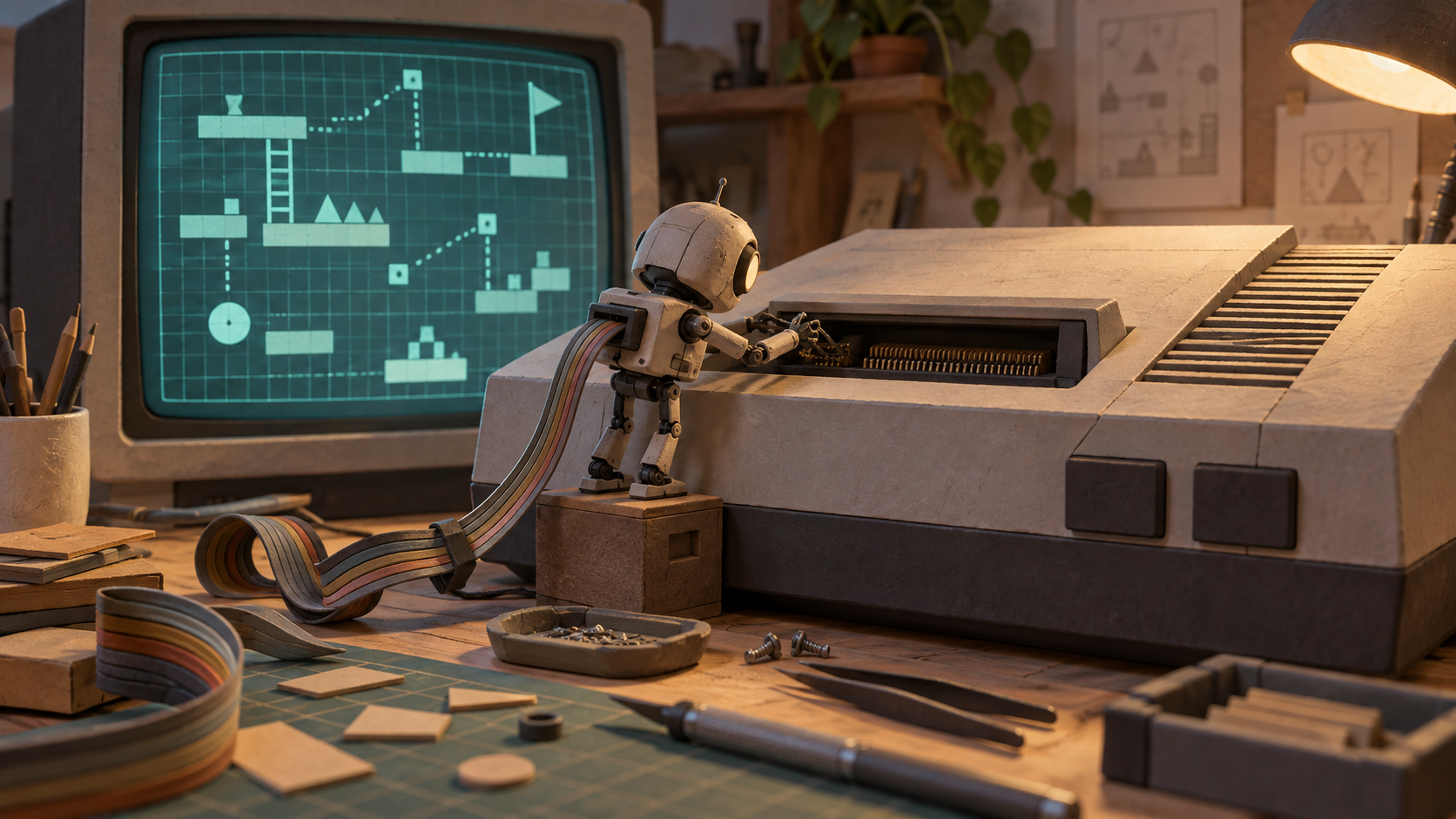
A robot hacked a level editor into a Super Nintendo by feeding it controller inputs the console blindly trusted. TASBot, a tool-assisted-speedrun robot, sent a crafted sequence of button presses through a running SNES’s controller ports and injected new software, including a Super Mario Maker style editor, into a machine built for neither.
What is TASBot?
TASBot is a well-known robot that plays game consoles by feeding them precise controller inputs. TAS stands for tool-assisted speedrun. Instead of human hands, it delivers a perfectly timed sequence of button presses through the same ports a normal controller uses, frame by frame, with inhuman accuracy.
Normally that precision is used to blast through games at superhuman speed. But the same idea, total control over exactly what the console receives at every instant, opens a much stranger door once you stop treating the controller as just a way to move Mario.
What did the demo actually do?
In a famous live demonstration, TASBot reprogrammed a running SNES on stage using nothing but controller inputs. It fed the machine a carefully crafted sequence through the controller ports and effectively injected new software into it, including a Super Mario Maker style level editor, on a decades-old console that had no cartridge for any such thing.
To be clear about what this is: it is a hacking and demo feat, done by experts on stage, not something that happens by accident during a normal game. Nobody’s childhood SNES is spontaneously turning into a level editor. The point of the demo is not the trick, it is what the trick reveals.
Why does the trick even work?
It works because the console blindly trusts whatever the controller sends. The SNES was designed to read button presses and act on them. It never asks whether the stream of inputs “makes sense,” whether it is longer or weirder than any human could produce, or whether it might be instructions rather than gameplay.
So a channel built for one small job, “which buttons is the player pressing,” becomes a way to smuggle in something else entirely. The hardware is not broken. It is doing exactly what it was told. The flaw is that it never questions the input. Give a trusting system a carefully shaped input and you can walk it far outside anything its designers imagined.
What does this have to do with my operations system?
This is the whole game in software security and, quietly, in day-to-day operations: a system that trusts its inputs without validation can be driven to do things it was never designed to do. The SNES is a vivid version of a risk that lives in every business tool that accepts data from somewhere else.
You do not need a robot with a controller. You need a bad import, a malformed order, or a careless spreadsheet paste. Data flows in, the system trusts it, and now your stock levels are negative, an order references a product that does not exist, or a bulk update quietly overwrites prices across the catalogue. Nobody attacked you. The system just did what the input told it, because nobody taught it to say no.
The real lesson for operations
The lesson is blunt: trust in, garbage out. A system is only as safe as the checks it puts on what comes through the door. The SNES had none, so a controller could rewrite it. Plenty of business setups, spreadsheets especially, have roughly the same amount, which is why one bad paste can quietly corrupt a month of records.
This is a big part of what we build into custom operations systems. Inputs get validated at the edge. An import that fails the rules gets rejected, not swallowed. Orders have to reference real products, quantities have to make sense, a stock move cannot take you below zero without a flag. The boring guardrails are the point, because they are the difference between a small caught error and a silent one you find three weeks later in the numbers.
If your operation runs on spreadsheets that will accept literally anything you paste into them, you have a TASBot-shaped hole. Worth finding it before a bad import does.
Book a free Operations Leak Audit
Curious what validated inputs and guardrails feel like in practice? Take a look at our live demos.
FAQ
Did TASBot really turn an SNES into Super Mario Maker?
In a famous live demonstration, TASBot fed a crafted sequence of controller inputs into a running SNES and injected new software, including a Super Mario Maker style level editor, into a console that had no cartridge for it.
Could this happen to my console by accident?
No. This is a deliberate hacking and demo feat performed by experts using precise, tool-assisted inputs. It does not happen during normal play.
Why does the trick work at all?
Because the console blindly trusts whatever the controller sends. It never validates that the input is normal gameplay, so a carefully shaped sequence can smuggle in instructions the hardware was never meant to run.
How is this relevant to business software?
Any system that accepts data without checking it can be driven to do things it was never designed to do. A bad import, a malformed order or a spreadsheet paste is the everyday version of the same risk, which is why input validation matters.