
The SkuVault Alternative After the Linnworks Takeover
SkuVault was a standalone warehouse and inventory tool until Linnworks absorbed it. If you are searching for a way out, the answer is usually not another SKU counter but one operations system shaped to how your business actually runs.
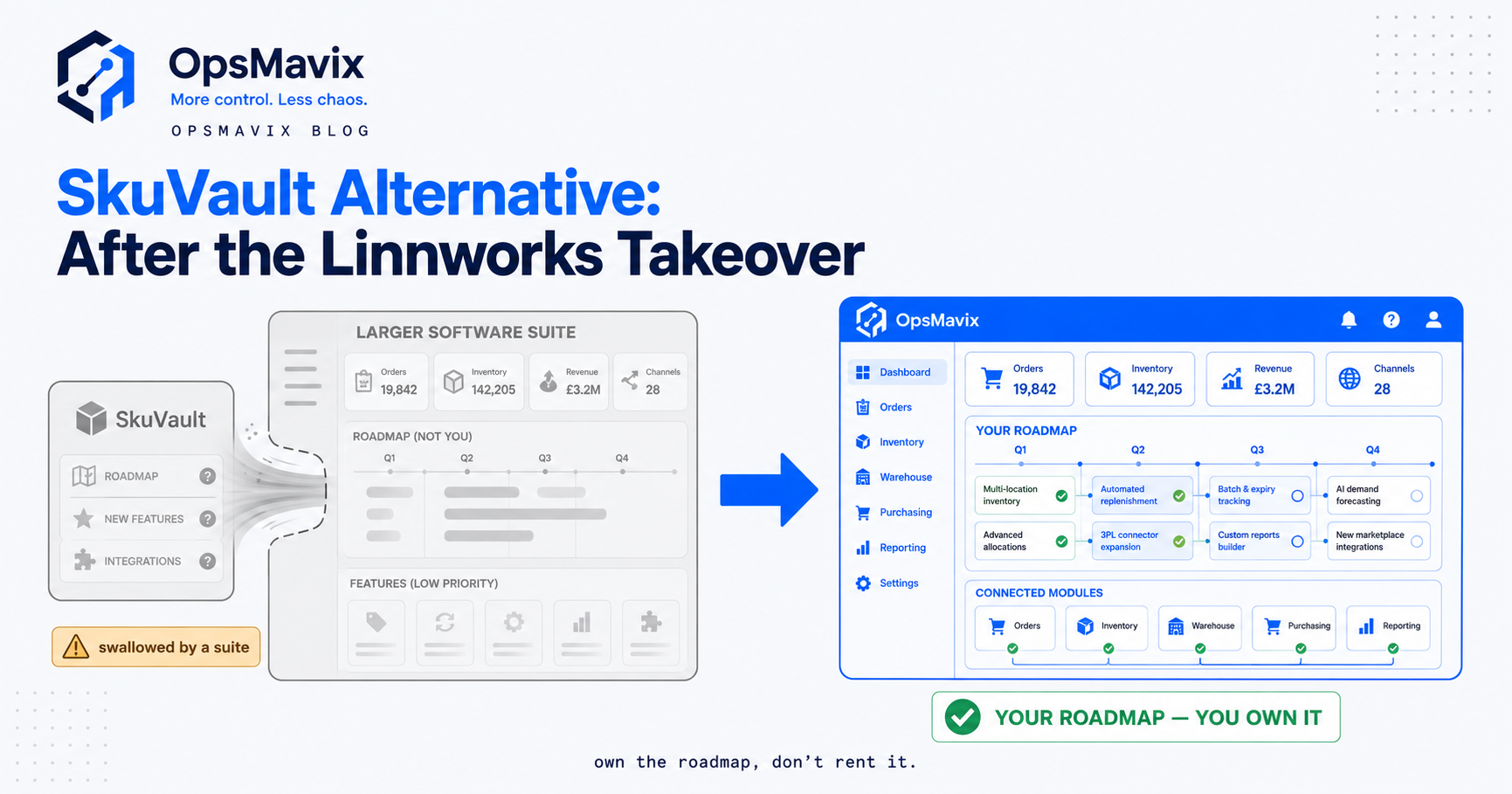
If you are hunting for a SkuVault alternative, the honest answer is that the best one is usually not another warehouse tool at all. It is one owned operations system, shaped to the way your business actually picks, packs, restocks and reports, instead of a packaged app you bend your process around. Most teams reach the “what else is out there” stage not because SkuVault counted stock badly, but because the tool now sits inside someone else’s roadmap and the fit keeps getting looser.
That is the reframe worth sitting with before you compare feature grids. Most people searching for a replacement are not unhappy with barcode scanning or cycle counts. They are quietly paying for modules they never switch on, exporting to spreadsheets to do the one report the tool will not give them, and working around a workflow that was designed for a generic ecommerce seller rather than for them. Swapping one boxed product for another rarely fixes that. It just moves the same compromise to a new login.
Key Takeaways
- The tool is fine; the fit is the problem. SkuVault does real warehouse work well. The friction is usually that your operation has outgrown a one-size product.
- Ownership changed the equation. SkuVault is no longer an independent company. Its direction is now set by Linnworks, not by SkuVault’s original team.
- Feature-swapping rarely closes the leak. Moving to another packaged inventory app keeps the same “bend your ops to the software” trade-off.
- Pricing is now quote-led. Post-acquisition, expect a sales conversation rather than a clean published price list, which makes true cost hard to compare.
- Sometimes buying is correct. For a standard multichannel seller with standard needs, an off-the-shelf tool is the sensible, cheaper call.
- The middle option is underrated. Between a spreadsheet and a full ERP sits one right-sized system you own, built around your real flow.
What SkuVault Actually Is
SkuVault is a cloud inventory and warehouse management platform originally built in Louisville, Kentucky, aimed at ecommerce and multichannel retailers. Its core job is the unglamorous, important stuff: barcode-driven receiving, putaway, picking and cycle counts, real-time stock levels synced across sales channels, and quality-control steps that cut mispicks and oversells. For a growing online seller drowning in manual stock counts, it genuinely earned its place.
Credit where it is due. The scanning-first workflow is well thought through, the quality-control and re-order logic saved a lot of teams from stockouts, and it integrated with the marketplaces and carriers most ecommerce operators actually use. As a dedicated warehouse layer, it did a specific job and did it competently.
The important change is ownership. SkuVault was acquired by Linnworks in 2022 and folded into the wider Linnworks offering, now positioned as “SkuVault Core” alongside the parent platform. That is not a criticism of the software; it is a fact about who steers it. A product that was once a focused standalone tool is now one component of a larger suite, and its roadmap, pricing and integration priorities are decided by the acquirer. If you are evaluating it today, you are really evaluating a Linnworks product. That is exactly why many buyers also weigh up a Linnworks alternative in the same search.
Where SkuVault Hits Its Ceiling
The ceiling is not in the picking. It is in everything around the edges of a packaged tool.
- Anything specific to your operation. Kitting rules, assembly or light manufacturing, unusual multi-warehouse allocation logic, customer-specific packing rules — the more your process differs from a generic ecommerce seller, the more you end up in exports and workarounds.
- Reporting that answers your questions. Standard dashboards answer standard questions. The margin-by-channel-after-returns view, or the “which SKUs are quietly bleeding us” report, usually lives in a spreadsheet you rebuild by hand.
- The joins between systems. Stock is only one part of an operation. Where inventory has to talk cleanly to purchasing, production, finance and your own internal admin, a boxed tool stops at its own boundary and leaves you gluing the gaps.
- Roadmap dependence. As a suite component, the features you care about compete for attention with everyone else’s. You wait for a parent-company backlog you do not control.
None of this makes SkuVault bad. It makes it a general product, which is fine until your operation stops being general. If your pain is multi-site allocation, our note on multi-location inventory management covers where that specifically breaks down.
The Pricing Reality
Here the honest answer is: it is harder to pin down than it used to be. In its independent days SkuVault published tiered subscription pricing aimed at small-to-mid ecommerce sellers, billed monthly per plan with volume and feature limits. Since the Linnworks acquisition, pricing has moved firmly towards a quote-led, talk-to-sales model rather than a clean public price list.
Two practical points follow, and both are in £ so you can compare like for like. First, because the numbers are now quote-based, the sticker price is only ever part of the story; onboarding, integration setup and the parent-platform bundle all move the real figure. Any headline monthly cost quoted in dollars should be read as an approximate £ figure once converted and once VAT and setup are added. Second, the honest way to judge cost is not the monthly fee at all. It is monthly fee plus the hours your team still spends in spreadsheets doing what the tool will not. A cheaper subscription that keeps three people in manual exports is not cheaper. Rather than quote a number I cannot verify, the fair statement is: treat it as a sales conversation, and cost the workarounds, not just the licence.
When SkuVault Is Genuinely the Right Choice
Buying it can be the correct decision, and pretending otherwise would be dishonest. If you are a fairly standard multichannel ecommerce seller — selling finished goods across a couple of marketplaces and a webstore, with a warehouse that needs solid barcode scanning and reliable stock sync, and no unusual assembly or reporting demands — then a packaged tool is the sensible, faster, cheaper option. You do not need something built for you to solve a problem thousands of sellers share.
The same is true if you are already committed to the Linnworks ecosystem and want the inventory layer that plugs straight in. In that case the acquisition is a feature, not a flaw, and the integration you would otherwise have to arrange is done for you. Buying beats building whenever your needs are genuinely standard. The trap is only assuming you are standard when your growing list of workarounds says you are not. For a wider view of that trade-off, our guide to fully automated inventory systems walks through what “standard” actually looks like.
The Right-Sized Middle: One Operations System
Here is the option most “alternative” searches skip. Between a spreadsheet you have outgrown and a full ERP you are not ready for sits a right-sized operations system that you own — the practical layer built around how your business already runs, rather than a product you reshape yourself to fit.
Instead of a box with modules you half-use, this is one system that models your real flow: your receiving and picking, your purchasing and reorder logic, your multi-site stock, and the exact reports you currently rebuild by hand every week. Because it is yours, its roadmap is your roadmap. No parent company decides which of your problems is worth solving, and there is no bundle of features you pay for and never open. It sits at the point OpsMavix exists for: outgrowing spreadsheets and disconnected tools. The goal is not more software. It is the leak closed — the manual exports, the oversells, the reporting gaps — for good.
This is not the right answer for everyone, and we will say so plainly when a packaged tool is the better buy. But for operations that have quietly turned their inventory tool into a spreadsheet-plus-workarounds hybrid, owning the system that matches your process is usually cheaper over three years than renting one that never quite fit. If you are weighing the broader category rather than a single tool, our overview of warehouse management software sets out the full landscape.
The Honest Build-vs-Buy Take
SkuVault is a competent warehouse tool that got absorbed into a bigger platform. If your needs are standard and you like the Linnworks direction, buy it — that is the honest call, and it will cost you less. If you are searching for an alternative because the fit keeps loosening, do not just swap it for the next boxed product with the same trade-off baked in. Cost the workarounds, be honest about how standard you really are, and then decide. The best SkuVault alternative is whichever option leaves your operation running on a system that matches it, instead of one you spend every week bending to fit.
Keep reading
Getting value from OpsMavix? Add us as a preferred source on Google — you'll see more of our operations content in your AI Overviews, AI Mode and Search.