
The Ordoro Alternative: Orders, Stock and Shipping Joined Up
Ordoro is genuinely strong shipping-and-inventory software with real dropshipping depth. But if your real leak is purchasing, production and reporting drifting apart from the pack bench, the best Ordoro alternative isn't another labels tool — it's one operations system shaped to how you actually run.
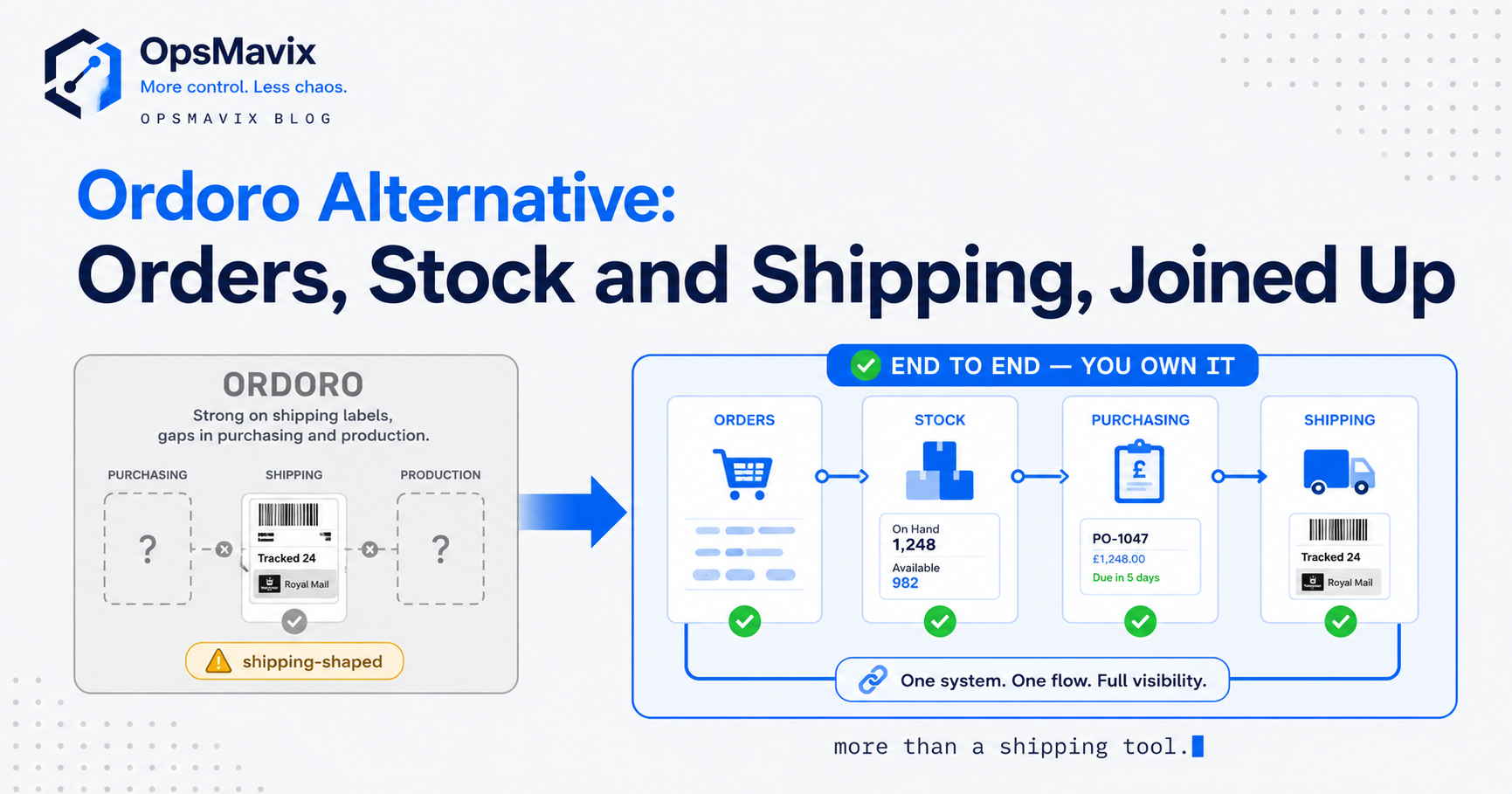
The best Ordoro alternative is usually not another shipping tool — it’s one owned operations system, shaped to how your business actually runs, that keeps orders, stock, purchasing and dispatch reading from the same numbers. Ordoro is genuinely good at the job it was built for: multichannel shipping labels, discounted carrier rates, inventory sync and some of the cleaner dropshipping automation on the market. If you’re looking to leave it, the honest first question is whether shipping was ever the part that was actually costing you.
For most people searching for an Ordoro alternative, the problem isn’t the print button or the rate-shopping — those work. It’s that the operation has quietly bent itself around a packaged ecommerce tool. Ordoro does more than labels — it has purchase orders, kitting and a bill of materials — but the depth runs out where your operation gets complicated: multi-stage production and work in progress, true landed margin per SKU across channels, financial reconciliation, and the trade orders that never came through a channel feed and get re-keyed by hand. That’s not a shipping problem, and no packaged ecommerce tool closes it. You’re either bending your operation to fit the tool, or paying for a shape that only covers part of your day.
Key Takeaways
- Ordoro is a US shipping-first platform (Austin, Texas) that does multichannel shipping, discounted rates, inventory sync and dropshipping well — validate that against your real bottleneck before switching.
- It covers more than shipping — but with a ceiling. Ordoro does have purchasing, kitting and a bill of materials; what runs out is depth — multi-stage production, true landed-margin reporting and financials sit at or beyond its edge.
- The right Ordoro alternative matches the real leak. If it’s stock accuracy, deeper production or reporting drift, you need a joined-up system, not another labels app.
- Sellers with real production or reporting depth hit the wall fastest — multi-stage builds and work in progress, true landed margin across channels, and financial reconciliation are where a packaged ecommerce tool ends.
- The middle ground is real. Between a shipping app and a full ERP sits a right-sized operations system you own — outgrowing spreadsheets and disconnected tools.
- Count the leak, not the subscription. Re-keying, reconciliation and workaround hours are the true bill, and they grow with volume.
What Ordoro Actually Is
Give it real credit first. Ordoro is a US-based (Austin, Texas) multichannel shipping and inventory platform aimed at ecommerce sellers. Its strengths are concrete: it pulls orders from marketplaces and webstores into one place, generates shipping labels, and gives small sellers access to pre-negotiated carrier rates they couldn’t get on their own. It keeps a central stock figure syncing back out to your channels, handles barcode-driven picking and packing, raises purchase orders (including auto-PO triggers off sales history) with supplier and lead-time management, supports kitting, a bill of materials and manufacturing orders, and — the part it’s genuinely known for — automates dropshipping, routing orders to suppliers and tracking them without the manual back-and-forth that usually makes dropshipping painful.
If your operation is shaped around shipping and supplier-fulfilled orders — you sell across a few channels, rate-shopping matters, and a chunk of your catalogue ships direct from suppliers — Ordoro is a sound, honest answer. Replacing software that genuinely fits is its own kind of leak. The only question worth asking is whether that shape is still yours.
Where Ordoro Hits Its Ceiling
The ceiling is set by depth and shape, not by a missing feature list. Ordoro genuinely does purchasing and production — POs, auto-PO triggers, supplier lead times, kitting, a bill of materials and manufacturing orders. The limit is how far those go before a growing operation needs more than the packaged version, and how much of your process you have to bend to fit the tool.
Production is where it shows first. Kitting and a basic bill of materials cover bundling and simple assembly, but multi-stage builds, work in progress across several steps, capacity and scheduling, and shop-floor tracking are beyond an ecommerce-grade model — so anything past “combine these components into that finished good” drifts back into a spreadsheet. Reporting is the second. Ordoro answers “what did I ship” far better than “what’s my true landed margin per SKU across channels after carriage, fees and returns,” so that answer gets rebuilt from exports every month. And financials — reconciliation, proper cost accounting, multi-entity — sit outside it entirely, because it was never meant to be your books.
Each gap becomes a side-spreadsheet, and every side-spreadsheet is a second place the truth can diverge — no audit trail, a single point of failure, silent errors. You end up with a fast, tidy shipping desk bolted to a slow, manual back office, and the fast bit only makes the slow bit more obvious.
The Pricing Reality
Ordoro prices in US dollars, tiered by capability rather than one flat fee. There’s a low-cost entry tier focused on shipping, with inventory management, advanced automation and dropshipping features moving you up into higher-priced monthly plans, and carrier discounts layered on top. Because those figures are set in USD and change over time, treat any headline number as needing a live check and a currency conversion — a US monthly plan converts to a different, moving £ figure each time the exchange rate shifts, so budget against the model, not a snapshot.
The mechanic that matters more than any figure: you pay for the tiers you need to switch on, and the parts of your operation Ordoro doesn’t cover — purchasing, production, the reporting you rebuild by hand — aren’t in the price because they aren’t in the tool. That cost hasn’t gone away; it’s just moved off the invoice and onto your team’s week. The honest sum is the subscription plus the hours the tool doesn’t touch, measured against a fixed-cost system you’d own outright.
When Ordoro Is Genuinely the Right Choice
Sometimes buying it is simply correct, and we’ll say so plainly. If your friction is shipping — you dispatch across several channels, rate-shopping is painful, and cheap carrier access is the win — Ordoro earns its keep. If a meaningful slice of your catalogue is dropshipped, its supplier-routing automation is one of the better answers going, and rebuilding that from scratch would be effort for no gain.
The test is whether the tool going away would fix anything. If your stock is clean, purchasing has a real process elsewhere that works, you don’t assemble or manufacture, and your reports already answer your questions — then Ordoro fits the shape of your operation, and a switch is a downgrade dressed up as an upgrade. Low complexity, shipping-centred, supplier-fulfilled: rent it, with a clear conscience.
The Right-Sized Middle: One Operations System
The mistake is swapping one packaged shipping tool for another and expecting the disconnected back office to fix itself. If Ordoro’s ceiling is that it’s built around shipping and dropshipping, the answer isn’t a clone with a different logo — it’s a system shaped around how your whole operation runs, that you own.
That means one place where channels and trade orders feed in and get entered once, validated so wrong codes and quantities can’t slip through. One true stock figure every channel reads from, decremented the instant anything sells. Purchasing and production modelled to your actual depth — multi-stage builds, work in progress and reorder logic that fit how you really make and buy, not the ecommerce-grade version you conform to — which is the ground a supplier order management system and a real operations control system are built on. Keep Ordoro as the shipping and dropshipping layer if it’s earning its place; fix the manual mess around it. That’s the practical layer between a spreadsheet and an ERP — outgrowing the first, not ready for the second — and the endgame is close to what a fully automated inventory system removes from your week.
The Honest Build-vs-Buy Take
If shipping is your only real friction, keep Ordoro — it’s good at it, and replacing working software is a step backwards. If you need a genuine enterprise ERP with full finance, deep manufacturing and multi-entity accounting, buy one and budget properly for the implementation.
But most people searching for an Ordoro alternative are neither. They’ve outgrown a shipping-first tool and they’re nowhere near needing a full ERP. That’s the middle: an operations system sized to how you actually work, keeping the shipping you like and closing the manual gaps around it — purchasing, production, one honest set of numbers — that you own outright, so it bends to your process instead of bending your process to a shipping tool’s centre of gravity. Name the real leak first. If it’s labels, you already have your answer. If it’s everything upstream and downstream of the labels, that’s the conversation worth having.
Keep reading
Getting value from OpsMavix? Add us as a preferred source on Google — you'll see more of our operations content in your AI Overviews, AI Mode and Search.