
Preventive Maintenance Software: Scheduling Repairs Before They Become Breakdowns
Preventive maintenance is servicing equipment on a planned schedule — by calendar time or by usage — so it gets attention before it breaks, not after. Most small manufacturers run their machines to failure and pay for it in stopped lines. Here's how time-based and meter-based PM schedules, a real asset register, maintenance work orders with checklists, and the right spares on the shelf move you off the breakdown treadmill.
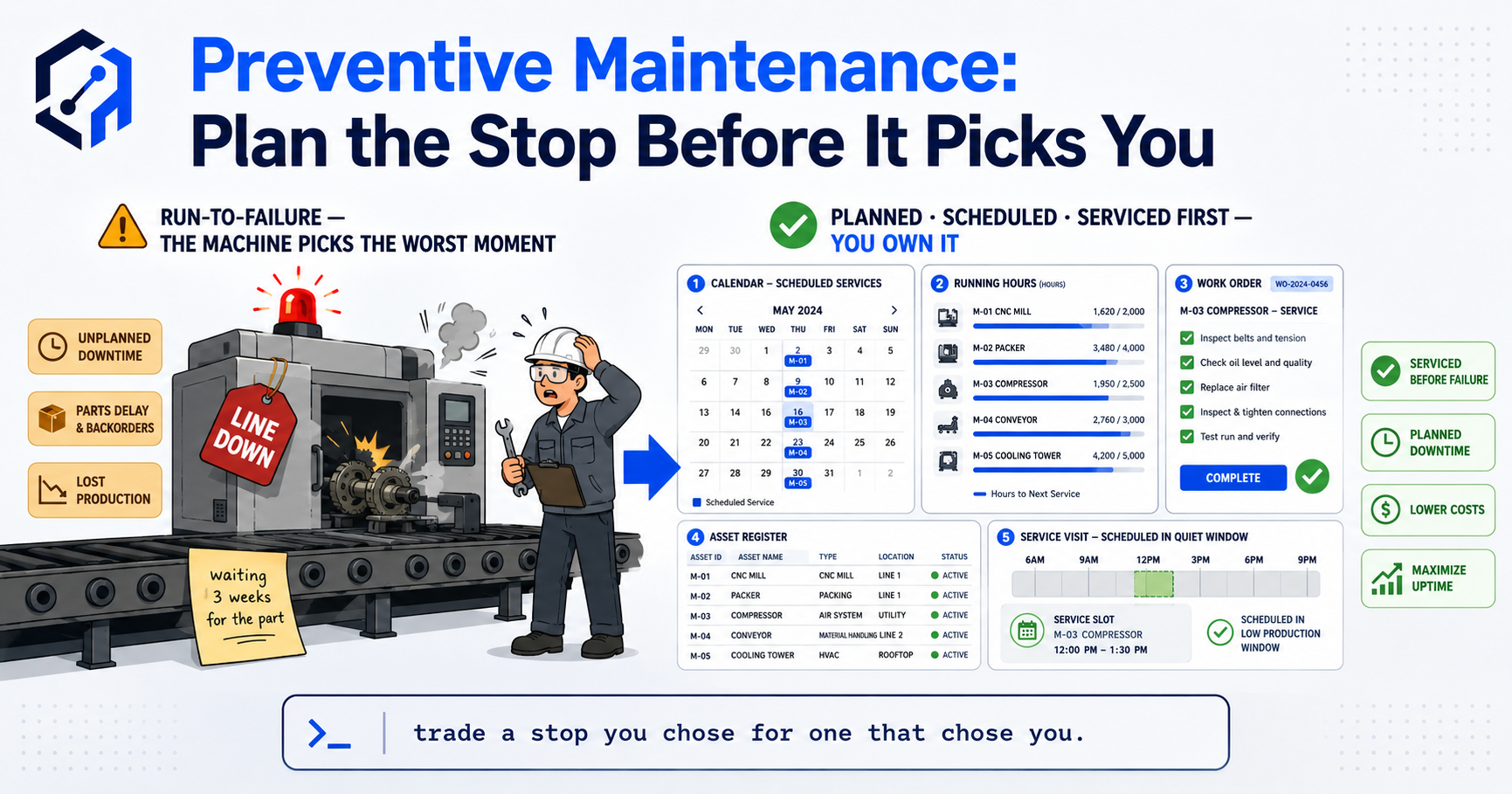
Preventive maintenance is servicing a machine on a planned schedule — set either by calendar time or by how much the machine has been used — so it gets inspected, cleaned, lubricated or have parts replaced before it fails, rather than after. It’s the difference between changing a bearing during a quiet Tuesday slot you chose and changing it at 2pm mid-run when it seizes and stops the whole line. The work is roughly the same. The cost of when you do it is not.
Most small manufacturers don’t work this way. They run equipment until something breaks, then scramble. Maintenance is a fire brigade, not a schedule — a phone call to the engineer, a wait for the part, a line standing idle while everyone stares at it. The knowledge of what needs doing lives in one person’s head, and the record of what was last done to which machine lives nowhere at all. Preventive maintenance software is the shift from reacting to breakdowns to planning them out of existence, and for a business losing production hours to surprise failures, it’s one of the cheapest big wins on the floor.
Key Takeaways
- Preventive maintenance is planned, scheduled upkeep — servicing before failure — as opposed to run-to-failure, where you fix things only once they’ve stopped.
- Schedules come in two flavours: time-based (every 30 days, every quarter) and usage/meter-based (every 500 running hours, every 10,000 cycles). Most floors need both.
- An asset register is the foundation. You can’t schedule maintenance for machines you haven’t listed, with their make, model, service history and current meter reading.
- Maintenance work orders with checklists turn “service the press” into a repeatable, tickable job any engineer can do the same way, with a record left behind.
- The right spares on the shelf are what let planned maintenance actually happen on schedule instead of waiting three weeks for a part.
- The whole point is cutting unplanned downtime — trading a stop you chose for a stop that chose you, when the line was full.
1. Run-to-Failure vs Preventive vs Predictive
There’s a ladder of maintenance strategies, and most small manufacturers are standing on the bottom rung without realising there’s a ladder. The bottom is run-to-failure: use the machine until it breaks, then repair it. It feels cheap because you’re not “wasting” time servicing things that still work. It isn’t cheap. It just moves the cost to the worst possible moment — when the machine is mid-job and the failure takes the line with it.
The middle rung is preventive: you service on a schedule, before failure, based on time or usage. You accept some “unnecessary” servicing of parts that had life left, in exchange for far fewer surprise stops. The top rung is predictive — sensors watching vibration, temperature or current draw, telling you a bearing is degrading before it fails, so you service exactly when needed and not a moment sooner. Predictive is powerful but it’s a bigger investment, and you don’t start there. You get preventive working first, because a business that can’t reliably do a scheduled 30-day service has no business wiring up vibration sensors it won’t act on.
2. Time-Based PM Schedules
The simplest preventive schedule is the calendar. Every machine gets a set of recurring tasks pinned to time: lubricate weekly, inspect belts monthly, full service every quarter, replace the filter every six months. The software’s job is to hold that schedule, count down to each due date, and put the task in front of a person before it lapses — not to email a reminder into a void, but to raise an actual work order that shows up on someone’s list.
Time-based works well for anything that degrades with the passage of time regardless of use: seals that perish, lubricants that break down, calibrations that drift. It’s also the easiest to plan around, because you know the dates in advance and can slot the work into quiet periods. The trap is treating every machine the same. A press running three shifts a day and an identical one running two days a week should not be on the same 30-day service clock — the heavily-used one is wearing far faster than the calendar suggests. Which is exactly why time alone isn’t enough.
3. Usage and Meter-Based PM Schedules
The other way to trigger maintenance is by how much the machine has actually done. Every 500 running hours. Every 10,000 cycles or strokes. Every 5,000 units produced. This is meter-based or usage-based PM, and it’s the honest measure of wear for anything whose life is driven by work done rather than time passed. A machine that sat idle for a month hasn’t worn its bearings; one that ran non-stop has. Meter-based scheduling reflects that reality where the calendar can’t.
The catch is you need the meter reading to flow in. That means either the machine reports its running hours or cycle count, or someone records it — and if you’re already capturing machine activity for production downtime tracking or an OEE monitoring system, that same signal can drive your PM triggers. One maintenance manager we spoke to described the win of connecting the two: “The moment the counter hit the service interval, the work order appeared on my board on its own. I stopped having to remember, and I stopped guessing at the hours.” Most real floors end up running both models side by side — time-based for the things that perish, meter-based for the things that wear.
4. The Asset Register: You Can’t Maintain What You Haven’t Listed
Underneath every preventive maintenance system is a boring, essential thing: a register of every asset you intend to maintain. Not a vague sense of “the machines” — an actual list. Each entry carries the make and model, a unique ID or asset tag, its location, its criticality to production, its current meter reading, and its service history. Without it, “schedule maintenance” is a sentence with no subject. You’re trying to plan care for equipment you haven’t even enumerated.
The service history is the part that pays off slowly and then all at once. When you can see that this specific pump has had the same seal replaced three times in eighteen months, you stop treating each failure as a one-off and start asking why this pump keeps eating seals — a question run-to-failure never lets you ask, because nobody’s holding the pattern. A factory owner described the before-state well: “If an engineer left, the maintenance knowledge left with him. There was no book. It was all in his head, and when he retired we were flying blind for a year.” The asset register is where that knowledge lives so it isn’t tied to one person’s memory.
5. Maintenance Work Orders and Checklists
A schedule that says “service due” isn’t enough. What actually needs doing? Preventive maintenance runs on work orders — a specific job raised for a specific asset, with a checklist of the exact steps: check this, clean that, torque to this figure, replace this part, record this reading. The checklist turns a service from an experienced engineer’s improvisation into a repeatable procedure any competent person can follow the same way, every time, and leave a record they did.
That repeatability is what makes maintenance a system rather than a personality. The work order captures who did the job, when, what they found, which parts they used, and whether anything needs following up. Over time those completed orders become the service history in the asset register, and the loop closes. This sits right alongside the wider job-tracking discipline in a manufacturing execution system: the same instinct to make work visible, standardised and recorded rather than trusting it happens correctly in the background.
6. Spares: The Part That Makes the Schedule Real
A preventive schedule is worthless if the part isn’t on the shelf when the job comes due. This is where a lot of maintenance ambition dies quietly — the work order says “replace filter,” the filter isn’t in stock, the job slips, and three slipped jobs later you’re back to run-to-failure without having decided to be. Preventive maintenance has a supply chain, and it’s the spares for the jobs you know are coming.
The advantage of planned maintenance is that it makes spares predictable. Because you know a filter changes every six months and you have twelve machines, you know roughly how many filters you’ll consume a year and can hold a sensible min level rather than panic-ordering at a premium when something’s already down. Critical spares — the expensive, long-lead part for the machine that stops everything if it fails — deserve their own decision: is it cheaper to hold one on the shelf, or to accept the days of lost production while it ships? Run-to-failure never lets you make that call in the calm. It makes it for you, at the worst time, at the highest price.
7. How Planned Maintenance Cuts Unplanned Downtime
Here’s the whole argument in one line: every hour of planned maintenance you do is a bet against a much more expensive hour of unplanned downtime later. A scheduled bearing change might cost you 40 minutes in a slot you chose, on a machine you stopped on purpose, with the part ready and the engineer booked. The same bearing failing on its own costs you the 40-minute repair plus the scramble to find the part, plus the hours the line stood idle waiting, plus whatever the stopped machine was holding up downstream. Same repair, wildly different bill.
That doesn’t mean maximum maintenance is the goal — over-servicing burns money and machine availability on parts that had life left. The art is tuning each schedule to the real failure pattern, which is why the asset register and service history matter so much: they tell you whether you’re servicing too often, too rarely, or about right. Measuring the downtime you do still suffer, and reading which failures keep recurring, is its own discipline — that’s what production downtime tracking is for, and it’s the feedback loop that tells you whether your PM schedule is actually working. Preventive maintenance is the plan; downtime tracking is how you check the plan against reality.
FAQ
What’s the difference between preventive and predictive maintenance?
Preventive maintenance runs on a fixed schedule — time or usage — servicing before failure whether or not the machine shows any sign of trouble. Predictive maintenance uses sensor data (vibration, temperature, current) to service only when a component actually shows signs of degrading. Predictive is more precise but needs more investment and data maturity. Nearly every small manufacturer should get preventive working reliably first.
How do I decide between time-based and meter-based schedules?
Use time-based for things that degrade with the passage of time regardless of use — perishing seals, degrading lubricants, calibration drift. Use meter-based for things that wear with work done — bearings, cutting tools, anything driven by cycles or running hours. Most floors run both, with different tasks on each machine triggered by whichever measure actually predicts that task’s wear.
Do I need dedicated software, or will a spreadsheet do?
A spreadsheet can hold an asset list and a schedule, but it can’t chase you. It won’t raise a work order when a service comes due, won’t stop the task lapsing when everyone’s busy, and won’t build a service history you can trust. The value of software is that the schedule acts on its own instead of relying on someone remembering to check the sheet — which, on a busy floor, they won’t.
How is this different from tracking downtime?
Preventive maintenance is about scheduling work to stop breakdowns before they happen. Downtime tracking is about measuring and logging stops after they occur, so you can see which failures keep recurring and how much they cost. They’re two halves of a loop: PM prevents, downtime tracking measures, and the measurements tell you how to tune the PM. You want both, but they’re separate jobs.
Where do I even start if we currently run everything to failure?
Start with the asset register — list every machine that matters, with make, model and current condition. Then pick your handful of most critical machines, the ones that hurt most when they stop, and put a basic time-based schedule on them. Get that working and recorded before expanding. Trying to schedule every asset at once usually collapses; a few critical machines maintained properly beats a full plan nobody follows.
How OpsMavix Can Help
Most maintenance problems on a small floor aren’t really about maintenance — they’re about the absence of a system to hold the schedule, the asset history and the spares in one place that acts without being nagged. The knowledge lives in one engineer’s head, the schedule lives on a whiteboard that’s always out of date, and the spares situation is a surprise every time. So the floor drifts back to run-to-failure by default, not by choice.
OpsMavix builds custom internal systems for exactly this: an asset register that holds the real history, PM schedules that trigger on both time and machine usage, work orders with checklists that leave a record, and spares levels tied to the maintenance you know is coming — connected to the rest of your operation, from production downtime tracking to your wider manufacturing production tracking, rather than bolted on as another disconnected tool. We don’t sell you a maintenance app to configure yourself; we build the system around how your floor actually runs. If surprise breakdowns keep stopping your line, the first step is seeing where they’re costing you.
Keep reading
Getting value from OpsMavix? Add us as a preferred source on Google — you'll see more of our operations content in your AI Overviews, AI Mode and Search.