
Normal Job Costing Explained: Actual Costs, Applied Overhead, and Why It Exists
Normal job costing charges each job with actual direct materials and actual direct labour, then applies overhead using a predetermined (budgeted) rate. It exists because real overhead figures arrive too late to price and invoice jobs on time. Here is how it works in practice and where the messy bits hide.
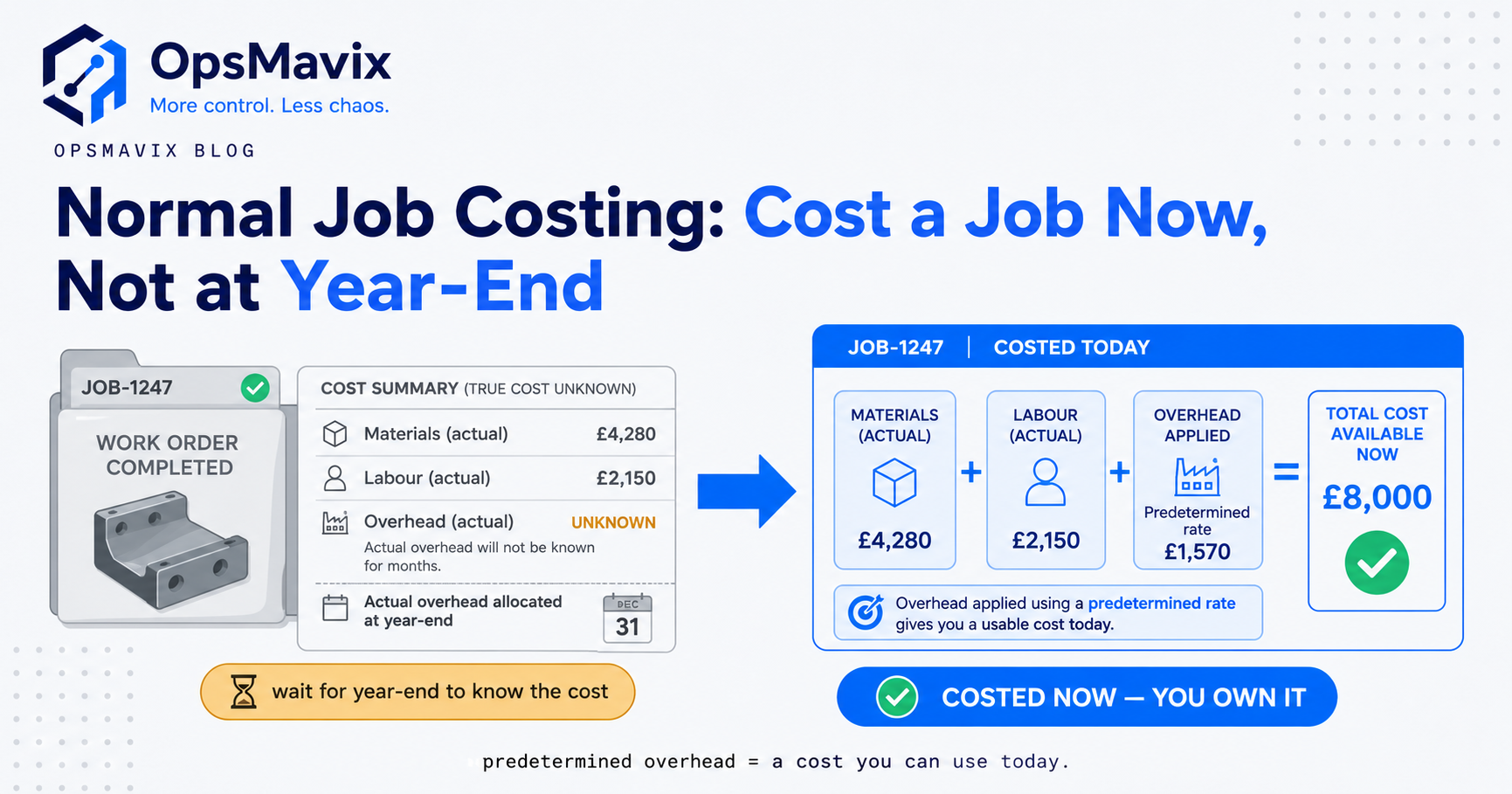
Normal job costing charges each job with its actual direct materials and actual direct labour, then adds overhead using a predetermined (budgeted) overhead rate rather than the real overhead figure. That one substitution is the whole method. You use real numbers where you can get them quickly (materials and labour hit the job as they happen) and a pre-agreed rate where you cannot (overhead, which only settles at period-end).
It exists for one reason: timing. If you waited for actual overhead before costing a job, you could not price, invoice, or judge profit until the accounts closed weeks later. Normal costing lets you cost a job the day it finishes. This post is the practical version of that idea, not the textbook one, and it sits under our hub on what job costing is.
Key Takeaways
- Normal costing is a hybrid. Actual direct materials plus actual direct labour plus applied overhead, where overhead uses a budgeted rate set before the year starts.
- The predetermined rate is the trick. Budgeted overhead divided by a budgeted activity base (labour hours, machine hours, or labour cost) gives a rate you can apply the moment a job records activity.
- It exists for timeliness. Actual overhead only lands at period-end. Normal costing lets you cost, price, and invoice jobs without waiting.
- It sits between two extremes. Actual costing uses real overhead (accurate but late). Standard costing uses budgeted everything (fast but detached). Normal costing splits the difference.
- Over- and under-applied overhead is expected. The applied figure rarely matches actual. The gap is normal and gets cleared at period-end, not ignored.
- The rate is only as good as its base. A wrong activity base or a stale annual rate quietly mis-costs every job that passes through.
What normal job costing actually is
Three ingredients go onto a job:
- Direct materials — actual cost of what was physically issued to the job.
- Direct labour — actual cost of the hours people booked to the job.
- Manufacturing overhead — not actual. Applied using a predetermined rate.
The first two are traced. Someone picks material against a works order; someone books hours against a job number. Those are real, job-specific figures, and they land on the job as the work happens.
Overhead is the problem child. Rent, supervision, machine depreciation, factory electricity, indirect materials — none of it belongs to one job, and none of it is known precisely until the period closes. So normal costing does not wait. It applies overhead using a rate agreed in advance.
The predetermined overhead rate
The rate is set before the period begins, usually annually:
Predetermined overhead rate = budgeted overhead ÷ budgeted activity base
The activity base is whatever best drives your overhead. Common choices:
- Direct labour hours — for labour-heavy shops.
- Machine hours — for automated or CNC-heavy production.
- Direct labour cost — simple, but skewed if wage rates vary a lot.
Say you budget £480,000 of overhead for the year and expect 24,000 machine hours. Your rate is £20 per machine hour. A job that uses 30 machine hours gets £600 of overhead applied. You did not wait to find out what electricity actually cost that month. You applied £20 an hour and moved on.
That is the entire mechanism. Everything else is bookkeeping around the edges.
Why normal costing exists (the timing argument)
Actual overhead is a period-end number. You cannot know the true overhead cost of a job in March until March’s accounts are closed, allocations run, and the totals settle. For a jobbing shop finishing several jobs a week, that is useless. You need to invoice on Friday, not in April.
Normal costing trades a little precision for a lot of timeliness. The direct costs are real, so the bulk of the job cost is accurate. Only the overhead slice is estimated, and it is estimated with a rate you deliberately calibrated. That is a good trade for almost every operation that runs discrete jobs.
Normal vs actual vs standard costing
The three methods differ only in how real each cost component is.
- Actual costing: actual materials + actual labour + actual overhead. Most accurate, hopelessly late. You cannot cost a job until the period closes.
- Normal costing: actual materials + actual labour + applied overhead (budgeted rate). Direct costs real, overhead estimated. Timely and close enough.
- Standard costing: standard (budgeted) materials + standard labour + applied overhead. Everything is a pre-set standard; you then analyse variances against reality. Great for repetitive high-volume production, blunt for one-off jobs.
Put simply: actual costing waits for everything, standard costing pre-decides everything, and normal costing waits only for the two things that arrive quickly.
That is our honest point of view: most owner-run manufacturing and fabrication businesses that think they “should” do standard costing are actually better served by normal costing. Standard costing earns its keep when you make the same thing thousands of times and want variance discipline. A jobbing shop making different things every week does not have that repetition to lean on.
Over-applied and under-applied overhead
Because the rate is budgeted, applied overhead will not equal actual overhead. This is expected, not a fault.
- Under-applied: you applied less overhead to jobs than you actually incurred (you were busier or costlier than budget assumed). Real costs were understated on jobs.
- Over-applied: you applied more than you incurred. Jobs carried slightly too much overhead.
At period-end the difference is cleared, usually written off to cost of goods sold if immaterial, or prorated across work-in-progress, finished goods and cost of sales if large. The key operational point: a persistent gap is a signal. If you are under-applying every month, your budgeted rate is stale and every job you quoted this year was priced light.
Where normal costing quietly breaks in real operations
The maths is easy. The failure is always in the plumbing.
Labour hours never get booked. The rate assumes hours land on the right job. In practice a fabricator finishes a weld, forgets the timesheet, and three hours vanish into “general.” The job looks more profitable than it was, and next time you quote it too low.
Materials get issued off-system. Someone grabs stock from the rack without recording it against the job. Direct materials — the one component that is supposed to be actual — quietly becomes an estimate too.
The rate is set once and forgotten. A predetermined rate is only fair for the assumptions behind it. Add a machine, lose a shift, or watch energy prices jump, and last year’s £20-an-hour rate is fiction. We regularly see overhead rates that haven’t been reviewed in years, meaning every quote in that time carried an overhead figure calibrated for a different business.
Spreadsheets can’t reconcile. When jobs live in one sheet, timesheets in another, and stock issues in a third, nobody actually confirms that applied overhead reconciles to the general ledger. The over/under-applied number is never calculated, so the drift is never caught.
Normal costing is only as honest as the data feeding it. The method is sound. The leak is upstream — in whether labour and materials actually reach the job record at all. That is the same gap our job costing software guidance keeps returning to, and it is why how to calculate job costing is the easy half of the problem.
A £-cost way to think about it
Imagine a shop running 300 jobs a year at an average £4,000 cost. If un-booked labour and off-system material issues understate each job by even 6%, that is £240 of hidden cost per job — £72,000 a year of work that was done but never landed on a job record. You did not lose the money on the shop floor. You lost it in the gap between the work happening and the number reaching the costing system. Normal costing does not create that gap, but it cannot fix it either. Only capturing the actuals reliably can.
Build, buy, or run your own system
You can run normal costing in a spreadsheet, and plenty of shops do. It works right up to the point where the volume of jobs, timesheets and stock movements outpaces the person keeping the sheets aligned. After that, the method stays correct while the data underneath rots.
Dedicated job-costing or ERP software fixes the data capture but often drags in a full manufacturing suite you did not want and cannot configure without a consultant. That is the real trade-off: too little structure and the numbers drift; too much and you are running someone else’s process.
The middle path is a system shaped to how your jobs, hours and stock already move — one place where materials get issued against a job, hours get booked against a job, and the predetermined rate applies overhead automatically, so over- and under-applied overhead is a number you see monthly instead of a surprise at year-end. Not a spreadsheet you police by hand, not an ERP you bend yourself to fit. Normal costing was designed to give you timely job costs. It only does that when the actuals actually arrive.
Keep reading

Getting value from OpsMavix? Add us as a preferred source on Google — you'll see more of our operations content in your AI Overviews, AI Mode and Search.