
Manufacturing PO Tracking System: Stop Material Shortages Stopping Jobs
In manufacturing, a purchase order isn't a purchasing task — it's a material a job is waiting on. A manufacturing PO tracking system links every open PO to the works order it feeds, so a late or short delivery is a flagged risk before it becomes a stopped line. Here's what that link gives you that a generic PO log can't.
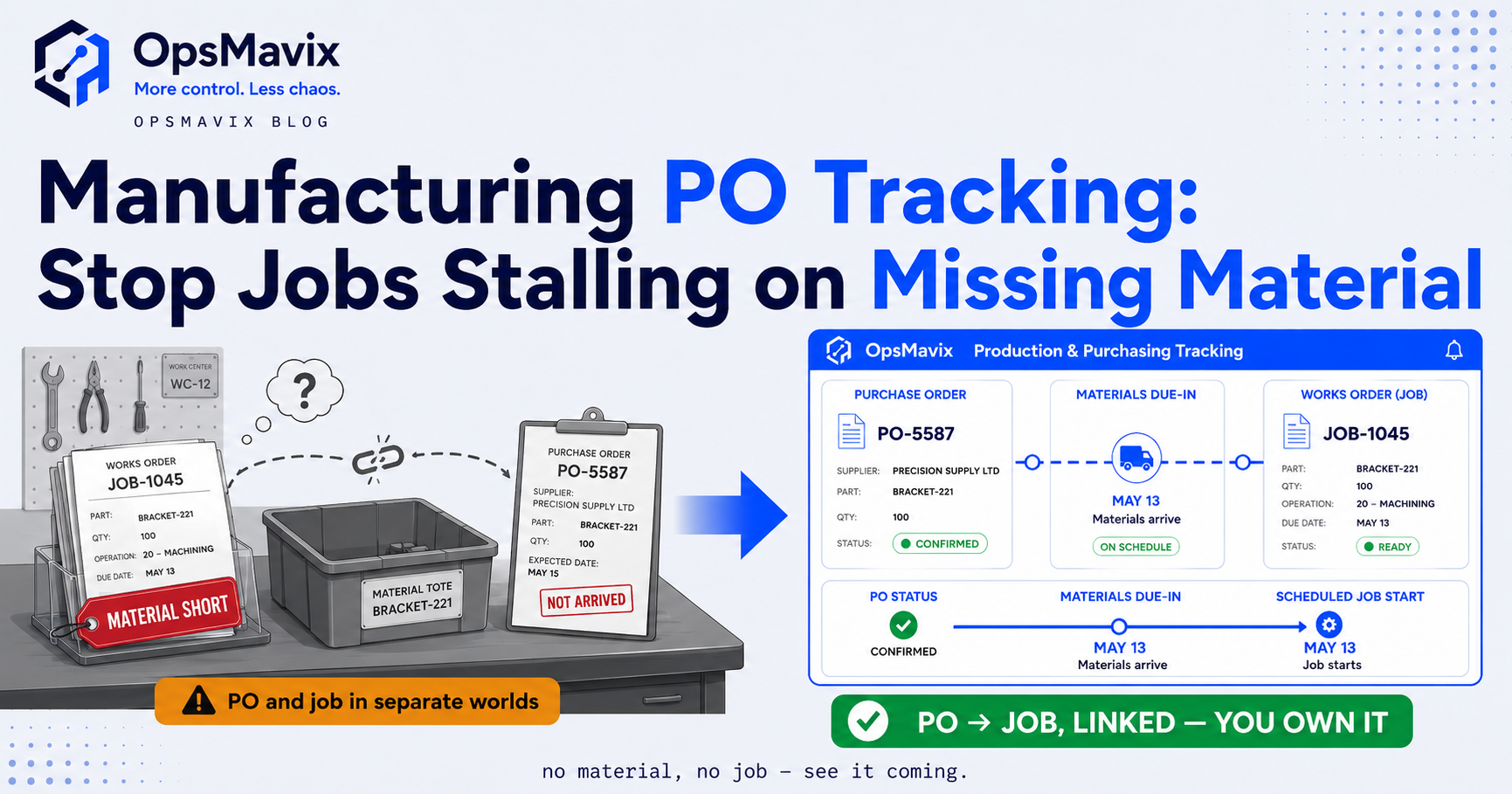
A manufacturing PO tracking system links every open purchase order to the works order it feeds, so a late or short material delivery is flagged as a job-at-risk before it turns into a stopped line on the floor. That link is the whole point, and it’s the thing a generic PO tracker doesn’t have. In a distribution business a late PO means stock arrives late. In a factory a late PO means a job can’t start — or worse, starts, gets half-built, and then stalls waiting on the one component that didn’t turn up. The purchase order stops being a purchasing task and becomes a dependency the production schedule is standing on.
This is a manufacturing-specific problem, so it needs a manufacturing-specific answer. The general purchase order tracking system covers the shared discipline — which POs are open, what’s due when, what arrived short. This post is about the extra join that only matters when POs feed production: tying each incoming order to the job it supplies, and reading material shortage as a schedule risk instead of a purchasing footnote.
Key Takeaways
- A manufacturing PO tracking system links POs to works orders — so every open order carries the job it feeds, and a late delivery reads as a stopped job, not just late stock.
- The leak in a factory isn’t late stock, it’s stalled production — a job that can’t start, or half-builds and stops, costs machine time and labour, not just a reorder.
- Material shortages should surface at planning, not at the bench — if the shortage shows up when an operator reaches for a part that isn’t there, the system found it too late.
- Part-receipts hit harder in manufacturing — a PO that’s 90% delivered can still be 100% blocking if the missing 10% is the one component the job needs.
- A generic PO log can’t see the job — it tracks the order in isolation, so it never tells you which production runs a late supplier is about to stop.
- Right-sized means the PO, the works order and stock share one view — not three tools that each know a fragment and none of which raise the alarm.
Why Manufacturing PO Tracking Is a Different Job
Track a purchase order in a wholesale business and the question is “when will the stock arrive?” Track one in a factory and the real question is “which job is this holding up?” Same order, completely different stakes. The order isn’t feeding a shelf a customer buys off; it’s feeding a works order that’s already scheduled, that has machine time booked and people rostered against it. Miss the delivery and you don’t just delay a sale — you leave a slot on the line empty, or you tie up a half-finished assembly waiting for one part.
That’s why generic PO tracking, good as it is, stops short here. It follows the order beautifully — sent, overdue, part-received, closed — but it treats the PO as an island. It doesn’t know the order exists because a works order needs the material, so it can never tell you the thing that matters most on the floor: this late supplier is about to stop that job on Thursday.
Linking the PO to the Works Order It Feeds
The core of manufacturing PO tracking is a link most systems never make: every purchase order carries the works order — or orders — it supplies. When you raise a PO for material against a scheduled job, that job’s identity travels with the order. So the open-PO list isn’t just “what’s inbound”; it’s “what’s inbound, and what’s waiting on it.”
That link changes what a late delivery means. On a generic tracker, an overdue PO is a chase — annoying, but abstract. With the works-order link, an overdue PO is a named job at risk, with a start date you can read against the promised delivery date. You’re not asking “is this order late?” You’re asking “does this job still start on time?” — and the system answers it before anyone walks to the bench.
It also runs the other way. Look at a works order and you can see every material it depends on, which POs cover them, and whether any of those POs are late. Planning a run stops being an act of faith. Planners describe the failure mode often enough: a job gets released, then mid-build a component turns out never to have been coming, because the PO was late and nobody connected it to the job until the operator hit the gap. The link closes that gap before the job is released, not after.
Material Shortages: Catch Them at Planning, Not at the Bench
The most expensive place to discover a material shortage is at the workstation, when an operator reaches for a part that isn’t there. By then the job’s released, the schedule’s committed, and the only options are to stop the line or scavenge parts off another job — which just moves the shortage down the queue. A manufacturing PO tracking system exists to move that discovery upstream: to the moment you plan the run, while there’s still time to react.
The mechanism is the join between the works order’s material requirement, current stock, and open POs. Before a job is released, the system can answer whether every component is either on hand or covered by a PO that lands in time. Anything that isn’t becomes a flagged shortage — visible in planning, not at the bench. That’s a scheduled conversation with a supplier days out, versus a fire drill on the floor.
Consider the £-shape of it. A late £400 PO for a bracket sounds like a £400 problem. But if that bracket stops a job that has a full shift of labour and a CNC cell booked against it, the real cost is the idle capacity — the shift you paid for and couldn’t run, plus the downstream jobs that shuffle back behind it. Operators tell us the material was rarely the expensive part; the stopped job around it was. Tracking the PO against the works order is what puts a number on that risk before it lands.
Part-Receipts Bite Harder on the Floor
A part-delivered PO is a nuisance in any business. In manufacturing it can be a total block. A supplier who ships 90 of 100 fasteners has, on a generic tracker, mostly delivered — the balance is small, the order looks nearly done. But if the job needs all 100, or if the missing 10 are the specific variant the assembly calls for, that PO is 100% blocking despite being 90% received. Percentage complete is the wrong measure; what the job needs is the right one.
Manufacturing PO tracking reads receipts against the works order’s actual requirement, not just against the order total. A part-receipt stays flagged as a shortage-in-effect if the outstanding balance is on the critical path of a scheduled job. The order can be “nearly complete” and the job can still be “cannot start” — and the system holds both truths at once instead of letting the reassuring order-level number hide the job-level block. This is the same discipline the works order processing side depends on: a job is only ready when every material it lists is genuinely available, not when the POs are mostly in.
Where Tracking Starts: Requisition to PO to Job
Good manufacturing PO tracking starts before the PO exists. Production drives the demand — a scheduled works order needs material, that need becomes a purchase requisition, and the requisition becomes a PO carrying the job it was raised for. Track that whole chain and the works-order link is native, not bolted on afterwards: the order knew which job it fed from the moment someone asked for it.
Break the chain and you get the common factory failure — purchasing raises POs off a reorder list or a gut feel, disconnected from the actual production schedule, so nobody can say which job any given order supports. The material arrives, or doesn’t, and the connection to the run has to be reconstructed by memory. Keeping requisition, PO and works order on one thread is what lets the system answer “which jobs are exposed?” instead of leaving a planner to work it out order by order.
Build, Buy, or Own the System
The honest read on build-versus-buy here. If you run a handful of jobs a month with material off the shelf and reliable local suppliers, you don’t need any of this — a shared schedule and a good PO log will hold, and building a system for that is solving a problem you don’t have yet. Full MRP suites sit at the other end: they do this and a great deal more, and if you’re at the scale and complexity that justifies one, that’s the right road.
The gap in the middle is where most growing manufacturers actually live — too many jobs and too much supplier variability for a spreadsheet to track by hand, but nowhere near ready to run their operation inside a heavy MRP platform. That’s the space a right-sized manufacturing production tracking system fills: the works-order link, the shortage flag at planning, the part-receipt that stays honest against what the job needs — tied to how you already schedule and buy, and owned outright rather than rented as a black box that can’t see your floor.
The measure isn’t a slicker purchase order. It’s the Thursday job that started on time because the late bracket got chased on Monday, back when it was still a line on a screen and not a team standing at an idle bench.
Keep reading

Getting value from OpsMavix? Add us as a preferred source on Google — you'll see more of our operations content in your AI Overviews, AI Mode and Search.