
Kanban 2 Bin System: How the Two-Bin Method Actually Works
A kanban 2 bin system is the simplest pull method there is: draw from one bin, and the moment it runs dry, that empty bin is your order signal. Here's how the two-bin method actually works, where it earns its place, where it quietly fails, and how to move from paper cards to a signal you can't lose.
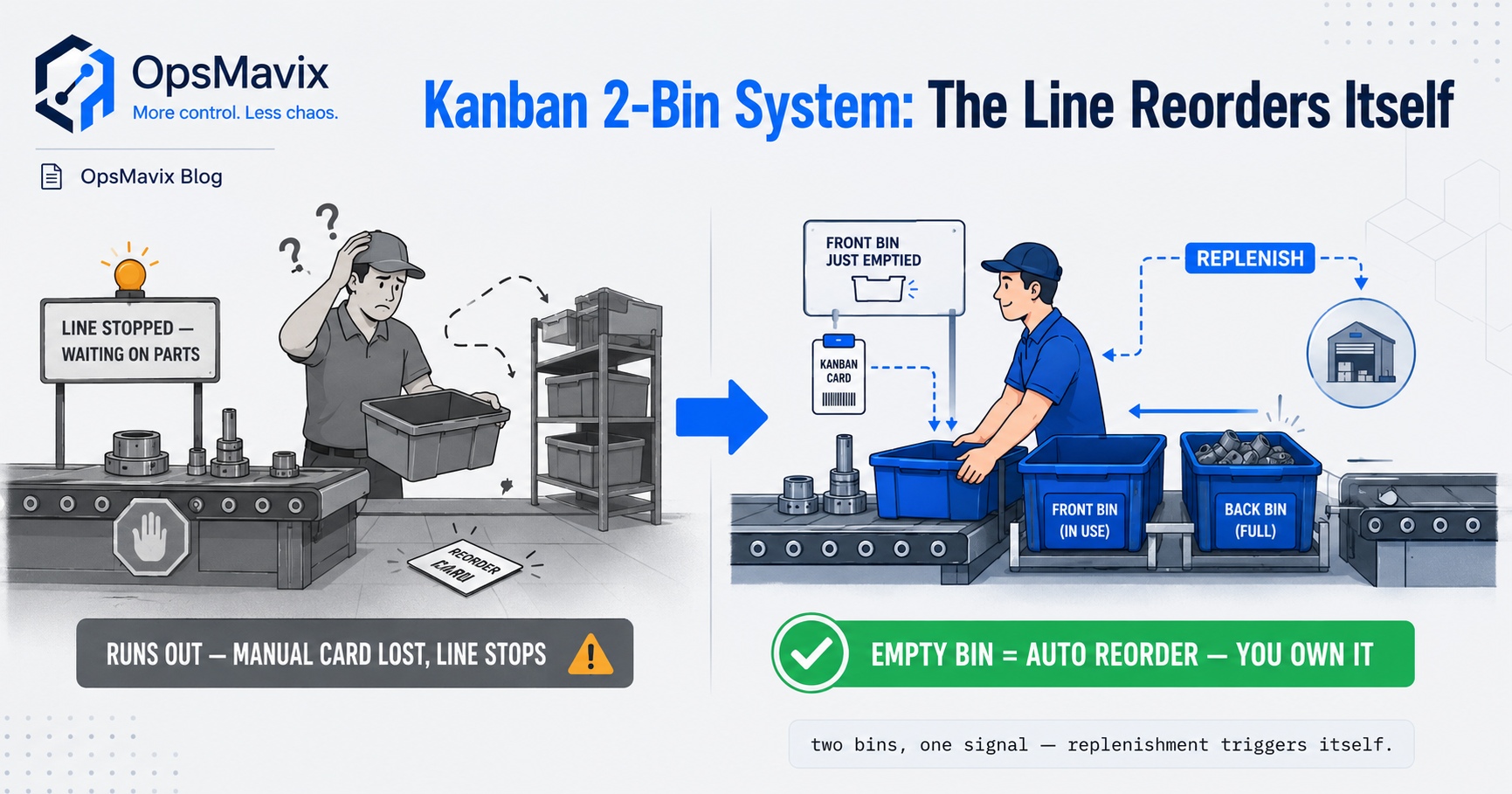
A kanban 2 bin system is the simplest pull method on the shelf: you hold two bins of the same part, draw from the first until it’s empty, and the empty bin itself becomes the signal to reorder. No count, no forecast, no spreadsheet — an empty bin means “buy or make more,” and the second bin keeps the line fed while replenishment arrives. Get the second bin sized right and a two-bin system runs a part almost on its own. Get it wrong, or scale it past what paper can hold, and it fails as quietly as it runs.
This post is the specific two-bin method — how the loop actually works, where it fits, where it breaks, and how to move it off laminated cards without turning it into an ERP project. For pull-based reordering in general, and the wider case for going digital, the electronic kanban system explainer covers that layer.
Key Takeaways
- A kanban 2 bin system holds two bins of a part; the first empties, becomes the reorder trigger, and the second (the reserve) covers you until stock arrives.
- The empty bin is the signal — no counting, no min/max maths on the floor. That simplicity is the whole point.
- The second bin must hold enough to cover demand during the replenishment lead time, plus a little safety. Under-size it and the line starves before stock lands.
- It fits steady-demand, low-value, high-frequency parts — fasteners, consumables, standard components. It’s poor for lumpy demand or expensive, slow-moving lines.
- On paper it works on a calm floor. Across many parts, sites, or a busy shift, cards get lost and the signal goes silent — that’s when a digital signal earns its place.
1. What a Kanban 2 Bin System Actually Is
A two-bin system is a replenishment method, not a piece of software. You hold each managed part in two identical containers. Work draws from the first bin only. The second bin sits behind it, untouched, as a reserve. The instant the first bin runs dry, that empty bin is the reorder trigger — it goes to the reorder point (or its card does), and the team switches to drawing from the second bin. When the new stock arrives, you refill, put the full bin at the back, and the loop resets.
The clever part is what’s missing. There’s no counting, no reading a number off a shelf, no deciding whether it’s “time” to order. An empty bin decides for you. That’s why it’s the entry point to lean pull replenishment: the signal is physical, obvious, and hard to argue with. It’s the same pull logic behind kanban generally — replenish what was actually consumed — stripped to its most basic form.
2. How the Two-Bin Loop Works, Step by Step
Walk one part around the loop and the whole method falls out of it:
- Both bins full. The part is fully stocked. Work draws from the front bin.
- Front bin empties. This is the trigger. The empty bin (or the card clipped to it) goes to whoever raises the order — purchasing for a bought part, the making cell for a manufactured one.
- Team switches to the second bin. The reserve now feeds the line. This bin has one job: cover demand for the entire time it takes stock to arrive.
- Replenishment arrives. The order quantity refills the empty bin. The just-arrived full bin goes to the back; the part-used reserve stays at the front and gets drawn down first.
- Loop resets. Two bins, one in use, one in reserve, waiting for the next empty.
The rule that makes it honest is first-in-first-out on the bins, and never dipping into the reserve early. The moment someone “borrows” from the second bin because the first is nearly out, the buffer you sized so carefully is gone, and the next stockout is already booked.
3. Where the Two-Bin System Earns Its Place
The two-bin method is brilliant at a specific job and poor outside it. It shines on parts with steady, predictable draw, low unit value, and high handling frequency: fasteners, fittings, seals, adhesives, gloves, standard off-the-shelf components — the C-class items you never want to think about but can’t run out of. For those, the cost of holding a second bin is trivial next to the cost of the line stopping for a 20p part.
It’s the classic answer for the long tail of consumables precisely because it needs almost no management. No one forecasts washers. You size the bins once, and the loop runs itself. That’s also why it pairs naturally with ABC-tiered stock discipline: put your cheap, steady C items on two-bin and reserve the careful counting for the A-class lines where the money actually sits.
4. Where the Two-Bin Method Breaks Down
Be honest about its limits, because a two-bin system fails silently. It assumes steady demand and a stable lead time. Feed it lumpy, spiky, or seasonal demand and the reserve bin — sized for the average — empties before stock lands, and the line starves with no warning. It’s a poor fit for expensive, slow-moving parts too: holding a second bin of a high-value item ties up cash for a signal you rarely trigger, and min/max or a planned order serves those better.
The quieter failure is the paper itself. On one calm line, cards survive. Across dozens of parts, multiple stores, or a shift running flat out, cards get dropped behind a rack, “borrowed,” or wiped off before anyone actions them — and an empty bin whose card nobody moved looks exactly like a full one until the cell runs dry. The method is sound; the laminated signal carrying it isn’t. That’s the same blind spot manufacturers describe running the whole floor from memory: “the entire shop is run from my head, and the first I hear a job’s slipped is when the customer phones.” A two-bin card wall only tells the truth if every human keeps it current, every shift.
5. Sizing the Second Bin — the Part Shops Get Wrong
The whole system lives or dies on one number: how much the reserve bin holds. Get it right and you never notice the method working. Get it wrong and you either starve the line or drown a shelf in stock you didn’t need.
The reserve has to cover demand during the replenishment lead time, plus a margin of safety for the days demand runs hot or the delivery runs late. Roughly: average usage per day, multiplied by the days from raising the order to stock hitting the shelf, plus a safety cushion sized to how variable both of those are. A part you burn steadily with a reliable two-day supplier needs a thin cushion. A part with jumpy demand or a flaky lead time needs a fat one — or it shouldn’t be on two-bin at all.
The mistake most shops make is sizing once and never revisiting. Demand shifts, a supplier’s lead time creeps from three days to eight, and the bin that used to cover you now doesn’t — but nobody re-sized it, so the first sign is a stockout. Two-bin isn’t fully “set and forget”; the bins encode assumptions, and assumptions drift.
6. Keeping the Empty-Bin Signal Honest
Two-bin’s one weak point is the signal itself: a paper card can be dropped, borrowed, or wiped, and an empty bin nobody actioned looks identical to a full one until the line starves. The method is sound — it’s the card carrying it that’s fragile. If that’s the pain you’re feeling, the fix isn’t to abandon two-bin. Keep the loop exactly as it is — draw one bin, reserve the second, empty means order — and move only the signal somewhere it can’t fall behind a machine or vanish before the shift ends.
How to do that across a whole floor — pull-based reordering as a signal you can’t lose, sized and re-sized from real trigger history — is its own topic, and the electronic kanban system explainer covers it end to end. If the sharper pain is job status and schedule rather than parts replenishment, factory scheduling software is the adjacent piece. The trap to avoid is thinking your only options are laminated cards or a six-figure ERP module — they aren’t. A focused system built around how your floor already pulls can run the same two-bin loop on a live stock figure, without losing the simplicity that makes it work in the first place.
FAQ
What is a kanban 2 bin system?
A kanban 2 bin system is a pull-based replenishment method where each part is held in two identical bins. Work draws from the first bin only; when it empties, that empty bin is the signal to reorder, and the team switches to the second (reserve) bin while new stock arrives. There’s no counting or forecasting on the floor — an empty bin means order more. It’s the simplest form of kanban and the standard way to manage steady, low-value, high-use parts.
How does the two-bin method actually trigger a reorder?
The trigger is physical: the first bin running empty. At that moment the empty bin, or a card clipped to it, goes to whoever raises the order — purchasing for a bought part, the making cell for a manufactured one. The second bin feeds the line meanwhile. When the order arrives, you refill the empty bin, put it at the back, and draw down the reserve first. No stock count decides the reorder — the empty container does.
How big should the second bin be?
Enough to cover demand for the full replenishment lead time, plus a safety margin. Roughly: average daily usage multiplied by the days from raising the order to stock arriving, plus a cushion sized to how variable your demand and lead time are. A steady part with a reliable supplier needs a thin cushion; a jumpy part or a slow supplier needs a fat one — or shouldn’t be on two-bin at all. Re-size it when demand or lead times shift.
When should you not use a two-bin system?
Avoid it for lumpy, spiky, or seasonal demand, and for expensive, slow-moving parts. Two-bin assumes steady draw and a stable lead time; feed it uneven demand and the reserve empties before stock lands, with no warning. High-value items tie up too much cash in a second bin for a signal you rarely trigger — min/max or planned ordering suits those better. It’s built for cheap, steady, high-frequency parts like fasteners and consumables.
Do we have to go digital to run a two-bin system?
No — on one calm line with a handful of parts, paper cards work fine. The case for going digital is scale and reliability: across many parts, several stores, or a busy shift, cards get lost, borrowed, or wiped, and an unactioned empty bin looks identical to a full one until the line starves. A digital signal keeps the same method but makes the empty-bin trigger impossible to lose and the reserve size easy to keep honest.
How OpsMavix Can Help
OpsMavix builds custom production tracking systems that run pull-based reordering — including two-bin loops — as a digital signal instead of a laminated card: the trigger fires on real stock movement, the reserve size lives per part, and an empty bin nobody actioned gets flagged before it starves the line. Connected to a live inventory system so the signal reflects what was genuinely consumed, built around how your floor already pulls, and owned outright — no lost cards, no wiped board, no six-figure ERP rollout to run one replenishment loop.
If your line has ever stopped over a cheap part because an empty bin’s signal went silent, that’s an operational leak: stopped hours, rush buys, and starved cells nobody saw coming. Book a Free Operations Leak Audit and we’ll map where your pull signals break down today, and what it’s costing you.
Keep reading
Getting value from OpsMavix? Add us as a preferred source on Google — you'll see more of our operations content in your AI Overviews, AI Mode and Search.