
Inventory Management Systems for Small Business: How to Choose Without Overbuying
Choosing between inventory management systems for small business is really a shortlist decision: a spreadsheet, a cheap app, or a right-sized owned system. This guide is honest about when each one wins, so you buy the cheapest thing that fixes your leak instead of a full ERP you don't need. Most small firms are outgrowing spreadsheets and disconnected tools.
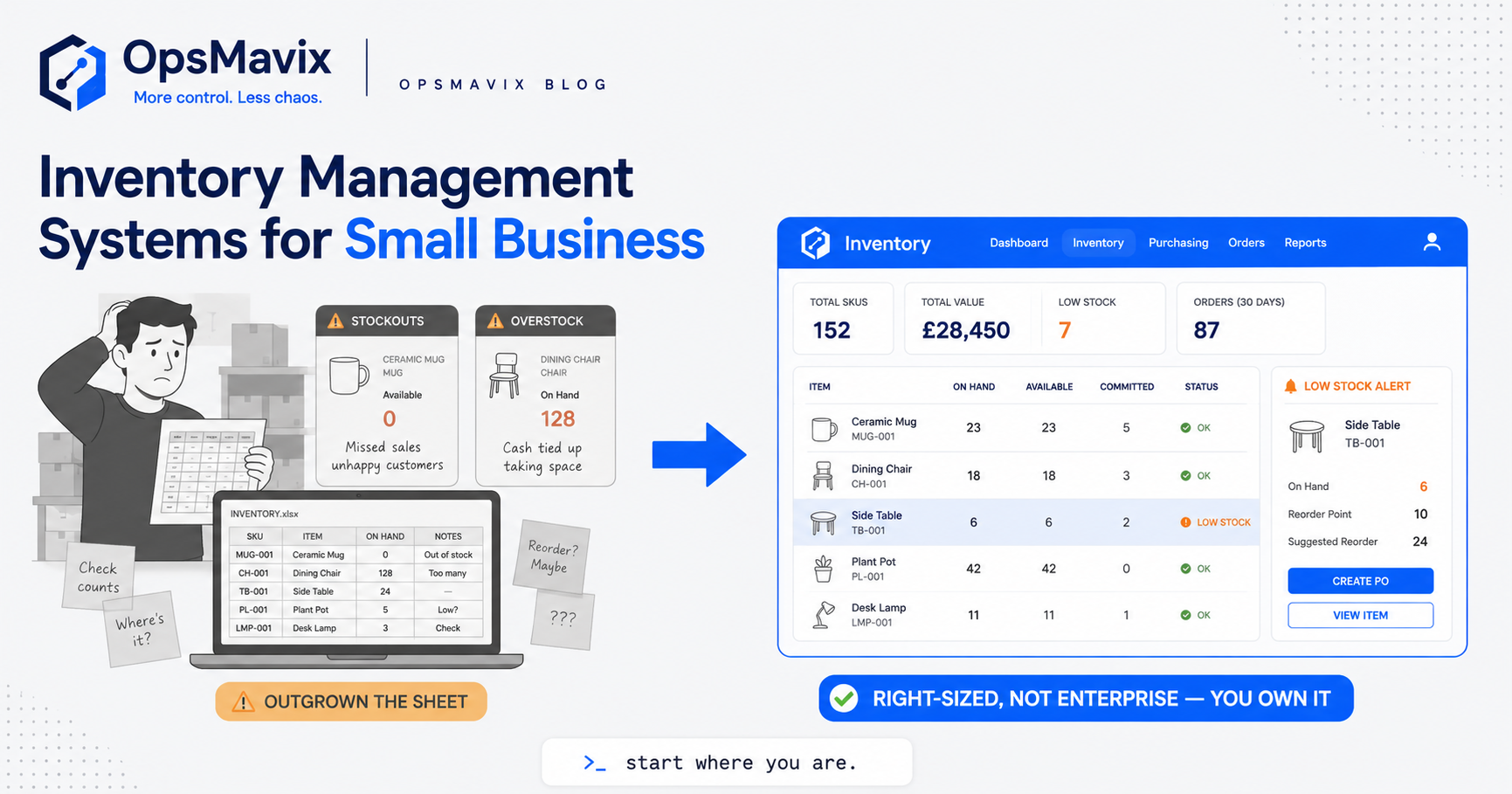
Every small business hits the same wall with stock. For a while a spreadsheet is genuinely fine. Then you add a second sales channel, or a warehouse shelf, or a member of staff who counts differently to you, and the numbers stop matching reality. You oversell something you don’t have. You reorder something already sitting in the back. You spend Sunday evening reconciling instead of resting.
By the time you’re searching for inventory management systems for small business, you already know you need something better than a shared sheet. The hard part isn’t deciding that you need a system. It’s deciding which one without overpaying for a bloated platform you’ll use 10% of. This guide walks the honest shortlist: a spreadsheet, a cheap off-the-shelf app, or a right-sized system built around how you actually work. We’ll be fair to all three, because the right answer depends entirely on the size and shape of your leak.
Quick summary: Most small firms are running on spreadsheets long past the point where they help. In a March 2026 survey of 400 businesses, 84.8% still used spreadsheets as their primary inventory tracking tool — and in the same study, 44% of operators reported stockouts at least once a month. The lesson isn’t “spreadsheets are evil.” It’s that most people cling to them until the errors cost real money, then buy in a panic. Choose deliberately instead.
Contents
- What an inventory system actually does
- The blind spot: measuring the leak before you buy
- The three real options, compared
- What features actually matter at small scale
- When a cheap app is the right answer (and when it isn’t)
- Integrations, and why ownership matters as you grow
- A worked example: a Bristol homeware brand
- FAQ
- How OpsMavix Can Help
- Sources
What an inventory system actually does
Strip away the marketing and an inventory system does four plain jobs. It tells you what you have (accurate stock counts, ideally per location). It tells you where it is (which shelf, van, or channel). It tells you what’s moving (sales velocity, so you reorder before you run dry). And it keeps that truth in one place so two people looking at the same product see the same number.
That’s it. Everything else — barcode scanning, purchase orders, batch tracking, low-stock alerts, demand forecasting — is a feature layered on top of those four jobs. A small business rarely needs all of them on day one. The trap is buying a platform sold on the strength of features you won’t touch for two years, while the four basics work no better than the spreadsheet you’re replacing.
So the buying question isn’t “which has the most features.” It’s “which does my four jobs cleanly, at a price that matches the cost of getting them wrong today.”
The blind spot: measuring the leak before you buy
Here’s the mistake almost everyone makes: they shop for software before they’ve measured the problem. They feel the pain — the oversells, the frantic counts — and jump straight to comparing apps.
Do the maths first. Roughly how many hours a week does someone spend manually updating stock, chasing counts, or reconciling channels? How often did you oversell last month, and what did each incident cost in refunds, rushed shipping, or a lost customer? How much cash is tied up in stock you bought twice or can’t find? Those numbers are your budget ceiling. If your inventory chaos costs you £200 a month, a £29 app that fixes it is a bargain and a £15,000 build is madness. If it’s costing you £4,000 a month in lost sales and wasted labour, the opposite is true.
Inventory accuracy is where the money hides. Industry benchmarks put the average retailer at around 83% inventory accuracy, with high performers at 95% or more. Every percentage point below that is stock you think you have but don’t, or stock you’re sitting on blind. Measure your own number before you spend a penny on tools.
The three real options, compared
There are really only three shapes of answer. A spreadsheet (free, flexible, breaks silently as you scale). A cheap off-the-shelf app (fast, cheap, fits its mould not yours). And a right-sized owned system (built around your workflow, expandable, higher upfront cost). A full ERP is a fourth option, but for a genuinely small business it’s almost always the wrong first move — long implementation, per-seat pricing forever, and you bending your business to fit the software.
| Spreadsheet | Cheap off-the-shelf app | Right-sized owned system | |
|---|---|---|---|
| Upfront cost | £0 | £0–£50/mo | £3k–£10k build |
| Ongoing cost | Your time | Per-seat/per-order fees, rising with scale | Hosting only (pennies); no per-seat rent |
| Fits your workflow | You bend it manually | You bend to it | Built around how you actually work |
| Multi-channel sync | Manual, error-prone | Usually yes, within limits | Exactly the channels you use |
| Scales with you | Breaks past a point | Until you outgrow the plan | Expandable, up to a full ERP later |
| Who owns it | You (but fragile) | The vendor | You, outright |
| Best when | Very low volume, one channel | Standard needs, tight budget | Non-standard process, real money leaking |
Read that table as a ladder, not a verdict. Most businesses should climb it one rung at a time and stop the moment the leak is closed.
What features actually matter at small scale
At small scale, four things matter far more than the long feature list:
- Real-time single source of truth. One number, updated the instant a sale happens, visible to everyone. This alone kills most overselling.
- Multi-channel sync — but only for the channels you actually sell on. A website, an Amazon store, and a trade counter is a common trio. You don’t need connectors to 40 marketplaces you’ll never use.
- Low-stock alerts and reorder points. The system should tell you to reorder before you run out, based on how fast things actually sell. This is where accuracy turns into money saved.
- Simple, forgiving stock counts. Scanning or a clean mobile count screen, so a busy staff member records the truth in ten seconds instead of skipping it.
Notice what’s not on that list: demand forecasting AI, batch/lot genealogy, landed-cost accounting, warehouse slotting optimisation. Those are real features for real businesses — just usually not yours yet. Paying for them now is paying rent on a house you haven’t moved into.
When a cheap app is the right answer (and when it isn’t)
Let’s be direct, because most guides in this niche won’t be: a cheap off-the-shelf app is often the correct first buy, and you should not feel bad about it.
If you sell fairly standard products, through one or two mainstream channels, in volumes an app’s plan comfortably covers — buy the app. It’s the fastest, cheapest way to get real-time counts and stop overselling this week. Tools built for exactly this stage will close the leak for the price of a couple of coffees a month. Spending £8,000 on a custom build to avoid a £29 subscription is ego, not economics.
You’ve genuinely outgrown the cheap app when you hit one of these walls:
- The app can’t model how your business actually works — kitting, made-to-order, split warehouses, unusual pricing — so you’re running side-spreadsheets again to patch the gaps.
- Per-seat or per-order fees have crept up until you’re paying more each month than a build would cost to amortise over a couple of years.
- You need it to talk to your other systems (accounts, production, a trade portal) and the app either can’t, or charges a premium tier plus a connector fee to do it badly.
- You’re exporting data to make decisions because the app’s reports don’t answer your actual questions.
That’s the real upgrade trigger: not “the app is bad,” but “the app now costs more — in fees, workarounds, and blind spots — than a system built for you would.” If you want a slower walk-through of that first rung, our guide to a stock management system for small business covers the entry-level choice in more depth, and the piece on an inventory tracking system for small business drills into getting counts accurate in the first place.
Integrations, and why ownership matters as you grow
A stock system is never an island. It has to sit inside the way orders, invoices, and reorders actually flow through your business. This is where the ownership question stops being philosophical and starts being financial.
With a cheap app, integrations are whatever the vendor decided to build. If they don’t connect to your accounting package, or your supplier’s ordering system, or your trade portal, you’re stuck — bridging the gap with manual exports or paying for a middleware subscription that adds another monthly bill and another thing to break. You’re also exposed if the vendor changes pricing, drops a feature, or shuts down. Your operations run on rails you don’t own.
A right-sized owned system flips that. It’s built to connect to the specific tools you use, and because you own the code, you can extend it when your fifth sales channel appears or your supplier changes their format. It starts as focused stock control and grows — into purchasing, production, reporting — up to a full ERP if you ever get there, without a rip-and-replace migration. That’s the whole point of inventory automation: the boring, repeated updates run themselves, and the system bends to you instead of the reverse. Ownership isn’t about pride. It’s about not paying rising rent on rails you can’t change.
A worked example: a Bristol homeware brand
Illustrative — not a claim about a specific client.
Picture a homeware brand in Bristol. They sell through their own Shopify site, an Etsy shop, and a handful of independent stockists they invoice directly. Revenue is around £45,000 a month. Stock lives in a small unit and a corner of the founder’s garage.
For two years they ran on a shared spreadsheet. It worked until Etsy sales grew. Now the sheet and the shops disagree: they oversell popular items about eight times a month. Each oversell means an apology, a refund or a rushed restock, and sometimes a lost repeat customer. Call it £180 per incident, all in — roughly £1,440 a month bleeding out. On top of that, the founder spends around six hours a week reconciling channels. At a modest £25/hour that’s another £650 a month in their own time.
Option one: a £39/month app syncing Shopify and Etsy. It kills most of the overselling instantly. But it doesn’t handle the direct-invoiced stockists, so those still get managed on a side-sheet — and reconciling that against the app eats back some of the saved time. Good enough for now, and the right call if cash is tight.
Option two: an owned system, roughly £6,000 to build, covering all three channels including the trade stockists, with reorder alerts tuned to real sell-through, and a clean mobile count screen for the unit and the garage. Ongoing cost is a few pounds a month of hosting. Against a leak of roughly £2,000 a month, it pays back in about three to four months, and there’s no per-seat fee waiting to grow as they add a fourth channel next year.
Neither answer is “correct” in the abstract. If the trade stockists were a rounding error, the app wins easily. Because they’re a third of the mess and the part no cheap app models well, the build starts to make sense. The decision falls out of the numbers, not the sales pitch.
FAQ
Is a spreadsheet ever good enough?
Yes — at genuinely low volume, on a single channel, with one person touching it. Spreadsheets fail on three things: real-time sync across people and channels, silent errors that compound, and hitting a ceiling you don’t see coming. If none of those bite you yet, keep your money.
How much should a small business spend on an inventory system?
Let the leak set the budget. Total up wasted hours, oversell costs, and cash tied in mystery stock. If that’s a couple of hundred pounds a month, a cheap app is right. If it’s thousands, a right-sized owned build (typically £3k–£10k for a starter system) can pay back in months. Never buy a full ERP to solve a small-app-sized problem.
Cheap app or custom system — which first?
Almost always the cheap app first, if it fits your workflow. It’s the fastest way to stop the bleeding for the least money. Move to an owned system only when the app can’t model how you actually work, or its fees and workarounds cost more than a build would.
What’s the single most important feature?
A real-time single source of truth — one stock number, updated the moment a sale happens, that everyone sees. Get that right and most overselling disappears. Everything else is secondary.
Will I have to migrate everything again later if I start small?
With a cheap app, possibly — you may outgrow it and re-platform. With a right-sized owned system, no: it’s built to expand from stock control into purchasing, production and reporting, up to a full ERP, without ripping it out and starting over.
How OpsMavix Can Help
OpsMavix builds right-sized, owned operations systems for growing UK businesses that are outgrowing spreadsheets and disconnected tools. We won’t sell you a build you don’t need — if a £39 app closes your leak, we’ll tell you to buy the app. But when off-the-shelf tools can’t model how you actually run, and the workarounds are costing real money, we design a system around your workflow that you own outright and can expand as you grow. It starts with measuring the leak, not quoting for code. Book a Free Operations Leak Audit
Sources
- State of Inventory Management 2026 — inFlow — March 2026 survey of 400 businesses; 84.8% use spreadsheets as their primary inventory tool and 44% report stockouts at least monthly.
- Top 15 Retail Inventory KPIs Every UK Business Should Track in 2026 — Growsights — UK-focused benchmarks: ~83% average inventory accuracy, 95%+ for high performers, and 40%+ of mid-market retailers still on spreadsheets.