
Inventory Management System for Warehouse: Making the Count Honest
An inventory management system for warehouse teams is really a machine for keeping one number honest: what's actually on the shelf. This is for the growing operation that's outgrowing spreadsheets and disconnected tools, and needs the count it can trust.
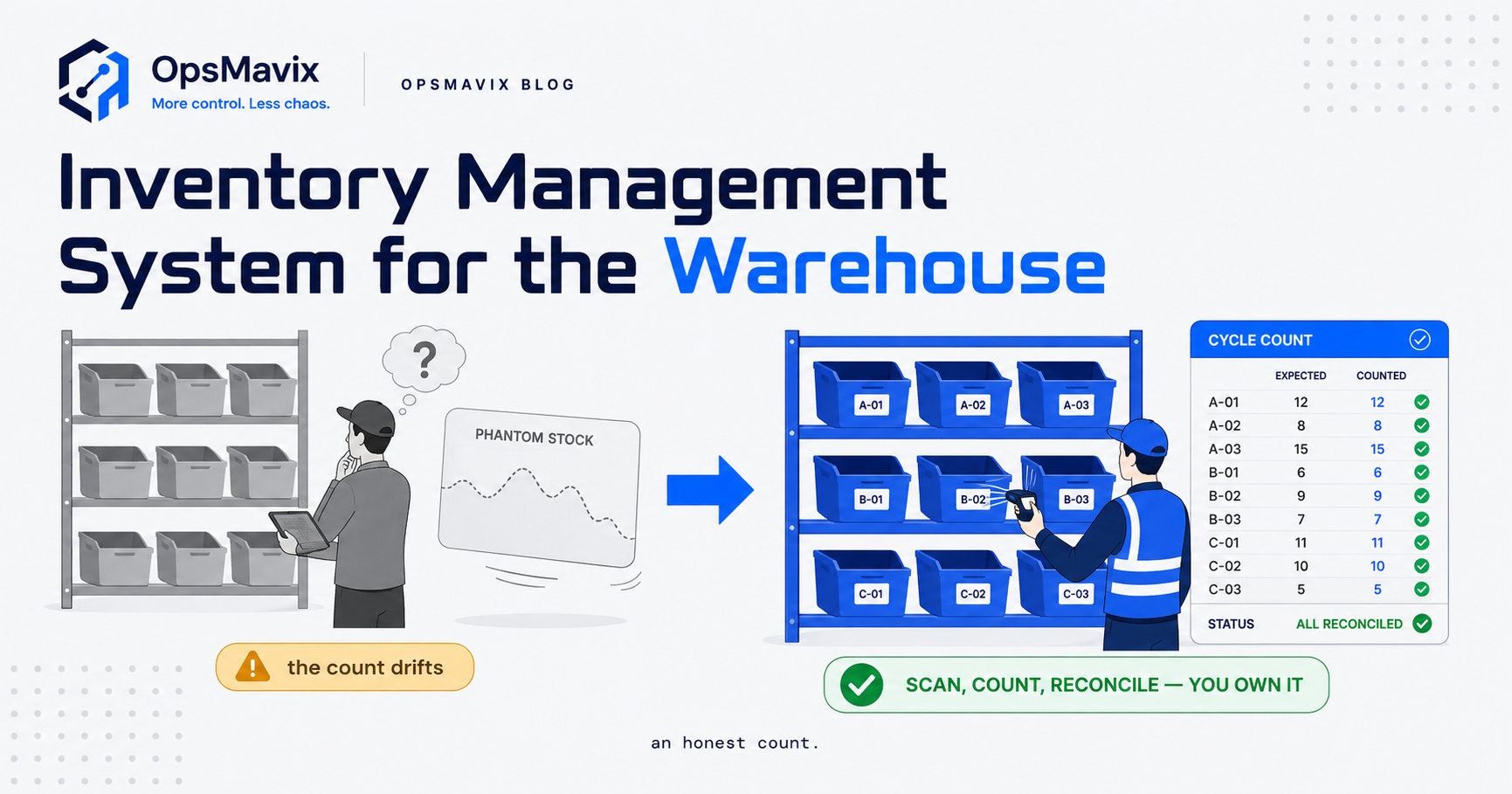
Ask most warehouse managers what their inventory management system is for and they’ll say “tracking stock.” Fair enough. But the real job is narrower and harder: keeping one number honest. What the system says is on the shelf has to match what’s physically there, bin by bin, SKU by SKU. The moment those two numbers drift apart, everything downstream inherits the lie. Pickers walk to empty locations. Buyers reorder things you already have. Sales promise stock that evaporates on the pick face.
If you run a growing warehouse, you already know software exists. You’re not asking whether to track inventory. You’re asking how to make the count trustworthy enough that you stop second-guessing it, without buying a system so heavy it takes nine months and a consultant to switch on. That’s the honest question, and it’s the one this piece answers.
Quick summary: Inventory records drift far more than people assume. A study of seven European retailers (including UK stores, analysed by researchers from Cardiff Business School) found that 59.54% of audited SKUs had inaccurate records — the physical count didn’t match the system — and that simply correcting those records lifted sales by an average of 5.98%. The warehouse’s job isn’t fancier reporting. It’s closing that gap.
Contents
What a warehouse inventory system actually does
Strip away the marketing and a warehouse inventory system does four concrete things. It records where each item lives (a bin, a shelf, a zone). It records how many are there. It captures every movement in and out at the point it happens, ideally by scan rather than memory. And it gives you a way to check the record against reality and fix the difference when they disagree.
That last part is where cheap tools quietly fall down. Plenty of software will happily hold a stock number and decrement it when you raise an order. Far fewer are built to challenge that number, to say “you think there are 48 here, go and count bin C-14 and tell me what’s really there.” A general stock app manages quantities. A proper warehouse system manages the truth of quantities, which is a different and more valuable thing.
For a business moving from spreadsheets, the upgrade that matters most isn’t real-time dashboards. It’s the shift from “someone typed a number they believed” to “someone scanned a barcode at a location, and the system knows exactly when, where, and by whom.” Accountability at the point of movement is what makes the count honest.
The blind spot: phantom stock
Phantom stock is inventory your system swears is on hand but isn’t. The record says 12; the bin has 3, or none. It builds up quietly from ordinary friction: a mis-scan, a return booked to the wrong SKU, a pallet moved without an update, breakage nobody logged, two similar part numbers swapped at receiving.
The damage is out of proportion to the cause. Phantom stock is a leading driver of avoidable out-of-stocks, because the system sees positive quantity and refuses to reorder while the shelf sits empty. Industry research suggests up to 60% of retailers’ inventory records may be inaccurate, and the cost of that inaccuracy is measured in billions of lost revenue. The insidious part is that phantom stock never announces itself. You find it when a picker radios in from an empty location, or when a customer order can’t be fulfilled against stock the system promised.
You cannot dashboard your way out of phantom stock. You catch it by counting, regularly and by location, and by having a system that treats a counted discrepancy as a signal to investigate rather than a number to silently overwrite.
Bin and location tracking: where the count lives
A quantity without a location is barely useful. “We have 200 of SKU 4471” tells a picker nothing about where to walk. Bin and location tracking gives every unit an address, and that address is what makes accuracy achievable at all.
Once stock lives at named locations, three things become possible. Pickers get directed to a specific face instead of hunting. You can count one aisle without freezing the whole warehouse. And when a discrepancy shows up, you can localise it — a wrong count in bin B-07 is a small, fixable problem, not a mystery smeared across the entire building.
Location discipline is also what lets barcode scanning earn its keep. Scan the item, scan the bin, and the system records a movement it can trust because a human physically stood in front of the stock to make it. That’s the whole game: replacing remembered numbers with scanned facts. It’s also the foundation you build the rest of your operation on, which is why we treat it as core in our inventory automation system rather than an add-on.
Cycle counts: reconcile, don’t overwrite
Most warehouses know they should count. The mistake is how they count and what they do with the result.
The wrong version is the annual stocktake: shut down, count everything, and when the numbers disagree, overwrite the system to match the count and move on. That “fixes” the number for a day and teaches you nothing. You never learn why bin C-14 was short, so it goes short again next quarter.
Cycle counting is the better model. Instead of one giant count, you count a small slice of the warehouse every day on a rolling schedule, weighted so fast-moving and high-value SKUs get counted more often. A good system generates the day’s count list, hands it to a scanner, and compares the counted figure against the record.
The crucial word is reconcile, not overwrite. When the count disagrees, the system logs the variance, flags it for a reason, and only then adjusts. Over a few weeks that variance log becomes a map of where your accuracy leaks: a receiving process that fat-fingers quantities, a returns desk booking to the wrong location, a product pair that keeps getting confused. Overwriting hides the leak. Reconciling exposes it so you can fix the cause. That distinction is the single biggest difference between a system that drifts back to chaos and one that stays honest.
The three ways to buy it
There are broadly three ways to solve warehouse inventory accuracy, and the right one depends on how messy your operation is and how much of it is genuinely unusual. Be honest about that before you spend.
| Cheap / generic stock tool | Full ERP / enterprise WMS | Right-sized owned system | |
|---|---|---|---|
| Best for | Small, simple stock rooms; one location; few SKUs | Large, complex operations that need every module | Growing warehouses with real process quirks, not yet at ERP scale |
| Bin & location tracking | Basic or bolt-on; often single-location | Deep, highly configurable | Modelled to your actual layout and zones |
| Cycle counting | Manual or absent; overwrite-style | Powerful but rigid; you follow its method | Built around reconcile-and-flag, tuned to your SKUs |
| Fits how you work | You bend to the tool | You bend the business to the ERP | The system is shaped to your process |
| Time to value | Days | 6–12+ months implementation | Weeks, expandable later |
| Cost shape | Low monthly per user | High licence + per-seat/module forever | One build you own; extend when you need to |
| Who holds the keys | Vendor | Vendor | You |
None of these is “wrong.” If you run a single small stockroom, a cheap off-the-shelf tool is the sensible answer and you shouldn’t overspend to look sophisticated. If you’re a large multi-site distributor with complex financials, a full ERP or enterprise WMS may genuinely be worth its weight and cost. The right-sized owned system is for the middle: outgrowing a spreadsheet or a basic app, but nowhere near needing a system that takes most of a year to switch on and charges you per seat forever.
Integrations and why ownership matters
Your warehouse count doesn’t live alone. It feeds purchasing, sales, your accounts, and often a production line. An accurate warehouse number that never reaches the reorder logic or the sales team is a private victory nobody benefits from. So the system has to connect: to your sales channels so committed stock is reserved, to purchasing so reorder points fire off real availability, and to whatever runs your books.
This is where ownership stops being an abstraction. When you rent a stock module, integrations happen on the vendor’s terms and timeline. Need to connect it to the odd bit of kit you use at goods-in, or push counts into a production tracker? You wait, or you pay, or you’re told it’s not on the roadmap. When you own the system, the connections bend to your operation. If your warehouse feeds a workshop, you can wire accurate stock straight into manufacturing production tracking instead of rekeying it. Ownership means the system serves how you actually run, not how a vendor assumed you should.
It also means you’re not renting your own operational truth. The record of where every unit sits and how the count reconciles is one of your most valuable operational assets. Keeping the keys to it is not a technical preference. It’s a business one.
A Worked Example
Illustrative — not a claim about a specific client.
A UK homeware distributor runs a single 12,000-square-foot warehouse, around 3,500 SKUs, five pickers, moving roughly £4m of goods a year. They track stock in a spreadsheet plus a basic online tool. Nobody trusts the numbers, so they hold “buffer” stock on the fast movers just to be safe, and they still miss orders.
They audit and find their inventory accuracy sitting around 82%. Reconciling to the European retail benchmark isn’t a fantasy: the same research above found correcting inventory records lifted sales by an average of about 6%. Even at half that, roughly 3% on £4m is £120,000 of orders they were quietly turning away. Separately, the safety buffer they carry because they don’t trust the count ties up around £45,000 of cash in stock they don’t strictly need.
They put in a right-sized owned system: barcoded bin locations across the warehouse, scan-on-move at goods-in and picking, and a daily cycle-count list weighted to their top 500 SKUs that reconciles and flags variances instead of overwriting. Within three months the variance log has pointed them at two repeat culprits — a returns process booking to the wrong location, and two near-identical SKUs swapped at receiving. Accuracy climbs past 96%.
The build cost sits in the low-to-mid Starter range. Against recovered orders and freed-up cash, it pays for itself inside the first year, and they own it outright — no per-seat licence eating the gain every month after. The numbers here are illustrative, but the shape is exactly how the maths tends to work.
FAQ
Do I need barcode scanners, or can staff just type counts in?
You can type, but typed counts are where phantom stock breeds. Scanning at the point of movement — scan the item, scan the bin — is what turns a remembered number into a recorded fact. Cheap Bluetooth scanners or even phone cameras are enough to start; you don’t need enterprise hardware to get honest counts.
How often should we cycle count?
Rolling, not annual. Weight it by value and velocity: count your fast-moving and high-value SKUs weekly or more, the long tail less often. The aim is that every important item gets counted several times a year without ever shutting the warehouse down. The system should generate the day’s list for you.
What’s the difference between this and a full WMS?
A full warehouse management system does everything — labour management, slotting optimisation, wave picking, yard management — and prices accordingly. Most growing warehouses need accurate bin-level counts, scanning, and cycle counting, not the whole suite. Buy the accuracy first. You can always expand a right-sized system toward full WMS later; you rarely need to start there.
Will it connect to our accounting and sales tools?
It should. An accurate warehouse count only pays off when it reaches purchasing, sales and your books. A right-sized owned system is built to connect to the specific tools you already run, rather than forcing you onto a vendor’s pre-approved list.
We tried a stock app and drifted back to chaos. Why would this be different?
Almost always because the old tool overwrote discrepancies instead of reconciling them, so the underlying causes never got fixed and the count rotted again. A system built to log, flag and investigate variances turns each disagreement into a fix. That’s what keeps accuracy from sliding back.
How OpsMavix Can Help
OpsMavix builds right-sized, owned operations systems for growing UK businesses that are outgrowing spreadsheets and disconnected tools. For a warehouse, that means the practical machinery of an honest count: barcoded bin and location tracking modelled on your real layout, scan-on-move at goods-in and picking, and cycle counting that reconciles and flags variances instead of quietly overwriting them — wired into the sales, purchasing and accounts tools you already use. You own it, and you extend it as you grow. If you want to see exactly where your count is leaking, that’s what the audit is for. Book a Free Operations Leak Audit
Sources
- ECR Retail Loss — Grow Sales by Improving Inventory Records — Study of seven European retailers (incl. UK, Cardiff Business School) finding 59.54% of audited SKUs had inaccurate records and a ~5.98% average sales uplift from correcting them.
- RELEX Solutions — How to Optimise Cycle Counting and Banish Phantom Inventory — Cites ECR Loss research that up to 60% of retailers’ inventory records may be inaccurate, with large associated revenue loss.
- CYBRA — How Accurate is the Average Retailer’s Inventory? — Reports the Auburn University RFID Lab finding that average retail inventory accuracy sits around 65%.