
Inventory Management Software for Ecommerce: One Stock Pool Across Every Channel
Inventory management software for ecommerce keeps one true stock number across Shopify, Amazon and eBay so you stop overselling and stop guessing. This is the guide for sellers who are outgrowing spreadsheets and disconnected tools.
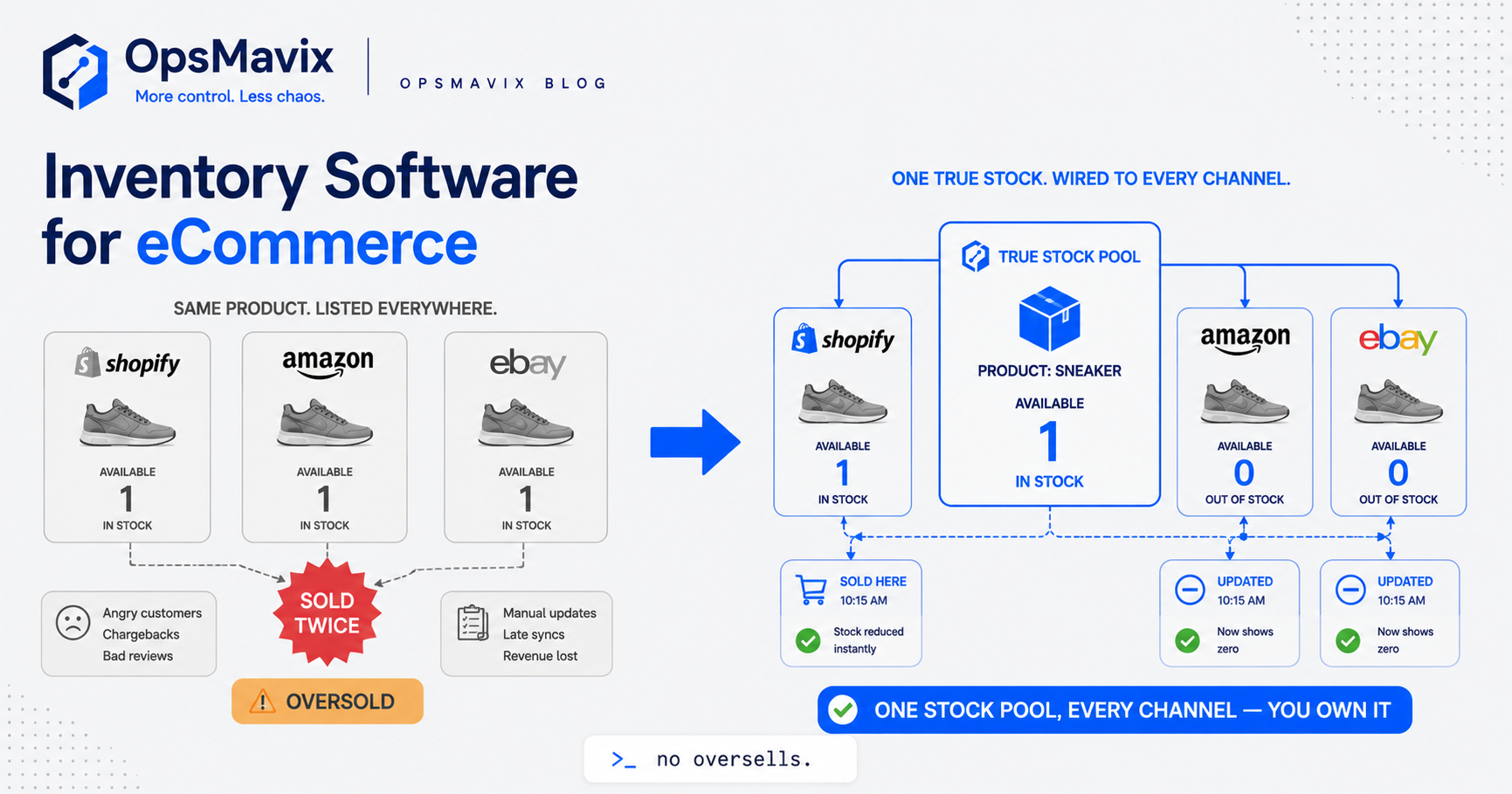
If you sell the same product on more than one channel, you already know the sinking feeling. An order lands on Amazon, another on Shopify, and a third on eBay, all for the last two units in the building. Two of those customers are getting an apology email and a refund. The stock said “3 available” everywhere, because every channel was counting the same physical items as if it owned them exclusively.
That is the core problem inventory management software for ecommerce is built to solve: giving you one true stock pool that every sales channel draws from in real time, instead of a handful of separate counts that quietly drift out of sync. It is not about fancier dashboards. It is about a single number that is actually correct, so the next order you take is one you can actually fulfil.
Quick summary: Stock is a bigger operational headache than most sellers admit. Pricer’s 2025 research found that inventory availability is the single biggest in-store challenge for UK retailers (36%), with inventory accuracy close behind at 34% (Retail Times). For a multichannel ecommerce seller, an inaccurate stock number is not a reporting annoyance. It is either a lost sale or a cancelled order, every single time.
Contents
- What ecommerce inventory software actually does
- The multichannel stock problem: one product, five truths
- Oversells, safety buffers and the sync lag behind them
- Bundles, kits and the stock maths nobody warns you about
- Off-the-shelf tool vs full ERP vs a right-sized owned system
- Integrations, and why ownership matters
- A worked example: a UK homeware seller
- FAQ
- How OpsMavix can help
- Sources
What ecommerce inventory software actually does
Strip away the marketing and the job is narrow and specific. Inventory management software for ecommerce sits between your warehouse (or your 3PL) and your sales channels, and it does four things well.
First, it holds a master stock record for every SKU: what you physically have, where it is, and how much is truly available to sell right now. Second, it pushes that number out to every connected channel so listings show the same figure. Third, it listens for orders coming back in and decrements the master count the moment a sale happens, then re-pushes the new number everywhere else. Fourth, it handles the awkward edges: incoming purchase orders, returns going back into stock, allocations, and reserved units that are sold but not yet shipped.
That loop, done in near real time, is the whole game. When it runs cleanly you can add a channel without adding chaos. When it does not, you get the refund emails. Most sellers start on spreadsheets, graduate to their Shopify stock count as the “source of truth,” then hit a wall the moment a second channel starts moving volume. The wall is not a Shopify problem. It is a single-pool problem that no single channel was ever designed to solve.
The multichannel stock problem: one product, five truths
Here is what actually happens without a central pool. You list 40 units of a product. Shopify says 40. You also list it on Amazon, so Amazon says 40. And on eBay, so eBay says 40. You now have 120 units “for sale” backed by 40 real ones. Every channel is confident, and every channel is wrong the moment a sale lands somewhere else.
You end up with five versions of the truth: the number on Shopify, the number on Amazon, the number on eBay, the number in your warehouse, and the number in your head. They agree first thing in the morning and diverge by lunchtime. The busier you get, the faster they drift, which means your worst inventory chaos arrives exactly when you are selling best.
The costs are real and measured. UK research from ROI Hunter found that 62% of retailers are struggling with overstocking, losing an average of £882,781 in revenue every quarter to stock they cannot shift (365Retail). Overselling is the same disease from the other end: you buy to cover demand you cannot see clearly, so you either over-buy and tie up cash, or under-buy and go dark on a bestseller. A single accurate pool is what lets you buy against reality instead of against a guess.
Oversells, safety buffers and the sync lag behind them
Oversells almost always come down to timing. Even with a central system, there is a moment between a sale completing on one channel and the new stock number reaching the others. On a quiet SKU that gap is harmless. On a bestseller during a promo, two orders can slip through for the same last unit before the sync catches up.
Good ecommerce inventory software manages this two ways. The first is speed: sync in seconds, not on an hourly batch. The second, and the one that actually saves you, is the safety buffer. You tell the system to hold back a small cushion on fast-moving SKUs, so a product with 5 real units is listed as 3 available. That buffer absorbs the sync-lag race and quietly disappears the oversell problem without you babysitting it.
The blind spot most sellers never see coming is the channel-specific reserve. Amazon FBA holds stock physically apart from your own warehouse. Pre-orders reserve units you have not received yet. A wholesale order allocates 200 units that are still sitting on your shelf looking available. If your software counts “physically present” instead of “genuinely free to sell,” you will oversell against stock that was already spoken for. Available-to-sell, not on-hand, is the number that has to reach your channels.
Bundles, kits and the stock maths nobody warns you about
Bundles are where naive stock counting falls apart completely. Say you sell a “starter kit” made of one candle, one holder and one box of matches. That kit is a SKU with its own listing, but it does not have its own stock. Its availability is a calculation: how many complete kits could you build from the components you hold right now?
Sell one kit, and three separate component counts have to drop by one. Sell a single candle on its own, and every bundle that contains that candle has to recalculate its available quantity, because you can now build one fewer kit. Do this across dozens of bundles sharing components and you have a maths problem no spreadsheet survives.
This is exactly where cheap channel-native tools tend to give up. They treat the bundle as its own stock number you have to maintain by hand, which is wrong within an hour. Proper inventory management software for ecommerce treats a bundle as a recipe of components and derives its availability automatically, so selling any part of it updates the whole. If kits, multipacks or “buy any three” offers are core to how you sell, this single feature is worth more than every dashboard in the product combined.
Off-the-shelf tool vs full ERP vs a right-sized owned system
There are three honest ways to solve this, and the right one depends entirely on your volume, your margins and how weird your product actually is.
| Cheap / generic channel tool | Full ERP | Right-sized owned system | |
|---|---|---|---|
| Best for | Early-stage, 1–2 channels, simple SKUs | Large, complex, multi-warehouse operations | Growing sellers whose real quirks break the templates |
| Multichannel sync | Solid for standard cases | Comprehensive, if configured | Built around your exact channel mix |
| Bundles / kits | Often clunky or manual | Handled, after heavy setup | Modelled to how you actually bundle |
| Cost shape | Low monthly per-channel fee | High licence + per-seat, forever | One build cost, then you own it |
| Setup time | Hours to days | Months, plus consultants | Weeks, scoped to one leak |
| Fits your workflow | You bend to the tool | You bend hard to the tool | The system bends to you |
| Expandable later | Limited | Vast, if you can afford it | Yes — extend toward a full ERP when ready |
Be fair to the cheap tools. If you sell straightforward SKUs across one or two channels, an off-the-shelf sync app is genuinely the right answer, and paying for anything more would be waste. Do not overbuy. The trouble starts when your reality stops matching the template: shared-component bundles, split 3PL and self-fulfilment, wholesale allocations sitting alongside retail, or one channel that needs stock held back for a key account. That is where you either wrestle the tool forever or bend your business to a full ERP you do not need yet.
The full ERP does everything, and that is exactly its cost. You pay per seat and per module indefinitely, the implementation runs for months, and you reshape your operation around its assumptions rather than the other way round. For a large multi-warehouse operation that is a fair trade. For a growing ecommerce seller it is usually a sledgehammer bought to crack a specific, nameable nut.
The middle path is a right-sized system built around how you actually run, that you own outright. It solves the one leak that is costing you now, fits your real channel mix and bundle logic, and stays extensible so it can grow toward a full ERP later if you ever genuinely need one. You buy the fix, not the empire.
Integrations, and why ownership matters
An ecommerce inventory system is only as good as its connections. At minimum it has to talk cleanly to your sales channels (Shopify, Amazon, eBay, TikTok Shop, your own site), your fulfilment (in-house or 3PL), your couriers, and your accounting. Each of those is a live API relationship that changes when the platform changes.
This is where ownership stops being an abstract idea and starts saving you money. With a rented tool, you get the integrations the vendor decided to build, priced how the vendor decides, and if they deprecate a connector or triple the fee, you absorb it. With a system you own, the integrations are yours. When Amazon changes an API or you add a new sales channel next year, you extend the thing you already have instead of renegotiating with a platform that knows you cannot easily leave.
Ownership also means your stock logic is yours. The safety buffers, the bundle recipes, the allocation rules, the way you handle pre-orders — that is your operational knowledge, encoded. On a rented platform it lives inside someone else’s product and walks out the door if you switch. Owned, it is an asset that compounds. If you want to see how that plays out for stock specifically, our ecommerce inventory automation work is built on exactly this principle: your rules, your data, your system.
A worked example: a UK homeware seller
Illustrative — not a claim about a specific client.
Take a UK homeware brand turning over around £1.4m a year across Shopify, Amazon and eBay. They sell roughly 300 SKUs, about 40 of which are gift bundles built from shared components. Stock lived in a spreadsheet reconciled by hand every evening.
The leaks were quiet but constant. Oversells ran at around 15 orders a month, each costing roughly £6 in refund admin, wasted picking and courier fees, plus the harder cost of a Amazon metric ticking the wrong way — call it £90 a month in hard cost. Worse, fear of overselling meant they listed bestsellers conservatively and went out of stock on the very products that sold, losing an estimated £3,500 a month in sales they simply were not capturing. The bundle maths was done manually, so kits were regularly listed as available when a component had run dry, generating cancellations that hurt their seller ratings.
A right-sized owned system gave them one central pool with a 2-unit safety buffer on fast movers, real-time sync across all three channels, and bundle availability calculated automatically from component stock. Oversells dropped to near zero. With accurate available-to-sell numbers they could list bestsellers at true availability and stopped going dark, recovering most of that £3,500. On conservative figures the system paid for itself inside the first quarter, and the evening reconciliation ritual — about an hour a day — disappeared entirely.
FAQ
Do I really need this if I only sell on Shopify right now?
Probably not yet, and that is fine. If you are single-channel with simple SKUs, Shopify’s own stock count is likely enough, and buying more is waste. The moment you add a second channel that moves real volume, or you start selling bundles built from shared components, the single-pool problem appears and a dedicated approach earns its keep. Buy it when the leak is real, not before.
How is this different from an order management system for ecommerce?
They are neighbours, not the same thing. Inventory software owns the stock number: what you have and what is truly available to sell. An order management system for ecommerce owns the order’s journey from checkout to delivery. They share data and often live in the same build, but the inventory side is specifically about keeping one accurate stock count across every channel.
Will a safety buffer cost me sales?
Marginally, and it is almost always worth it. Holding back 2 units on a fast mover means you occasionally show “out of stock” while a couple of units technically exist. Weigh that against the cost of an oversell: the refund, the admin, the courier fees and the platform penalty. On bestsellers the buffer pays for itself many times over. You can tune it per SKU, so slow movers carry no buffer at all.
Can it handle my 3PL and my own warehouse at the same time?
Yes, and this is exactly where off-the-shelf tools tend to strain. Stock split across a 3PL, Amazon FBA and your own shelves needs a system that tracks available-to-sell per location and rolls it into one channel-facing number. A right-sized owned system models your actual fulfilment setup rather than forcing you into a single-warehouse assumption.
What happens when I add a new sales channel next year?
With a system you own, you extend it. The central pool already exists, so adding TikTok Shop or a new marketplace is a new connection into the same logic, not a fresh platform migration. This is the practical payoff of ownership: growth is an extension, not a rebuild. For the wider picture on selling everywhere at once, see our guide to multi-channel inventory management.
How OpsMavix can help
We build right-sized, owned operations systems for growing businesses that are outgrowing spreadsheets and disconnected tools. For ecommerce sellers that usually means one true stock pool across every channel, real-time sync that kills oversells, safety buffers you control, and bundle logic that actually reflects how you sell — built around your real workflow and yours to keep. We recommend the cheapest thing that closes your real leak, and if an off-the-shelf app is genuinely enough, we will tell you. If your reality has outgrown the templates, we can help. Book a Free Operations Leak Audit
Sources
- Retail Times — Pricer research on UK retailers’ 2025 inventory challenges — 36% cite inventory availability and 34% inventory accuracy as top in-store challenges.
- 365Retail — ROI Hunter research on UK overstocking — 62% of UK retailers struggling with overstocking, losing an average £882,781 in revenue per quarter.