
Inventory Control Software for Small Business: Stopping the Count From Drifting
Inventory control software for small business is about accuracy and accountability, not just storing a number. This guide shows how the right-sized system stops your count drifting for firms outgrowing spreadsheets and disconnected tools.
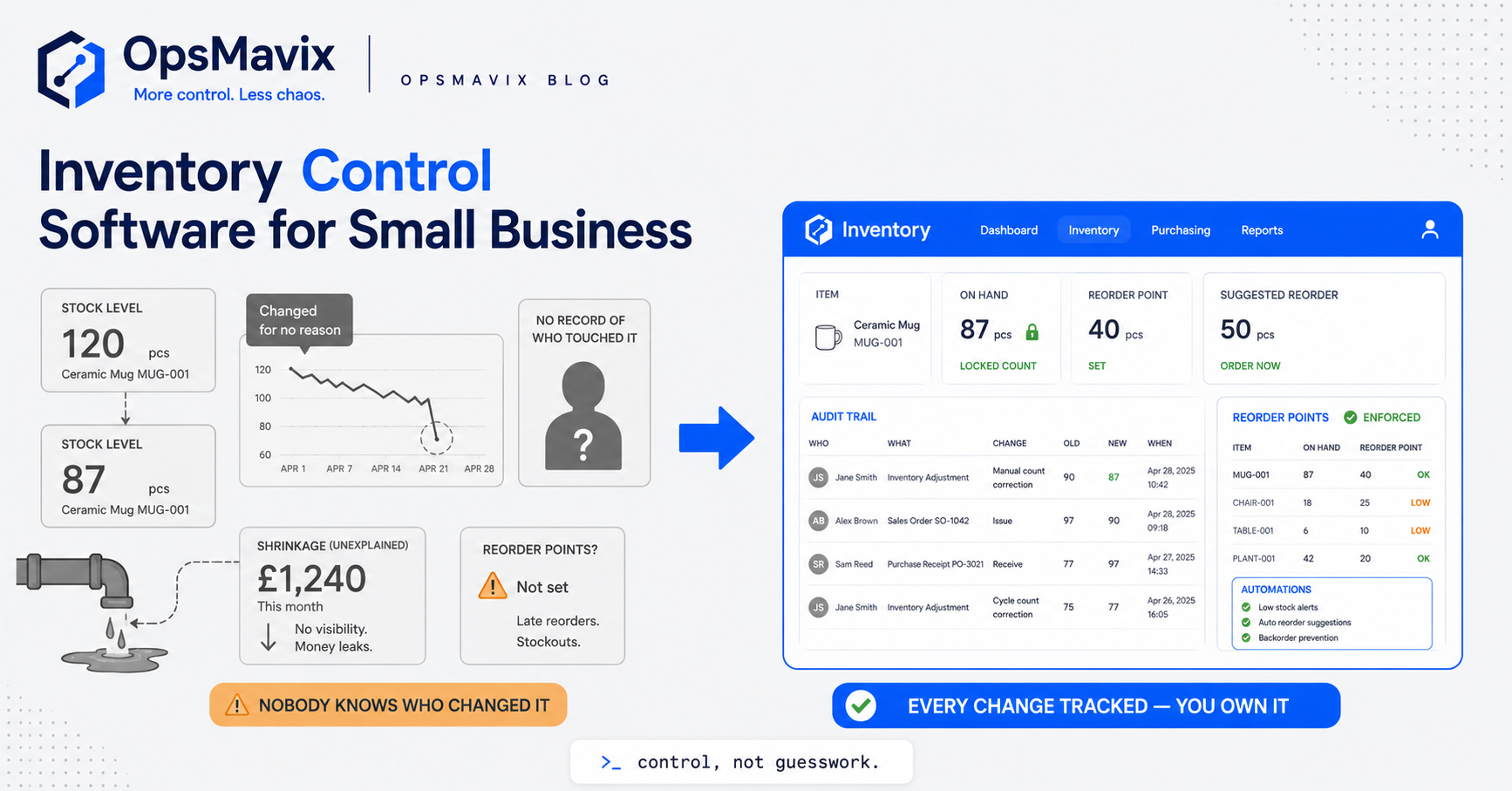
Most small businesses do not have an inventory problem. They have a control problem. The number on the shelf and the number on the screen have quietly drifted apart, and nobody can say exactly when, how, or who moved it. You order stock you already have. You promise a customer something that sold last week. You write off the gap at year-end and call it “shrinkage” because there is no better word for money that vanished without a paper trail.
Storing a stock figure is easy. Any spreadsheet does that. What separates real inventory control software for small business from a glorified list is discipline: a locked count, enforced reorder points, and a record of every adjustment that answers the only question that matters when the numbers are wrong — who changed what, and why? This guide is about that discipline, not about pretty stock cards.
Quick summary: Inventory records drift far more than owners assume. In the largest European study of its kind, ECR Retail Loss found that 59.5% of audited stock records did not match the physical count — and that correcting those discrepancies lifted sales by roughly 4% to 8%, because accurate stock means you actually sell what you think you have. Control is not admin. It is revenue you are currently leaking.
Contents
What inventory control software actually does
A stock list tells you a quantity. Inventory control software tells you a quantity you can trust, and enforces the rules that keep it trustworthy. In practice that means four things working together.
It maintains a single, live count that updates as stock moves — goods in, sales out, transfers, returns, damages. It enforces reorder points so the system tells you to buy before you run dry, rather than after a customer complains. It records an audit trail on every movement, so an adjustment is never anonymous. And it supports counting — cycle counts and full stocktakes — as a routine that reconciles physical reality back to the record, instead of a once-a-year panic.
The difference is accountability. A spreadsheet lets anyone overwrite a cell and move on. Control software makes every change attributable and reversible. When the count is off, you are not guessing — you are reading a log.
The blind spot: your count is already wrong
Here is the uncomfortable part. If you have never run a disciplined count, your inventory is almost certainly inaccurate right now, and by more than you would guess. The ECR study above found discrepancies in nearly six of every ten records. UK retail as a whole loses an estimated 1.4% to 1.7% of sales to shrinkage — theft, error, damage and fraud combined, and a large share of that is not dramatic crime. It is process error: a delivery booked in wrong, a sale rung up against the wrong SKU, a return that never got put back, a breakage nobody logged.
Small businesses are especially exposed because the count lives in someone’s head or a shared spreadsheet. The same UK source notes that around 43% of small businesses still track inventory manually. Manual tracking has no audit trail. So when the numbers drift, there is nothing to investigate — the evidence was never captured. You cannot fix a leak you cannot see, and a spreadsheet is designed to forget.
The goal of inventory control software is not to eliminate every discrepancy. That is impossible. The goal is to shrink the gap and make it visible and explainable, so a 2% variance triggers a five-minute look at the log instead of a quarter of quiet write-offs.
The four disciplines of real stock control
Software only helps if it enforces the right habits. These are the four that actually move accuracy.
Reorder points, enforced. Every SKU gets a minimum level and a reorder quantity based on how fast it sells and how long the supplier takes. When stock crosses the line, the system flags it — ideally before you stock out, not the moment you already have. This kills both problems at once: dead cash tied up in overstock, and lost sales from running dry. If you want the buying side handled properly, this pairs directly with a purchase order system for small business.
A locked, attributable count. No silent overwrites. Every movement — receipt, sale, transfer, adjustment — is a logged transaction with a timestamp and a person attached. Corrections are new entries, not edits that erase history.
Cycle counting instead of one big stocktake. Rather than shutting down once a year to count everything, you count a slice of stock continuously — high-value or fast-moving lines weekly, the long tail monthly. Errors surface while the cause is still fresh and fixable, not eleven months later.
An audit trail you can actually read. When the count is wrong, you open the history for that SKU and see exactly what happened and who touched it. That single feature is the whole difference between “shrinkage” as a mystery and shrinkage as a solvable process fault.
Get these four right and accuracy stops being luck. For the foundations of tracking itself, a stock management system for small business covers the mechanics; control software is that plus the accountability layer.
Cheap tool vs full ERP vs a right-sized owned system
You have three honest routes, and the right one depends entirely on how tangled your stock actually is. Be fair to all three.
| Cheap / off-the-shelf tool | Full ERP | Right-sized owned system | |
|---|---|---|---|
| Best for | One location, simple product range, low SKU count | Large firm, many sites, complex finance and supply chain | The “outgrowing spreadsheets and disconnected tools” middle |
| Stock control depth | Basic counts, simple reorder alerts | Deep, but generic to every industry | Built around your movements, rules and exceptions |
| Audit trail | Limited or add-on | Comprehensive but complex to read | Exactly the log fields you need, nothing you don’t |
| Setup time | Hours to days | Months, often with consultants | Weeks, built around how you already work |
| Cost shape | Low monthly per-seat fee | High licence + per-module + per-seat, forever | One build cost, then you own it |
| Fit to your process | You bend to the tool | You bend the business to the ERP | The system bends to you |
| Expandable later | Limited; you outgrow it | Already vast | Yes — grow it toward a full ERP only when you need to |
The cheap tool is genuinely fine until you outgrow it. If you sell a modest range from one place, start there and do not overspend. The full ERP does everything, but you pay for that breadth with a long implementation, per-seat fees that never stop, and a business reshaped to fit the software. The right-sized owned system is for the middle: firms whose stock control is too involved for an off-the-shelf app but who would be mad to buy a full ERP to solve it. You buy the control you need, own it outright, and expand it later.
Integrations and why ownership matters
Inventory does not live alone. Your count is only as accurate as the moment it last synced with sales, purchasing, and your accounts. Real control software connects to your sales channels so stock drops as orders land, to your purchasing so receipts update the count automatically, and to accounting so stock value flows through without a double-entry step where errors breed.
This is where ownership earns its keep. With a cheap tool, you get the integrations the vendor decided to build, and when they retire one or change their pricing, that is your problem. With a full ERP, integration is possible but slow and often billable. With an owned system, the connections are built around your actual stack — your till, your Shopify or trade counter, your accountant’s software — and they are yours. Nobody deprecates a feature you rely on. Nobody raises the per-seat price because you hired three people. The system is an asset on your side of the table, and stock automation like a right-sized inventory automation system can then remove the manual re-keying that causes drift in the first place.
A worked example: a Midlands wholesaler
Illustrative — not a claim about a specific client.
A wholesaler in the Midlands turns over £1.8m a year across roughly 1,400 SKUs, run on a shared spreadsheet plus the sales team’s memory. Their year-end stocktake keeps throwing up gaps: last year they wrote off £31,000 of stock they could not account for — about 1.7% of turnover, right in line with the UK shrinkage range.
The pain was not just the write-off. Twice a month they oversold a line that the spreadsheet said was in stock, costing rushed replacements and a couple of lost accounts. And they routinely reordered fast-movers late, because nobody watched the levels until a shelf was bare.
They rejected a full ERP — a six-figure commitment and months of disruption to solve what was really a control problem. They rejected staying on the spreadsheet too, because it had no audit trail and no way to enforce reorder points. They chose a right-sized owned system: live counts, enforced reorder points on their top 200 lines, a locked audit trail on every adjustment, and weekly cycle counts on high-value SKUs.
The rough numbers, one year on: unexplained write-offs fell from £31,000 to around £9,000, because most of the old “shrinkage” was traceable process error the log now caught early. Oversells effectively stopped. Reordering shifted from reactive to timed, freeing roughly £14,000 of cash previously stuck in dead overstock. Against a mid-single-figure-thousands build they own outright, the control paid for itself inside the first year — and the ECR finding that accurate stock lifts sales by 4-8% suggests the real gain is larger than the write-off line alone shows.
FAQ
How is inventory control software different from a stock list or spreadsheet?
A spreadsheet stores a number that anyone can overwrite silently. Control software enforces rules — reorder points, locked movements, an audit trail — so every change is attributable and the count stays trustworthy. The difference is accountability, not features.
We’re small. Do we really need this, or is a spreadsheet fine?
If you have one location, a handful of products, and no oversell or write-off problem, a spreadsheet or a cheap off-the-shelf app is genuinely fine — do not overspend. You need control software when the count keeps drifting, you’re overselling, or year-end write-offs have become a mystery you can’t explain.
What is an audit trail and why does it matter so much?
It’s a logged history of every stock movement — receipt, sale, transfer, adjustment — with a timestamp and a person attached. It matters because when your count is wrong, the audit trail turns “unexplained shrinkage” into a specific, fixable process fault you can actually investigate.
How do reorder points stop stock problems?
Each product gets a minimum level and a reorder quantity based on sales speed and supplier lead time. When stock crosses the line, the system flags it before you run out. That kills both stockouts and the cash-draining overstock that comes from panic-buying or guessing.
Will it connect to our sales channels and accounting?
A right-sized owned system is built to connect to your actual stack — till, online store, purchasing, and accounts — so the count updates automatically and you’re not re-keying figures between systems. Manual re-keying is one of the biggest causes of drift, so removing it is often the fastest accuracy win.
How OpsMavix can help
OpsMavix builds right-sized, owned operations systems for UK businesses that are outgrowing spreadsheets and disconnected tools. If your stock count keeps drifting, if you’re overselling, or if “shrinkage” has become a year-end mystery, we start by finding exactly where the accuracy leaks — then build the smallest system that stops it: enforced reorder points, a locked count, and an audit trail that answers who changed what and why. You own it outright and expand it only when your business genuinely needs more. Book a Free Operations Leak Audit
Sources
- ECR Retail Loss — Grow Sales by Improving Inventory Records: large European study finding 59.5% of audited stock records were inaccurate and that correcting them lifted sales by 4-8%.
- Growsights — Top 15 Retail Inventory KPIs Every UK Business Should Track in 2026: UK shrinkage rate of 1.4-1.7% of sales and the share of small businesses still tracking inventory manually.