
Use Google Ads to Find Real SEO Keywords (Not Estimated Ones)
Most SEO stalls because it's built on guessed keywords from third-party tools that only estimate what people search. A small Google Ads search campaign hands you the exact terms real people typed to reach your kind of service. This guide walks the full method — seed research, a one-to-two week ad campaign, harvesting the real search terms, then content, on-page and backlinks — so you're targeting genuine demand from month one instead of waiting three to six months to find out you guessed wrong.
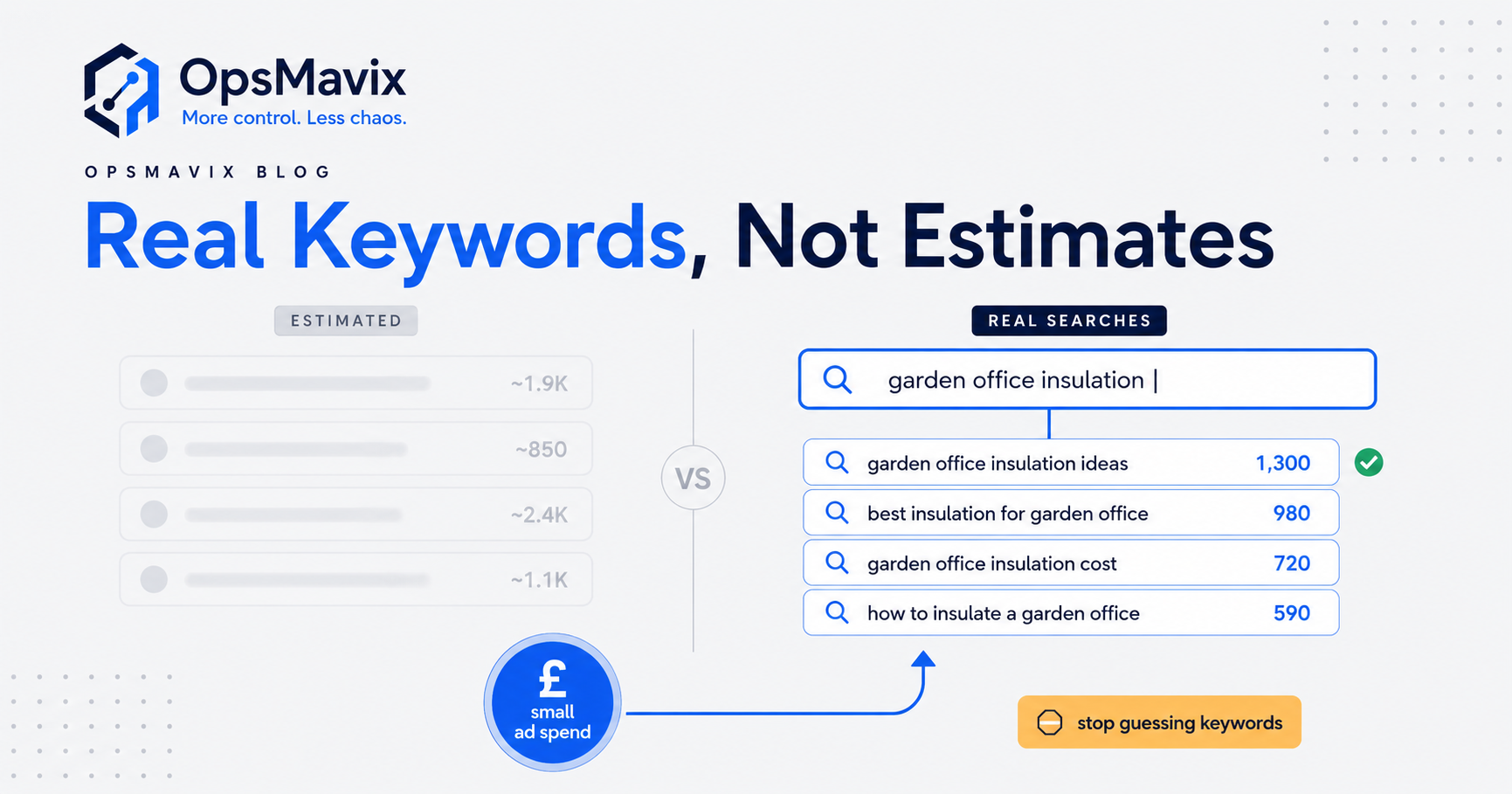
Quick summary: The most reliable way to find the keywords worth writing for is not a third-party estimate tool — it’s a small Google Ads search campaign. Ads shows you the exact search terms real people typed to reach a service like yours, not a modelled guess. Seed a campaign with researched keywords, run it for one to two weeks, harvest the real search-terms report, then build content and pages around what people genuinely search. Combined with basic on-page SEO and backlinks, this can produce movement from the first month, because you’re targeting confirmed demand instead of assumed demand.
The reason SEO so often feels like luck is that most of it is built on a guess. You pick keywords from a tool, write around them, and wait three to six months to find out whether the guess was any good. The method below removes most of that guesswork by getting the one thing every keyword tool only estimates: the exact words real people type.
Contents
Why SEO feels like luck
For most businesses, the SEO process looks like this: pay for an expensive tool, export a large list of keywords with estimated volumes, pick some that look relevant, write content, and wait. Months later, some pages rank and some don’t, and it’s rarely clear why. The advice online rarely gives an exact method — it gives principles, and a lot of dashboards that create the impression of progress without confirming that anyone is actually searching for the terms you chose.
The root problem is upstream of the content. If the keyword itself was a guess, then the best on-page SEO in the world is optimising a page for demand that may not exist. The single highest-leverage decision in the whole process is which terms you target — and that’s exactly the decision most people make on estimates.
Estimated keywords vs real search terms
A keyword research tool such as Semrush or Ahrefs is genuinely useful for scale, competitor mapping and getting a feel for a market. But the search volumes and keyword lists it gives you are modelled. They’re inferred from clickstream data, extrapolation and estimation. The tool is telling you what it thinks people search, and how often it thinks they search it. For a lot of long-tail and local terms, that estimate is thin, rounded, or simply wrong.
A Google Ads search campaign gives you something categorically different: the search terms report — the actual strings people typed into Google before clicking your ad. Not a category, not a rounded estimate, not a “related keyword”. The literal query.
| Keyword tools (Semrush, Ahrefs, etc.) | Google Ads search terms | |
|---|---|---|
| What you get | Estimated keywords + modelled volume | The exact queries real people typed |
| Source | Inferred / extrapolated data | First-party, confirmed searches |
| Long-tail accuracy | Often thin or missing | Captured as typed |
| Intent signal | Assumed from the keyword | Proven — they searched and clicked |
| Cost | Monthly subscription | A small, controlled ad spend |
| Best for | Scale, competitor mapping, ideas | Confirming what to actually write |
The distinction matters because it changes what you’re betting on. With estimates, you bet that the demand is real. With the search-terms report, you already know it is — someone typed it, saw your ad, and clicked. That’s a confirmed searcher with intent, not a line in a spreadsheet.
The method, step by step
The process is simple and repeatable across almost any type of company.
- Do the seed research. For the brand, identify the keywords and queries that genuinely fit the service. This is where a tool like Semrush does earn its place — use it to build the starting list, understand the market and spot themes. You’re not writing from this list; you’re using it to seed the campaign.
- Run a small Google Ads search campaign. Point a modest budget at those seed keywords. Use broad and phrase match deliberately here — you want Google to show your ad against adjacent queries, because those adjacent queries are the data you’re buying. Send clicks to a relevant page.
- Let it run for one to two weeks. Long enough to accumulate real search-terms data across enough clicks to be meaningful. Watch the search terms report fill up with the actual phrasing people use.
- Harvest the real search terms. Export the search-terms report. This is the gold — the exact language, the unexpected phrasings, the questions, the local and long-tail variants no estimate tool surfaced. Cluster them by intent.
- Write content and build pages around what people genuinely search. Now every blog post and landing page is aimed at confirmed demand. You’re not guessing the topic or the phrasing — you’re matching it.
- Do the on-page basics properly, then build backlinks. Titles, headings, internal links, structure, clean content — then earn links to the pages. Covered below.
Why Google Ads gives you the truth
Google is more likely to reward content that matches real searches, because that’s the entire job of a search engine — return the best answer to a genuine query. When your content is built from the search-terms report, you’re writing answers to questions Google already knows people ask, in the words they ask them. You’ve removed the gap between “what I think people search” and “what people search”.
There’s a second benefit that’s easy to miss. The search-terms report doesn’t just tell you which topics — it tells you the exact phrasing, which is often more valuable. People rarely search the tidy keyword a tool suggests. They search messy, specific, real-world questions. Writing for the real phrasing is how you pick up the long tail that competitors optimising for the clean keyword never touch.
Why this compresses the timeline
The usual SEO promise is three to six months before you see anything. A lot of that wait is the time it takes to discover that some of your keyword bets were wrong and to redo them. When the keywords are confirmed from day one, you cut out the most expensive part of the cycle — the guessing and the re-guessing.
Combine confirmed search terms, correct on-page SEO and backlinks, and it’s realistic to see movement from the first month rather than waiting half a year. This isn’t a magic-bullet claim — ranking still depends on competition, domain strength and how well the content answers the query. What the method removes is the self-inflicted delay of building on assumptions. You’re not waiting to find out if you guessed right, because you didn’t guess.
On-page SEO is not the secret
This is worth saying plainly, because a lot of the industry sells it as the hard part: on-page SEO is not where the advantage is. The rules for titles, headings, internal links, page structure and content quality are well documented and freely available. Anyone can learn them in an afternoon. They’re necessary — do them properly — but they’re not a differentiator, because everyone has access to the same rules.
The real advantage, the thing most competitors get wrong, is upstream: knowing the exact terms people search. Get the target right and competent on-page execution is enough. Get the target wrong and no amount of on-page polish saves the page.
Backlinks: the multiplier
Once the content is built on real demand and the on-page is clean, backlinks are what turn a good page into a ranking one. Links are still one of the strongest signals of authority and trust, and they’re what let well-targeted content actually climb rather than sit on page three.
The order matters. Backlinks to a page targeting a guessed keyword are effort spent promoting demand that may not exist. Backlinks to a page built from confirmed search terms are effort compounding on something you already know people want. Real search-term data, correct on-page, then links — in that order — is what makes the whole system work.
The honest caveats
No method is free of trade-offs, and pretending otherwise is how SEO got its reputation for hand-waving. A few honest ones:
- It costs ad spend. The search-terms data isn’t free — you’re paying for clicks to buy the intelligence. The upside is you often get real leads during the discovery phase too, so the budget frequently pays for part of itself.
- You need enough click volume. A campaign that gets a handful of clicks won’t produce a meaningful search-terms report. The niche has to have enough search activity to generate data in one to two weeks.
- Ranking in Ads is not ranking in organic. Paying to appear for a term doesn’t mean you’ll rank organically for it — it means you’ve confirmed the demand is real so it’s worth targeting organically. Two different games; the campaign informs the second, it doesn’t win it.
- It works best where intent is clear. Service businesses, local searches, problem-and-solution queries — the method shines. Very broad, ambiguous or purely informational markets are harder to read from a short campaign.
The method in one paragraph
Use a small Google Ads budget to discover the exact terms people actually search, create content around those terms, do the on-page SEO correctly, then build backlinks. That’s it. It works for almost any type of company, and it removes most of the luck and guesswork that makes SEO feel uncertain — not by adding another expensive tool, but by replacing estimated demand with confirmed demand before you write a single word.