
Four AIs Ran a Supply Chain. The Smartest One Caused the Worst Chaos.
In 2026 research, four large language models each ran one tier of the classic MIT Beer Game supply chain simulation. The result was blunt. The model you...
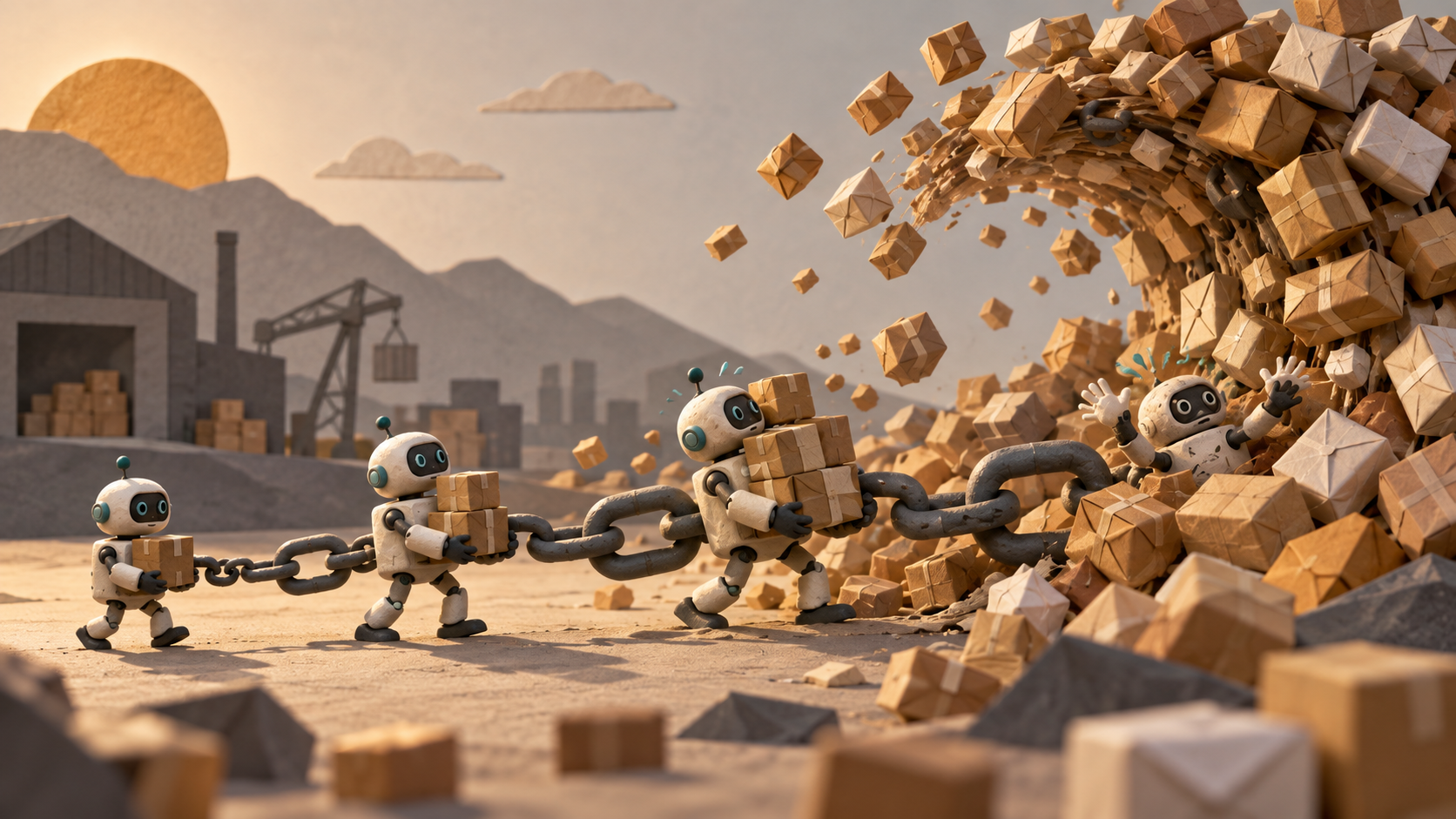
In 2026 research, four large language models each ran one tier of the classic MIT Beer Game supply chain simulation. The result was blunt. The model you pick decides everything, most setups drowned in bullwhip, and the most advanced collaborative framework performed worse than the rest.
What did the experiment actually test?
Researchers put LLM agents in charge of a supply chain and watched what happened. In the MIT Beer Game, a well-worn supply chain simulation, each player controls one tier: retailer, wholesaler, distributor, or factory. Every tier sees only the order coming from the tier below it, then decides how much to order from the tier above. The setup here handed one LLM to each tier, turning a business school teaching exercise into a test of whether AI can hold a chain steady.
Which mattered more, the AI or the setup?
The choice of LLM was the single most important determinant of performance. The agent’s reasoning ability fed straight into supply chain cost and stability. Weaker models amplified small demand blips into costly swings, while stronger models dampened them. So the same simulation, same rules, same starting demand, produced calm or chaos depending on nothing more than which model was sitting in the seat. That is a useful and slightly uncomfortable finding: the “brain” you drop into the job changes the outcome more than the job itself.
What is the bullwhip effect, and why did it show up?
The bullwhip effect is when small changes in customer demand turn into big swings in orders and stock as they travel up the supply chain. A shop sells a few extra units, the manager orders a lot extra to be safe, the supplier builds even more, and the wobble grows at every step. In the default decentralized setting, where each agent decides on its own the way most real supply chains work, most models suffered severe bullwhip. Left to optimize locally, with only the order below them to react to, the agents chased noise and overcorrected, exactly like a person or a spreadsheet with no rule telling it when to hold steady.
We ran the small-scale version of this with a very different “brain” in a companion piece, we let a fruit fly’s brain run a warehouse, and got the same failure. The controller barely matters. The missing rule does.
Why did the smartest AI cause the worst chaos?
Because coordination is not the same as intelligence. The research turned up what it called a collaboration paradox: the most advanced collaborative AI framework consistently underperformed simpler setups, producing service levels even worse than a non-AI baseline. Read that twice. The fanciest, most cooperative arrangement of clever agents did a worse job of keeping shelves stocked than doing nothing clever at all. Adding more sophisticated coordination between smart agents did not calm the chain. It gave the swings more ways to feed each other.
What actually fixes the bullwhip?
Coordination rules and a shared demand signal beat “smarter agents each optimizing locally.” The lesson from the experiment is not “buy a better model.” It is that structure wins. Below are the parts that do the real work.
A shared demand signal
Let every tier see real customer demand, not just the order from the tier below. When everyone reacts to the same true number instead of a distorted echo, the wobble stops multiplying on its way up the chain.
Coordination rules
Agree in advance how orders get placed and when to hold steady, rather than letting each seat improvise. Rules turn four independent reactions into one coherent response, which is the whole point.
Order smoothing
Do not fully correct a gap in one go. Ordering part of the shortfall each cycle damps the swing instead of amplifying it, whether the thing placing the order is a person, a spreadsheet, or an LLM.
What OpsMavix builds instead
This experiment sits squarely in our category: inventory, ordering, and the bullwhip effect that eats cash when they go wrong. The takeaway is not that AI cannot run a supply chain. It is that a chain of independent deciders, however clever, needs shared information and clear coordination rules or it will amplify its own noise. That is a systems problem, not an intelligence problem, and it is what we build for: one shared view of demand, reorder rules that fire on a line instead of a mood, and buffers sized by arithmetic. For the calm version on a single product, our inventory reorder calculator sets the reorder point and safety buffer in about a minute.
If your ordering swings between “sold out” and “drowning,” it is not bad luck and it is not a missing AI. It is a missing rule. Book a free Operations Leak Audit and we will show you where the bullwhip is hiding in your chain.
FAQ
What is the MIT Beer Game?
It is a supply chain simulation created at MIT where each player manages one tier of a chain and sees only the order from the tier below. It reliably produces a bullwhip effect and has been used for decades to teach how ordering rules, not smarter people, fix it.
Does a better AI model really run a supply chain better?
In this research, yes. The choice of model was the single most important factor in performance, because a stronger model dampened demand swings while a weaker one amplified them into costly bullwhip.
What is the collaboration paradox?
It is the finding that the most advanced collaborative AI framework consistently underperformed simpler setups, with service levels even worse than a non-AI baseline. More sophisticated coordination between smart agents made things worse, not better.
How do you actually reduce the bullwhip effect?
Give every tier the same view of real customer demand, agree clear coordination rules for how and when orders get placed, and smooth orders instead of fully correcting in one go. Structure beats swapping in a smarter decider.