
Fly vs Chess: A Unique Intersection of Insect Intelligence and Strategy Games
Fly vs Chess turns a fruit fly connectome into one of the internet's strangest chess opponents. Discover how the experiment works, why people are talking about it, and try playing against the fly yourself.
What Is Fly vs Chess?
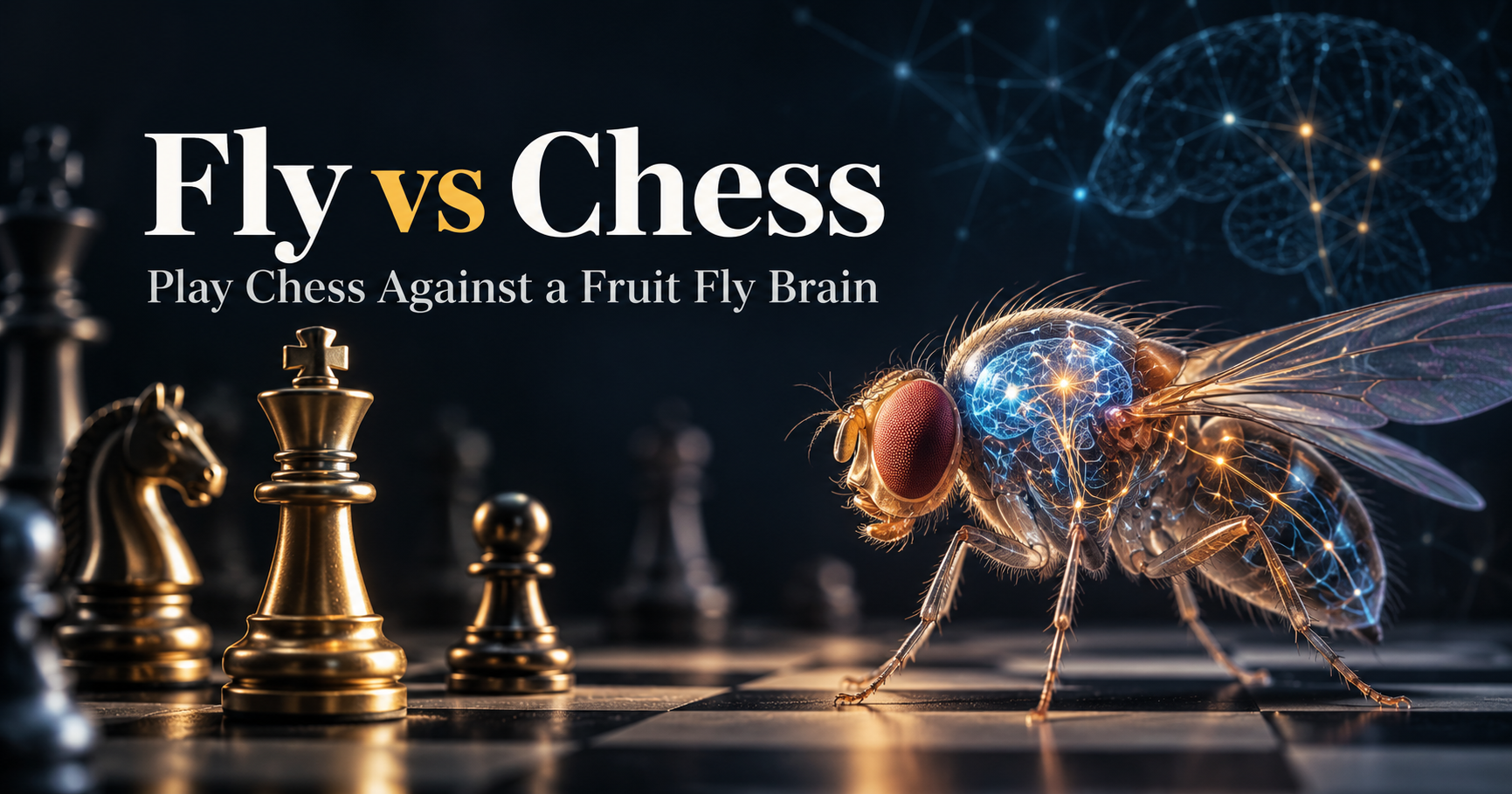
fly vs chess is a playful web experiment that turns a serious idea into something easy to get: what happens when a chessboard meets a digital fruit fly nervous system? Instead of treating chess only as a contest between people or old engines, the idea brings in insect behavior, technology, strategy games, and a very odd kind of opponent.
+Discover what fly vs chess is, why it is trending, how it works, and why a fruit fly connectome makes this chess experiment so engaging.
At first glance, it sounds like a joke from a chess club. But that is part of the appeal. It mixes a familiar board game with one of science’s smallest animals, then wraps it in a browser game.
Fly vs Chess is an online chess experiment built around a fruit fly connectome, which is a map of a fly nervous system. On the site, the game calls itself ‘Chess vs. a Fruit Fly’, says that ‘the fly is playing you’, and shows a chessboard next to live-looking labels such as optic lobe, central brain, sensory input, and motor output. The page also says the connectome used is the male fruit fly central nervous system v1.0, with the wiring left unchanged and only a linear readout of motor neurons trained. (flychess-hq.vercel.app)
In plain English, fly vs chess is not a case of a fly learning chess like a grandmaster. It is more like an interactive science-meets-game setup. Chess moves are fed into a model inspired by real fruit fly neural wiring, and the output becomes a strange opponent you can play.
That matters because it keeps the idea fun without making it sound bigger than it is. The joke is not that a housefly is calculating openings. The joke is that a tiny biological system, shown through modern tech, is being placed inside the strict world of chess moves.

Why Is Fly vs Chess Trending?
Fly vs chess seems to be trending because it sits where a lot of online curiosity meets: chess, AI, neuroscience, weird browser games, and the old urge to ask, ‘Can I beat that?’ Recent fruit fly connectome news also gives the idea a real science backdrop. Google Research described a 2026 project with HHMI Janelia Research Campus and others as releasing a full wiring diagram of the male fruit fly brain and central nervous system, while Janelia’s Male CNS Connectome page notes the MaleCNS paper and its work with Google Research and other groups. (research.google)
The novelty helps too. People are used to chess engines being scary, sharp, and a little cold. A fruit fly opponent feels different. It is funny, a bit absurd, and just plausible enough in the age of neural models to make people click.
A few likely reasons the idea gets attention are:
- It is easy to explain: ‘Play chess against a fly brain’ sticks fast.
- It is visually striking: A chessboard plus neural labels feels like science fiction.
- It mixes humor and curiosity: You can laugh at the premise and still wonder how it picks moves.
- It invites experimentation: Every game becomes a small test of unusual behavior.
- It fits tech culture: People like seeing biology, AI tools, simulations, and classic games collide.
How Fly vs Chess Works
Fly vs chess gives the player a normal chess interface, then presents the fly connectome as the source of the opponent’s choice. The site’s own text says the fly wiring is not changed and that chess is not stored in the connectome; instead, only a linear readout of motor neurons is trained. (flychess-hq.vercel.app)
Think of it like this: the fly system is not a tiny person at the board. It is a network being stimulated and read. The game turns board data into input, runs it through the connectome-inspired setup, and reads an output that becomes a move.
For players, the flow is simple:
- Open the game in a browser.
- Make a legal chess move.
- Watch the fly-side system reply.
- Follow the board and the activity labels.
- Adapt as you go.
The key point is that the fly does not understand chess the way people do. Instead, a chess position becomes input for a biological wiring-inspired system, and the result is turned into play. That is what makes fly vs chess feel different from a normal engine match.
Fly Strategy vs Chess Strategy
Fly strategy and chess strategy are almost comically different. Chess strategy is deliberate, symbolic, and rule-heavy. A player thinks about king safety, pawn structure, open files, forks, pins, discovered attacks, endgames, and chess tactics that can decide a position in one move.
A fly lives in a world of motion, smell, light, danger, food, mating signals, and fast response. Insect behavior is not about checkmating a king. It is about getting through a messy world fast enough to stay alive.
That contrast is the heart of fly vs chess. Chess asks for long-term planning. Fly behavior suggests fast reaction, pattern response, and sense-move loops. Put them together and you get a fun mismatch: a board game built for abstract thought, handled through a system inspired by animal wiring.
The chess side of the board
Chess strategy is built on clarity. Every piece has a fixed move pattern. Every legal move changes the position in a clear way. Strong players use calculation and judgment to ask practical questions: Is my king safe? Can I win material? Do I have a tactic? What is my opponent threatening?
That is why chess has become such a famous test for intelligence and computing. The rules are easy to state, but the number of possible lines stays deep.
The fly side of the idea
The fly side is interesting for the opposite reason. A fly does not use a neat list of chess rules. Its nervous system evolved for action in the physical world, not board games. When people talk about fly intelligence, they usually mean how a small nervous system can still support useful behavior: movement, sensing, learning, navigation, and response.
In fly vs chess, that makes a playful question: what happens when a system linked to real-world insect behavior is placed inside a rule-based strategy game? The result may not be ‘good chess’ in engine terms, but it can still be engaging because it feels alien.
What players can learn from the mismatch
The best way to think about fly vs chess is not to ask whether the fly is a future world champ. Treat it as a reminder that ‘strategy’ can mean different things in different systems.
For a chess player, strategy often means planning several moves ahead. For an insect, strategy may look more like fast action based on sensory input. For a builder, strategy can mean designing the right path from input to model to output. Fly vs chess brings all three ideas into one small, strange, memorable game.
How Intelligent Are Flies?
Flies are not smart in the same way humans are, and they do not know chess ideas like sacrifice, tempo, or mating nets. But fruit flies are important in science because their nervous systems are small enough to study in detail while still supporting complex behavior. Nature reported that the adult female fruit fly brain connectome has 139,255 neurons and more than 50 million chemical synapses, giving researchers a detailed wiring map for studying how information may move through the brain. (nature.com)
That is the sweet spot. A fruit fly is simple compared with a human, but not simple in everyday terms. It can sense, move, respond, and learn in ways that make it very useful for neuroscience.
So when people ask about fly intelligence, the answer depends on what they mean. If intelligence means writing poetry, planning a trip, or learning chess openings, then no. If it means using a nervous system to turn sensory data into adaptive behavior, then flies are much more interesting than their size suggests.
This is also why insect games can be more than a gimmick. Games give people a familiar way to explore an unfamiliar system. Instead of reading a dense paper on neural wiring, a general audience can meet the idea through a chessboard.
Of course, a game should not be taken as proof of fly awareness, chess understanding, or human-like thought. Fly vs chess is best seen as a playful doorway into connectomics, simulation, decision-making, AI interpretation, and the gap between behavior and understanding.
The strange appeal of insect games and strategy games
Insect games work because insects are familiar and strange at the same time. Everyone knows what a fly is. Most people have swatted one away or watched one zigzag through a room. But very few have thought about the wiring that makes that movement possible.
Strategy games work for another reason. They turn choices into visible results. Move a knight to the wrong square, and a fork might appear. Push a pawn too early, and a diagonal can open up. Chess makes invisible thinking visible on a board.
Fly vs chess joins those two pleasures. The insect gives the game character. The chessboard gives the experiment form. The tech gives the whole thing a reason to exist beyond the joke.
That mix makes the concept easy to share. A normal chess engine is impressive, but not surprising anymore. A fruit fly connectome making chess moves is surprising every time you say it.
How to Play Fly vs Chess Like an Experiment
The best way to enjoy fly vs chess is to stop expecting a normal computer opponent. If you approach it like Stockfish with wings, you may miss the point. Play like a curious observer.
Try this:
- Start with normal chess ideas. Control the center, develop pieces, keep your king safe, and avoid hanging material.
- Watch how the opponent reacts. Does it favor certain pieces, squares, captures, or odd lines?
- Test small changes. Try a quiet opening once, then a sharp one next time.
- Look for chess tactics. Even odd opponents can walk into forks, pins, skewers, and discovered attacks.
- Stay flexible. If the game becomes strange, treat it as a puzzle.
That is where fly vs chess becomes useful for decision-making. You are not just trying to win. You are making a guess, testing it, changing your plan, and learning from feedback. That same rhythm shows up in game design, research, and many kinds of problem solving.
For casual players, that can feel less intimidating than standard competitive chess. You do not need to know a lot of openings. You can just play, watch, and laugh when the board goes weird.
Where to Try Fly vs Chess
You can try fly vs chess in your browser and see the idea for yourself. The site shows a playable chessboard with the fruit fly connectome theme, plus labels that frame the opponent’s activity as sensory input, central processing, and motor output. (flychess-hq.vercel.app)
Because this is a web experiment, not a full chess platform, set the right expectations. Treat it as a playful demo, not as a replacement for serious engine study or rated online chess. If you want training, use a chess tool made for that. If you want a memorable ‘wait, what am I playing against?’ moment, this is exactly the kind of odd project the internet does well.
A good first session might look like this:
- Play one game normally and see what happens.
- Replay with a more tactical opening and compare the feel.
- Try simple chess tactics instead of deep theory.
- Share the idea with a friend who likes science, chess, AI, or strange web games.
- Use it as a talking point about how tech can turn research data into an interactive experience.

What Makes Fly vs Chess Worth Talking About
The real value of fly vs chess is not just whether the fly wins or loses. It is that the idea makes abstract science feel easy to reach. Connectomes, neural readouts, sensory pathways, and motor outputs can sound distant. Put them next to a rook and a queen, and the topic becomes easier to grasp.
It also gives players a fresh way to think about strategy. In chess, you usually judge a move by whether it improves the position. In a project like this, you may also wonder where the move came from, how the system turned the board into input, and why that output appeared.
That extra layer changes the feel. You are not only playing a game. You are watching a decision system act inside a rule-based space.
For teachers, creators, and curious players, that is powerful. It shows how games can make complex tech more inviting. It also shows how humor can open the door to serious ideas without making the whole thing feel like homework.
Frequently Asked Questions About Fly vs Chess
Is Fly vs Chess a real chess game?
Yes, it is a playable chess experience, but its main draw is the unusual opponent idea rather than standard chess training. The game uses the normal structure of chess while framing the opponent around a fruit fly connectome.
Is the fly actually thinking like a human chess player?
No. The site says chess is not stored in the connectome and that the fly wiring is not changed. It is better to think of the project as an experimental link between chess input and a connectome-based output system, not as proof that a fly understands chess. (flychess-hq.vercel.app)
Why use a fruit fly for this idea?
Fruit flies are widely used in neuroscience because they have small nervous systems that can still produce rich behavior. Recent connectome work has also made fruit fly neural wiring a visible topic in science and tech circles. (research.google)
Can Fly vs Chess improve my chess tactics?
It may help you stay alert in odd positions, but it should not be treated as a formal chess coach. If your goal is serious improvement, study tactics, review your games, and play opponents or engines made for training. If your goal is curiosity and fun, fly vs chess is a better fit.
Why are people interested in insect behavior and games?
Games make hidden decision processes easier to see. Insect behavior adds biological mystery. Put them together, and you get something fun and educational: a familiar board becomes a stage for thinking about intelligence, adaptation, and technology.
Final Takeaway: Fly vs Chess Is Weird in the Best Way
Fly vs chess works because it takes a serious science idea and gives it a playful shape. It does not need to prove that fruit flies are grandmasters. Its charm comes from the collision: insect behavior meets chess moves, fly intelligence meets human strategy, and a classic board game becomes a tiny experiment in decision-making.
If you enjoy strategy games, odd tech demos, or web projects that make you say ‘I have to see this’, this one is worth a look. Open the board, make a move, watch the fly respond, and decide for yourself whether you are ready to play fly vs chess.