
ERP Software for the Retail Industry: A Right-Sized Guide for Growing Shops
ERP software for the retail industry promises to run your POS, stock, purchasing, and reporting from one place. But most independent and growing retailers overbuy — they are outgrowing spreadsheets and disconnected tools. Here is the honest middle path.
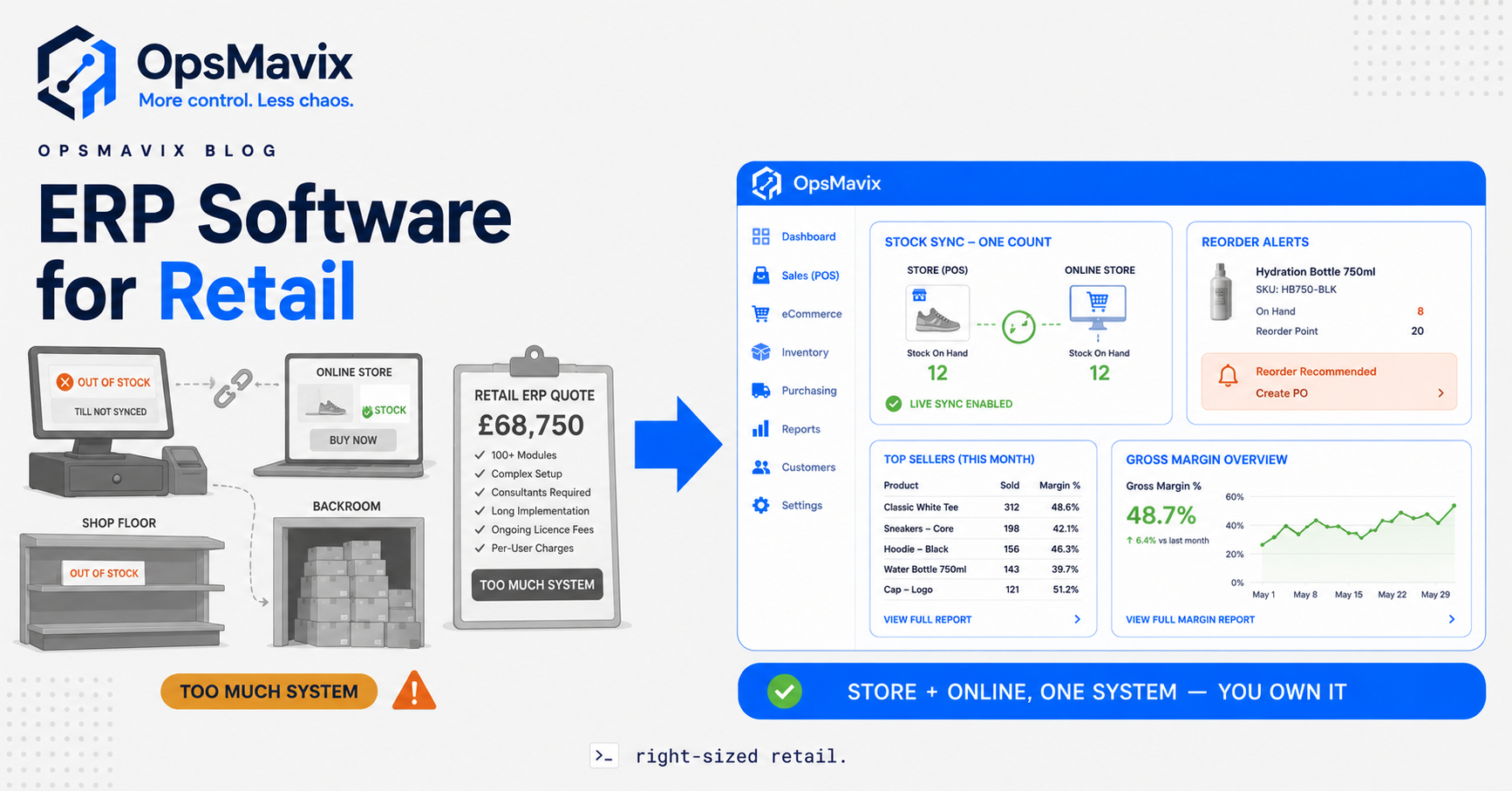
If you run a growing shop, you have probably been told you need “an ERP.” The pitch is tidy: one system for your point of sale, your stock, your purchasing, your suppliers, and your reporting, so the number on the shelf, the number on the website, and the number in the accounts finally agree. For a national chain with warehouses and hundreds of staff, that pitch is usually right. For an independent retailer with two or three shops, a website, and a stockroom that only one person really understands, it is often a trap.
ERP software for the retail industry is a category built for the top of the market and sold to everyone below it. The buyer down here is not confused about whether they need a system. They have already outgrown the spreadsheet, the shoebox of supplier emails, and the till that does not talk to the website. The real question is narrower and more expensive to get wrong: how much system do you actually need to close the gaps that are costing you money, without signing up for a two-year implementation and per-seat licences forever?
Quick summary: Retail loss is not an abstract worry. The British Retail Consortium’s 2025 Crime Survey found customer theft alone cost UK retailers £2.2 billion in 2023/24, part of a £4.2 billion total cost of retail crime, across more than 20 million recorded theft incidents — over 55,000 a day (British Retail Consortium, 2025). Theft is the headline, but the same blind spots that let stock walk out the door — no real-time count, no reconciliation between channels, no reorder discipline — also drive overstock, dead stock, and lost sales. A retail system earns its keep by making stock visible and accountable, whichever way it leaks.
Contents
What retail ERP software actually does
Strip away the branding and a retail ERP is a set of connected modules sitting on one shared database. The point of sale records what sold and takes the payment. Stock control decrements the count in real time, across every location. Purchasing turns low stock into supplier orders and tracks what is due in. Reporting reads all of it to tell you margin by product, sell-through by store, and which lines are dead money on the shelf.
The value is not in any single module. You can buy a good till, a good stock app, and a good accounting package separately. The value is that they share one source of truth, so a sale at the till, a return online, and a delivery into the stockroom all move the same number. When that number is trustworthy, everything downstream gets easier: reordering stops being a guess, stocktakes stop being a shock, and you can price and promote against real margin instead of gut feel.
That is the promise, and it is a genuine one. The problem is that full retail ERP platforms bundle a great deal more — warehouse management, franchise controls, loyalty engines, complex tax and multi-currency handling, workforce scheduling — and they charge for the whole thing whether you use it or not. Most growing retailers need perhaps a third of what a full retail ERP offers, and they need that third to work flawlessly. The rest is weight.
It helps to be concrete about which third actually earns its place in a growing shop. In practice it is almost always the same four things: a live stock count that stays right between stocktakes, purchasing that reorders before you run out, reporting that shows margin and sell-through by line, and — the moment you sell in more than one place — a single master count that keeps every channel honest. Everything else a full platform offers is either something you already have working elsewhere, or something you will not touch for years. The skill is telling the difference, because paying for a module you do not use is not a one-off waste — it is a fee you keep paying every month for the life of the contract.
Where independent retailers get burned
The specific pain is rarely “we have no system.” It is that the systems you have do not agree with each other. The till says one thing, the website says another, the accountant works off a spreadsheet that was accurate on the day someone last updated it. Nobody is lying; the data is just scattered, and reconciling it is a manual job that only happens when something has already gone wrong.
Three blind spots do most of the damage. The first is stock accuracy. If your count is only right at stocktake, you are flying blind for the eleven and a half months in between. You oversell lines that are actually gone and you sit on lines you think are running low. The second is reorder discipline. Without a reliable minimum-stock trigger, ordering is reactive — you notice a gap on the shelf, or a customer asks for something you cannot find, and only then do you chase the supplier. By that point you have already lost the sale and probably paid a premium to expedite. The third is margin visibility. Plenty of retailers know their total takings to the penny and could not tell you, without an afternoon of spreadsheet work, which products actually make money once you account for discounts, shrinkage, and the cost of holding stock that will not move.
There is a fourth, quieter cost that ties the first three together: the labour of reconciliation itself. Somewhere in most growing retailers there is a person — often the owner, often the best person in the building — who spends a chunk of every week exporting figures, pasting them into a spreadsheet, and squinting at the differences. That work produces nothing. It does not sell a thing or delight a customer; it just keeps the numbers from drifting too far apart, and it only ever happens after the drift has already cost you something. When people say a system “pays for itself,” this is usually the hidden line they mean: the day that stops being a manual job is the day you get a skilled person’s week back.
None of these blind spots require a full ERP to fix. They require a trustworthy count, a rule that fires before you run out, and a report that reads real numbers. That is a much smaller and cheaper thing than a retail ERP — but it is also more than an off-the-shelf app will do once you have more than one channel and more than one location.
Multichannel: the gap that quietly costs the most
The moment a shop adds a website, the stock problem stops being one problem and becomes a synchronisation problem. A jumper sold at the till has to disappear from the website’s available count within minutes, or you will sell it twice and disappoint a customer. A return online has to put a unit back into the pool the shop floor can see. A click-and-collect order has to ring-fence stock in the right store. Do this by hand and it breaks the first busy Saturday. Do it with two apps that each think they own the master count and you get double-sells, oversells, and a slow erosion of trust in your own numbers.
This is where growing retailers most often reach for a full ERP, because the ERP salesperson correctly points out that a proper platform keeps one master count. What they leave out is that you can get the same single-master behaviour from a right-sized system that syncs your till and your online store — without buying the warehouse module, the loyalty engine, and the franchise controls you will never switch on. If multichannel stock sync is your real leak, that is the gap to close, and it does not justify the price of the whole platform. Our write-up on order management for ecommerce walks through how the order side of that sync works in practice.
Multichannel also quietly changes what “in stock” even means. A unit sitting in the back of your Bristol shop is available to a walk-in customer, but is it available to sell online for next-day dispatch? Is it available for a click-and-collect order at your Exeter store? The honest answer depends on rules only you know — which locations fulfil online, how much buffer you keep back for the shop floor, whether a slow-moving line should be pushed online before it dies in the stockroom. A generic app cannot encode those rules because it does not know your business; a full ERP can, but you configure it inside a platform built for a much larger operation. A right-sized system lets you write those rules plainly, because they were the reason it was built. That is the difference between a count that is merely accurate and a count that is actually useful. Getting the underlying stock data trustworthy in the first place is the foundation, which is why it is worth reading how a proper retail store inventory management system handles the count before you layer channels on top.
The three ways to close the gap
There are broadly three routes a growing retailer can take. Each is the right answer for someone — the mistake is picking the one built for a different-sized business.
| Cheap / off-the-shelf tool | Full retail ERP | Right-sized owned system | |
|---|---|---|---|
| Best for | Single shop, simple range, one channel | Chains, warehouses, franchises, complex tax | Growing multi-shop or shop-plus-online retailer |
| Setup time | Hours to days | 6–18 months | Weeks |
| Cost shape | Low monthly per app, adds up as you stack apps | High upfront + per-seat/per-module fees forever | One build cost, you own it; add modules later |
| Stock accuracy | Good within the app, breaks across channels | Excellent, single master count | Excellent for your channels, nothing wasted |
| Fits how you work | You bend to the app’s assumptions | You bend your business to the ERP | Built around your actual process |
| Multichannel sync | Fragile, often needs bolt-on connectors | Built in, but you pay for everything else too | Built for exactly your channels |
| Ownership | Rented; stops when you stop paying | Licensed; leaving means re-platforming | Owned asset; yours to keep and extend |
| When it fails you | The day you outgrow one location/channel | The day the quote and the timeline land | Only if you genuinely need the heavy modules |
Be fair to the cheap tool. For a single shop with a straightforward range, a good POS-and-stock app is the right answer and buying anything heavier would be a waste. The trouble starts when you add a second location or a website, because that is precisely the point at which the off-the-shelf app’s assumptions stop matching your business, and you find yourself stacking connectors and copying data by hand.
Be fair to the full ERP too. If you are heading towards genuine scale — multiple warehouses, franchises, complex international tax — you will need that platform eventually, and building towards it early can save a re-platform later. The question is timing. Most growing retailers reach for the ERP years before they need its heavy modules, and pay for that weight the entire time.
The right-sized owned system is the honest middle. You build the third of a retail ERP you actually use — POS-to-online stock sync, reorder triggers, margin reporting — around the way your shop really runs, and you own it outright. When you do need more, you extend it. It is not a toy that you will outgrow in a year, and it is not a platform you are renting forever. This is the ground our inventory automation system is built for.
A useful way to choose between the three is to ignore the feature lists entirely and look at total cost over five years, including the cost of the things that go wrong. The cheap tool looks free until you count the connectors you bolt on, the hours lost to manual reconciliation, and the sales you miss when it cannot keep up — at which point its true cost is much higher than the sticker. The full ERP’s five-year cost is easy to see and easy to underestimate: the implementation fee is only the start, and the per-seat, per-module licences compound quietly for as long as you use it. The owned system front-loads its cost into a single build and then largely stops, which feels expensive on day one and cheap by year three. None of this tells you which to pick on its own; it tells you to run the sum honestly before a salesperson runs it for you.
Integrations and why ownership matters
A retail system is only as good as the things it connects to. In practice that means your card terminal and POS, your ecommerce platform, your accounting software, your couriers, and often a supplier feed or two. A full ERP handles these through its own connector marketplace, which is convenient until a connector is deprecated, priced up, or simply does not exist for the niche tool you rely on. An off-the-shelf app handles them through whatever integrations its vendor decided to build, and no others.
Ownership changes the maths. When you own the system, an integration is a piece of work you commission once and keep — not a monthly line item that can be withdrawn when a vendor changes strategy. If your accountant moves you to a different package, you point the connection at the new one. If a courier changes their API, you update it. You are never held hostage by a roadmap you do not control, and you are never told that the one integration your business depends on is “not supported on your plan.”
This matters most at the awkward middle size, where your stack is a little unusual — a specific POS, a specific ecommerce platform, a bespoke way of handling wholesale alongside retail — and the mass-market platforms only half-fit. An owned system is shaped to your stack, not the average of everyone else’s.
There is also a data point worth naming here. Your sales history, your supplier terms, your product margins, your customers — that data is one of the most valuable assets your business owns, and where it lives matters. On a rented platform it sits inside someone else’s system, exportable in theory but rarely in a shape you can actually use, and always subject to their pricing and their decisions. When you own the system, you own the data outright and can point any tool you like at it — a new accounting package, a demand forecast, a supplier scorecard — without asking permission or paying a gatekeeper. For a business whose whole edge is knowing its own numbers better than the competition, that is not a technical footnote. It is the point.
A worked example: a three-shop homeware retailer
Illustrative — not a claim about a specific client.
Consider a homeware retailer with three shops in the South West and a Shopify site, turning over around £2.1m a year. Stock lived in the POS for the shops and separately in Shopify for online. Once a week, a manager exported both and reconciled them by hand in a spreadsheet. It took most of a day, and it was already out of date by the time it was finished.
The leaks were ordinary and expensive. Double-sells on popular lines — sold in a shop and online before the weekly reconcile caught up — meant roughly a dozen apologetic “sorry, that’s actually gone” emails a month, and a handful of refunds. Reordering was by eye, so fast-moving lines went out of stock for days while slow lines piled up in the stockroom. A rough count put dead and overstocked lines at around £45,000 of cash tied up on shelves. And nobody could say, without a spreadsheet afternoon, which of the top 50 lines actually made money after discounts.
They priced a full retail ERP: around £30,000 to implement plus roughly £900 a month in licences, and a timeline that ran past the following Christmas. For a business this size, that was the heavy modules they would not use subsidising the third they would. The licence alone came to nearly £11,000 a year, every year, for warehouse and franchise features a three-shop homeware retailer was never going to switch on. And the timeline mattered as much as the money: the leaks were bleeding now, and the platform would not have stopped a single double-sell before the following winter.
Instead they had a right-sized owned system built for the gaps that were actually bleeding: a single master stock count synced live between the three tills and Shopify, minimum-stock reorder triggers per line, and a weekly margin-and-sell-through report that read real numbers. Build cost landed in the mid-teens of thousands, delivered in weeks, owned outright. The weekly reconcile day disappeared. Double-sells effectively stopped. Over the following two quarters they released a large chunk of that tied-up cash by clearing dead stock they could finally see and reordering the fast lines on time. The numbers here are illustrative, but the shape is typical: the money was in three specific leaks, and closing exactly those three cost a fraction of the platform.
FAQ
Is a full ERP overkill for a small retail business?
Usually, yes — at least early. Full retail ERP platforms are priced and scoped for chains, warehouses, and franchises. A growing independent typically uses a fraction of the modules and pays for all of them. If your real problems are stock accuracy, reordering, and channel sync, you can close those for far less. Buy the full platform when you are genuinely heading into warehouse-and-franchise territory, not before.
Can I keep my current POS and just fix the stock side?
Often, yes. A well-designed system can sit alongside your existing till and ecommerce platform and act as the single master count both read from, rather than forcing you to rip and replace. Whether that is possible depends on whether your POS exposes a decent integration point — which is one of the first things worth checking in an audit.
What is the difference between retail ERP and inventory management software?
Inventory management software focuses on stock: counts, locations, reorder points, valuation. A retail ERP wraps inventory together with POS, purchasing, accounting, reporting, and often much more, on one shared database. For many growing retailers the honest answer sits between the two — strong inventory and channel sync, plus the specific reporting and purchasing pieces they use, without the full platform’s weight.
How do I stop the shop and the website double-selling the same item?
You need one master stock count that both the till and the website read from and write to in near real time, so a sale in either channel immediately reduces availability in the other. Two separate apps each holding their own count will always drift. This is exactly the multichannel sync problem a right-sized system is built to solve.
If I start small, can I add more later without rebuilding?
That is the point of building an owned system rather than buying a rented one. You start with the modules that close your current leaks and extend it as you grow — adding purchasing automation, supplier portals, or richer reporting when you actually need them, right up to full-ERP scope if the business gets there. You are not locked into a plan tier or forced to re-platform.
How OpsMavix can help
OpsMavix builds right-sized, owned operations systems for retailers who are outgrowing spreadsheets but not looking for — or well served by — a full retail ERP. We start by finding where your stock, orders, and reporting actually leak, then build the smallest system that closes those specific gaps: live stock sync across your shops and website, reorder discipline, and reporting that reads real numbers, shaped around how you already work and owned outright so you are never renting your own operations. If you later need more, we extend it rather than replace it. See how the ecommerce side fits in our ecommerce inventory automation work, or start with the leak itself: Book a Free Operations Leak Audit
Sources
- British Retail Consortium — Retail crime “spiralling out of control” (2025 Crime Survey) — UK figures for customer theft (£2.2bn), total cost of retail crime (£4.2bn), and theft incident volumes in 2023/24.