
The Veeqo Alternative for Businesses That Outgrew Shipping Software
The best Veeqo alternative depends on why you're leaving. Veeqo is genuinely strong free shipping software owned by Amazon, but if your problem is orders, stock and production drifting apart, you need an operations system, not another labels tool.
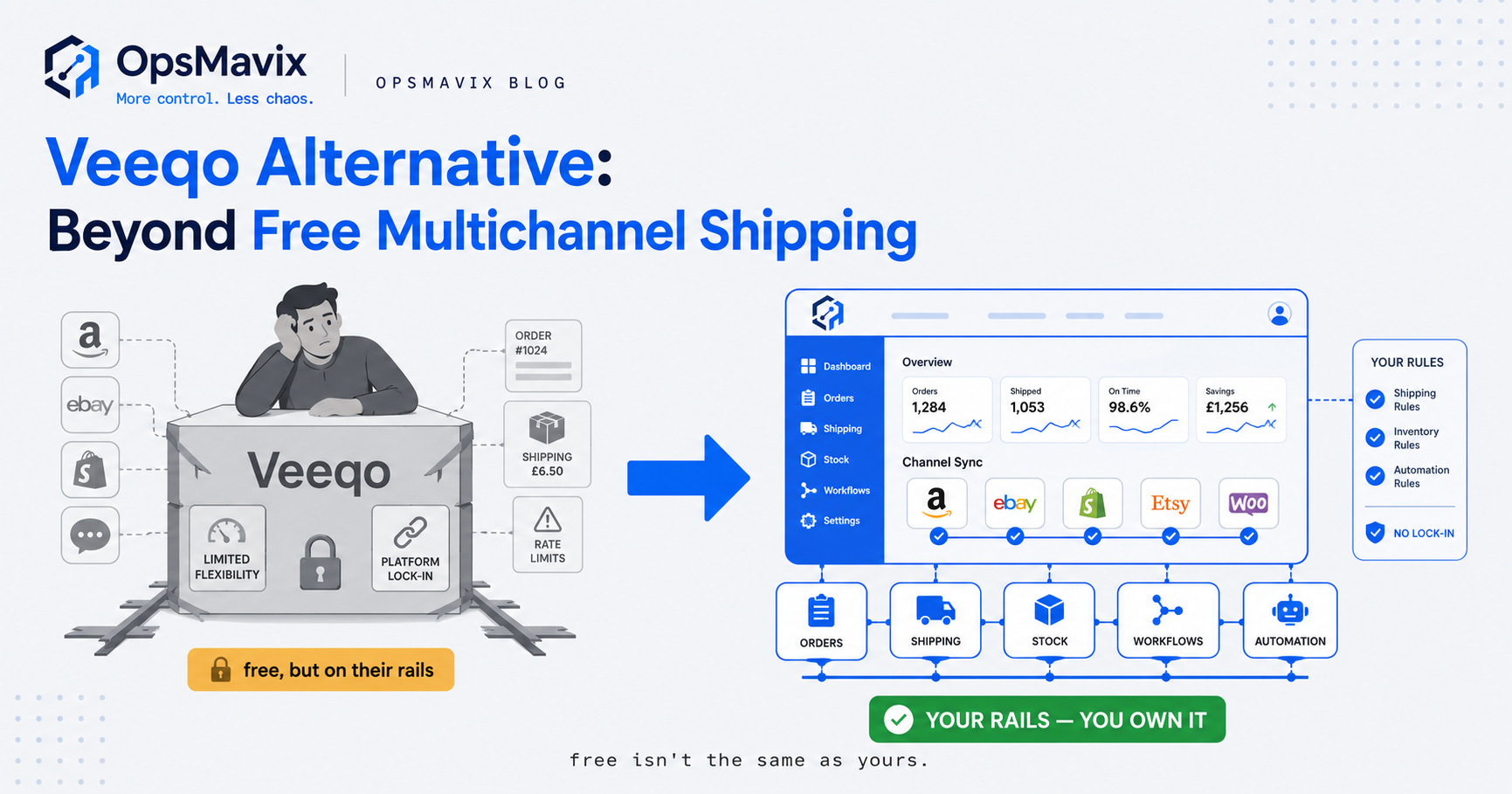
The best Veeqo alternative is not another free shipping tool — it’s an operations system that keeps your orders, stock, purchasing and dispatch in one place, so the numbers stop disagreeing with each other. Veeqo is genuinely good at what it does: free multichannel shipping, discounted carrier rates, and solid inventory sync. If you’re leaving it, the real question is whether shipping labels were ever the actual problem.
For most growing sellers who search for a Veeqo alternative, the pain isn’t the print button. It’s that stock says one thing, the marketplace says another, purchasing is a spreadsheet, and someone re-keys orders into a second system every morning. That’s not a shipping problem. That’s an operations leak, and no labels tool fixes it.
Key Takeaways
- Veeqo is Amazon-owned and free for shipping, with optional paid plans for advanced inventory sync. Validate that against your actual needs before you switch.
- “Free” has a ceiling: the tool is built to funnel volume through Amazon’s carrier network, so your workflow bends toward what suits the platform, not your ops.
- A Veeqo alternative should match the real problem. If it’s stock accuracy, purchasing and production drift, you need a system, not a shipping app.
- Multichannel sellers with stock complexity (bundles, kits, light assembly, multi-warehouse) hit the walls of any packaged tool fastest.
- The middle ground exists: between a shipping tool and a full ERP sits a right-sized operations system you actually own.
- Switching cost is real. Count re-keying, reconciliation and workaround time, not just the monthly fee.
What Veeqo Actually Is (and Why It’s Good)
Veeqo is multichannel shipping and inventory software. Amazon acquired it in 2021, and shipping is now permanently free: unlimited users, shipments and stores, with access to pre-negotiated UPS, USPS, FedEx and DHL rates that a small seller couldn’t get alone. You can even earn back up to 5% in Veeqo Credits on labels. Paid plans, priced on the order volume you sync, add deeper inventory sync and power features like digital picking.
For a seller whose main friction is “I ship from five channels and rate-shopping is painful,” Veeqo is a strong, honest answer. We won’t pretend otherwise. If free multichannel shipping with cheap carrier rates is the whole job, Veeqo does it well and you probably shouldn’t leave.
The trouble starts when shipping was never the bottleneck — it was just the part with a nice button.
The Ceiling: Free Isn’t Free When Your Ops Are the Cost
Here’s the OpsMavix point of view. When a tool is free and owned by the marketplace you sell on, the tool’s job is to move volume through that marketplace’s network. That’s a fair trade for cheap labels. It also means the software optimises for what suits Amazon’s shipping economics, not the messy reality of your operation.
That shows up as ceilings. Inventory sync that works until your stock model gets interesting: bundles, kits, assembled goods, components consumed by production. Reporting that answers “what did I ship” better than “what’s my true landed margin per SKU across channels.” Purchasing that lives outside the tool entirely. You end up with a fast shipping desk bolted to a slow, manual back office.
The monthly price being £0 is not the same as the operation being cheap. If two staff spend a combined ten hours a week re-keying, reconciling and chasing stock discrepancies, that’s the real bill, and it grows with volume.
When You’ve Genuinely Outgrown It
A concrete scenario. A wholesale-and-DTC seller runs Shopify, Amazon and eBay, plus a trade phone line. They hold 1,200 SKUs, assemble 40 gift bundles from loose components, and reorder from three suppliers on different lead times. Veeqo ships their orders beautifully. But the bundle stock never quite ties out, the trade orders arrive by email and get typed in twice, and nobody can answer “what do I need to reorder this week” without opening a spreadsheet.
None of those are shipping problems. They’re operations problems: assembly consuming component stock, a purchasing process with no home, and an order channel that never touched the software. This is the pattern we see again and again. Operators tell us the shipping tool was fine — it was everything upstream and downstream of the pack bench that stayed manual.
Six Questions That Tell You Whether It’s a Shipping Problem
Before you shortlist any Veeqo alternative, run through these. If most answers are “yes,” your problem lives upstream of the pack bench and no shipping tool will touch it.
- Does someone re-key orders from a channel the software never sees? Trade phone lines, email orders and B2B portals are the usual culprits. Every re-key is a place stock and price can silently diverge.
- Do bundles, kits or assembled items ever go out of sync? If selling one gift set is supposed to consume six components and the numbers drift, that’s an assembly and stock-model problem, not a labels problem.
- Is purchasing a spreadsheet with no reorder triggers? When “what do I reorder this week” needs a human opening a file and eyeballing it, you’re carrying dead stock in some SKUs and overselling in others.
- Can you see true landed margin per SKU, per channel? Most shipping tools answer “what did I ship,” not “what did that actually make me after carrier, fees and returns.”
- Does month-end reconciliation eat days? Hours spent squaring stock across channels are the clearest signal the back office is doing by hand what a system should do continuously.
- Would the shipping tool going away actually fix anything? If you’d still have every other headache tomorrow, shipping was never the bottleneck.
The point of the exercise is honesty. Some sellers run it and realise Veeqo is fine. Others realise the pack bench was the one part already working.
What a Real Veeqo Alternative Looks Like
The mistake is swapping one packaged tool for another packaged tool and expecting a different result. If Veeqo’s ceiling is that it’s built around Amazon’s shipping model, the answer isn’t a clone with a different logo — it’s a system shaped around how you actually operate.
That means one place where channels feed in, stock is accurate including bundles and assembly, purchasing has a real process with reorder triggers, and reporting answers your questions rather than the vendor’s default ones. It keeps the good part. Veeqo can even stay as the shipping layer if it’s earning its place, while the manual back office around it gets fixed.
This is the ground between a shipping tool and a full ERP: the practical middle you own, sized to your business instead of the other way round. If you’re weighing that middle against the marketplaces you already run, our breakdown of Linnworks alternatives and the wider Linnworks competitors comparison covers the same trade-off from the order-management side.
The £-Cost Framing Nobody Runs
Before you switch, do the sum most sellers skip. Not “what does the tool cost” but “what does the leak cost.”
Count the hours: re-keying trade orders, reconciling stock across channels, manually working out reorders, chasing discrepancies at month-end, and the sales you lose to overselling or the cash you tie up in dead stock from over-ordering. Put a rough £ figure on it per week. That number, not the subscription line, is what a proper operations system has to beat — and for a busy multichannel seller it’s usually where the real money hides.
A shipping tool, free or paid, cannot touch most of that, because most of it happens away from the pack bench. That’s the honest reason “free” stops being the deciding factor once you’re past a certain volume. If you want the endgame version of this, we’ve written up what a fully automated inventory system actually removes from your week.
Build, Buy, or Own the Middle
Honest take. If shipping is your only real friction, keep Veeqo. It’s free and good, and replacing it would be a step backwards. If you need a genuine ERP with finance, manufacturing depth and multi-entity accounting, buy one and budget for the implementation.
But most sellers searching for a Veeqo alternative are neither. They’ve outgrown a shipping tool and they’re nowhere near needing a full ERP. That’s the middle: an operations system sized to how you work, that keeps the shipping you like and fixes the manual mess around it. You own the shape of it, so it bends to your process instead of bending your process to a marketplace’s shipping economics.
Start by naming the actual leak. If it’s labels, you already have your answer. If it’s everything upstream of the labels, that’s the conversation worth having.
Keep reading
Getting value from OpsMavix? Add us as a preferred source on Google — you'll see more of our operations content in your AI Overviews, AI Mode and Search.