Mintsoft vs Peoplevox: Which Warehouse System Fits How You Actually Ship?
Mintsoft suits multi-client 3PLs and cost-conscious ecommerce warehouses; Peoplevox targets high-growth D2C brands that live and die by pick accuracy. Here is how the two differ on ownership, pricing shape and where each one stops.
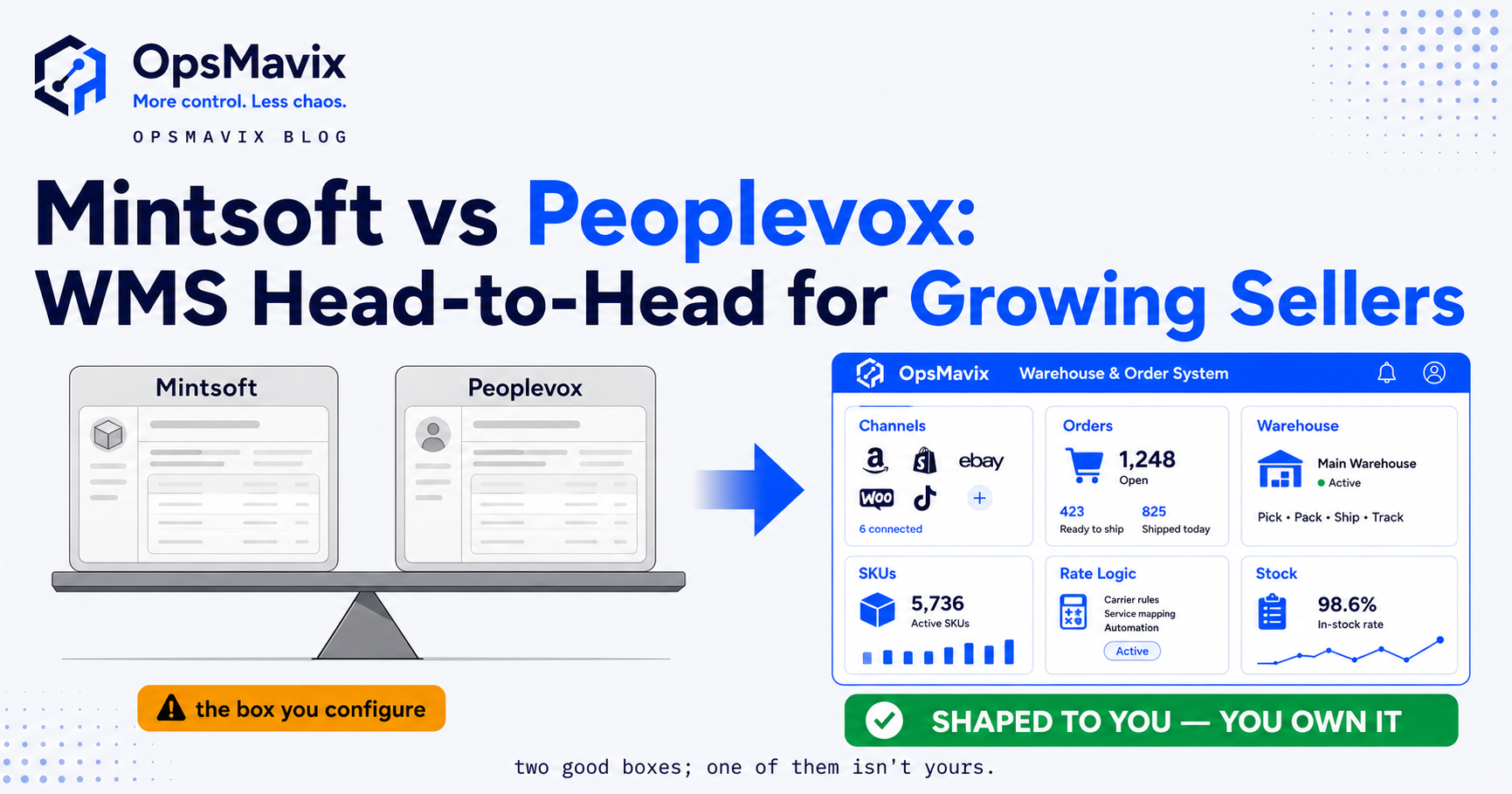
If you are weighing Mintsoft vs Peoplevox, the short version is this: Mintsoft (owned by The Access Group) is built around multi-client 3PL billing and lower-cost entry, while Peoplevox (owned by Descartes) is built around fast, accurate picking for high-growth direct-to-consumer brands. Neither is “better” in the abstract. They are shaped for different warehouses, and the right pick depends on whether your money comes from serving many clients or shipping your own orders fast.
Both are proper warehouse management systems, not spreadsheets with a barcode font. If you are comparing them seriously, you have already outgrown manual pick lists and stock counts that lie. The real question is which system’s assumptions match your operation, and where each one runs out of road once your process stops looking like the vendor’s template.
Key Takeaways
- Different owners, different DNA. Mintsoft sits inside The Access Group; Peoplevox is a Descartes product. That parentage shapes roadmap, pricing and who gets prioritised.
- Mintsoft leans 3PL. Multi-client separation, chargeable rates and client billing are first-class. If you fulfil for other brands, that is the draw.
- Peoplevox leans D2C pick accuracy. It is pitched hard at high-growth ecommerce brands that need throughput and shipping accuracy above all.
- Pricing shape differs sharply. Mintsoft advertises entry from around £159/month; Peoplevox sits higher, quoted in the four-figures-per-month range and clearly aimed at scale.
- Both are boxes. You configure inside their model. The moment your workflow needs something the box does not do, you adapt to it, not the other way round.
- There is a third option most comparisons skip: one operations system built around how you actually run, that you own outright.
Who Owns What, and Why It Matters
Mintsoft is now Access Mintsoft, part of The Access Group’s warehouse management line-up. That means it lives beside a broad stack of Access business software, and its roadmap answers to a large UK software group.
Peoplevox is Descartes Peoplevox, owned by the Descartes Systems Group, a logistics-technology company. Descartes positions Peoplevox specifically as an ecommerce WMS for high-growth brands, with a designated Client Success Manager on every plan and support by phone, email and video.
Neither ownership story is a red flag. Both are stable, well-resourced products. But it does tell you something: you are buying into someone else’s direction of travel, and your operation has to keep fitting inside it.
Mintsoft: Built for the Multi-Client Warehouse
Mintsoft’s strongest hand is the 3PL use case. It handles multiple warehouses and multiple clients from one interface, with clear separation between customers, chargeable rates, inventory held per client, and client invoicing based on storage, handling and shipping. There is a 3PL client portal and 3PL billing on the fulfilment-focused plans.
For a fulfilment house, that billing layer is genuinely valuable. Working out what each brand owes for storage and picks is exactly the admin that quietly bleeds margin when it lives in a spreadsheet.
Mintsoft also advertises a large integration count (131 standard integrations, 150-plus sales channels) and barcode scanning built into core workflows. Entry pricing is quoted from around £159/month, with 3PL plans from roughly £375/month, which makes it approachable for smaller operations.
Where does it hit a ceiling? When your operation stops being a clean multi-client fulfilment model. If you manufacture, kit, or run production alongside fulfilment, or your billing rules get unusual, you start bending your process to fit Mintsoft’s client-billing model rather than the reverse. We dig into that scenario in our guide on using Mintsoft for 3PL.
Peoplevox: Built for the High-Growth D2C Brand
Peoplevox points its energy at ecommerce pick accuracy and throughput. Descartes markets it around outcomes like high shipping accuracy, faster despatch and better inventory accuracy for brands scaling their own fulfilment. The core across plans covers goods-in, picking and sorting, returns, mobile barcode scanning, inventory control and reporting.
It connects to a focused set of ecommerce and shipping tools (Shopify, Shopify Plus, Adobe Commerce, BigCommerce, NetSuite, and carrier/despatch tools among them), and every plan comes with a named Client Success Manager rather than a ticket queue.
The trade-off is level of entry. Peoplevox is priced and positioned for scale, with plans quoted in the four-figures-per-month range (list pricing appears in AUD; confirm current UK figures with Descartes directly). It is not aiming at the £159/month end of the market, and its brand is D2C-first rather than 3PL-first.
Peoplevox is strong exactly there. Its ceiling shows up when your business is not a pure single-brand D2C shipper: heavy wholesale B2B, multi-client 3PL billing, or manufacturing steps sit outside its sweet spot, and you end up buying a specialised ecommerce picker to do a job it was not shaped for.
Head to Head: How to Actually Choose
Strip away the marketing and the decision is mostly about what makes you money.
Choose Mintsoft if you fulfil for other brands, need per-client billing and storage charges handled properly, and want a lower cost of entry. It is the more natural fit for a 3PL or a warehouse-as-a-service operation.
Choose Peoplevox if you are a single brand shipping high volumes of your own ecommerce orders, and pick accuracy plus despatch speed is the metric your day lives or dies by. It is the more natural fit for a scaling D2C brand.
If you find yourself wanting Mintsoft’s client billing and Peoplevox’s picking discipline and something to handle production or wholesale on top, that is a signal. It usually means your operation has grown past what any single off-the-shelf WMS box was designed to hold. For a wider view of the field, see our roundup of Mintsoft competitors and our take on the Fulfillor alternative question.
The Hidden Cost: Adapting Your Ops to Someone Else’s Box
Both systems ask the same quiet thing of you: change how you work to match how the software thinks. That is fine when your process is standard. It gets expensive when it is not.
Operators tell us the pain rarely shows up in the demo. It shows up eight months later, when a returns rule, a kitting step, or an odd client-billing arrangement does not fit the template, and the answer is “that is not how the system does it.” Then you are running a workaround spreadsheet beside the WMS you paid for, which is the exact leak you bought the WMS to close.
Put a rough number on it. If two staff each spend an hour a day on reconciliation and workaround admin the system should have handled, that is roughly 40 hours a month of skilled warehouse time spent feeding software. At a modest loaded rate, that is real money leaking every month, quietly, forever, on top of the licence fee.
Build, Buy, or Own Your System?
Here is the honest take. If your operation is a clean fit for one of these boxes, buy the box. A 3PL that needs standard client billing should look hard at Mintsoft. A D2C brand that needs raw picking speed should look hard at Peoplevox. Off-the-shelf is cheaper and faster to stand up when your process matches the template, and you should not pay to rebuild what already exists.
The third path matters when neither box fits. If your operation mixes fulfilment, wholesale, production and reporting, or your billing and workflow rules are genuinely your own, forcing that into a single-purpose WMS costs you in workarounds, integration glue and staff time for years. That is where one operations system, shaped to how you already run and owned by you rather than rented against someone else’s roadmap, stops being a luxury and starts being the cheaper option over time.
You do not need to decide that today. Get clear first on where your process actually leaks, and whether a box closes the leak or just moves it. That answer tells you whether the right move is Mintsoft, Peoplevox, or a system built around you.
Keep reading
Getting value from OpsMavix? Add us as a preferred source on Google — you'll see more of our operations content in your AI Overviews, AI Mode and Search.