
The Megaventory Alternative With Room to Actually Grow
Megaventory is a capable cloud inventory, order and light-manufacturing tool for small teams — until per-user pricing, transaction caps and shallow process depth start bending your operation around the software. This is the honest guide to when a Megaventory alternative makes sense, and why the real one is often an owned operations system rather than the next subscription.
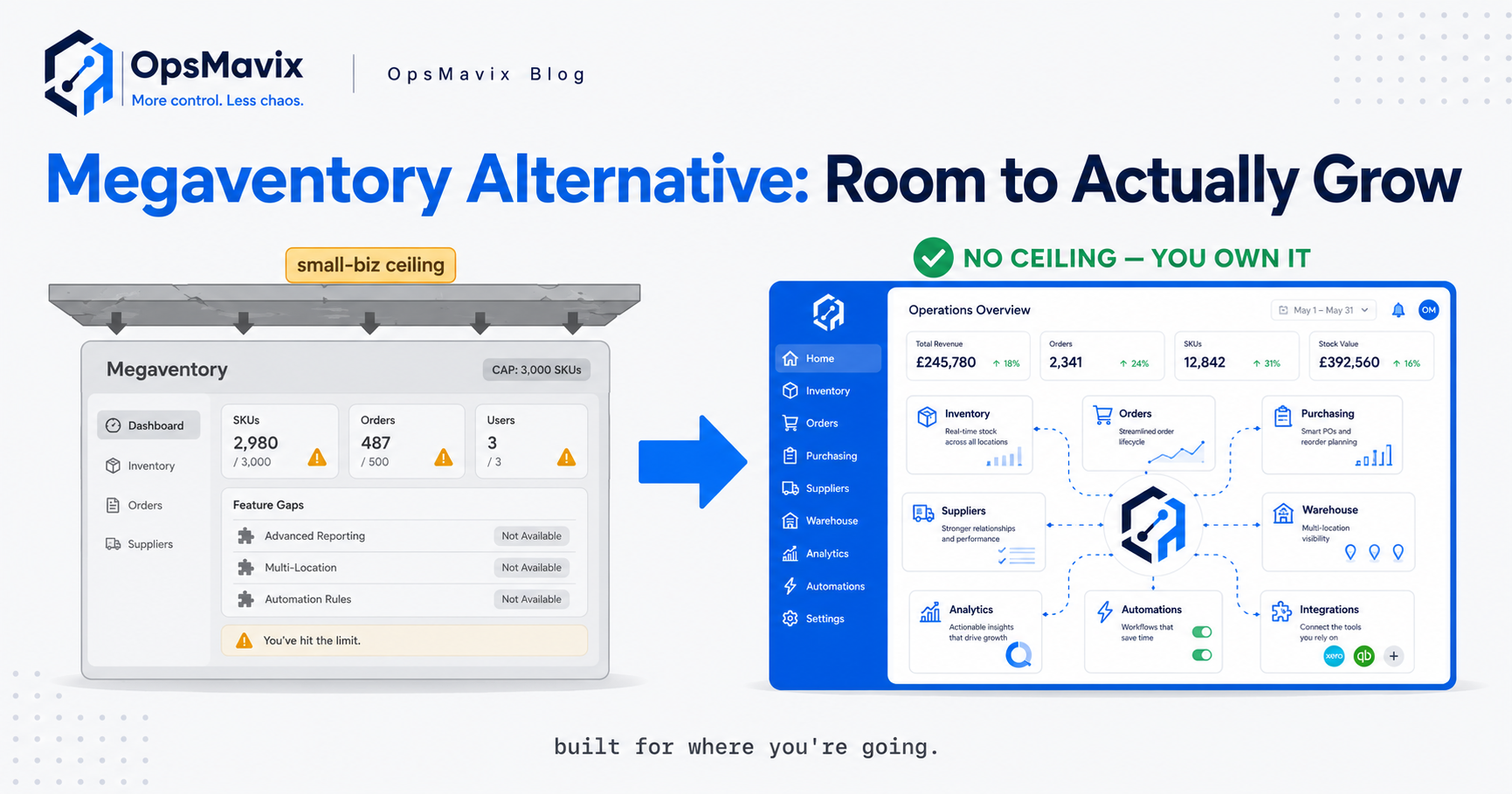
The best Megaventory alternative is usually not another inventory app with a slightly different menu — it’s one owned operations system shaped to how your business actually runs orders, stock and production. Megaventory does a real job for small teams: it centralises inventory across locations, handles purchase and sales orders, and covers light manufacturing without the weight of a full ERP. But the reasons people go looking for something else are rarely about a missing button. They’re about hitting the edges of a tool that was priced and shaped for a smaller operation than the one they now run.
Most people typing “Megaventory alternative” into a search box aren’t unhappy with its features. They’re tired of bending their operation to fit it — routing an odd order through a note, keeping a spreadsheet beside the tool for the thing it has no field for, or watching the monthly bill climb every time they add a user or cross a transaction line. That’s not a feature gap. It’s the ceiling of a packaged tool, and swapping one packaged tool for another just resets the clock until you meet the next one.
Key Takeaways
- Megaventory is a genuine small-business tool — cloud inventory across locations, purchase and sales orders, and light manufacturing with bills of materials — and for a small, standard operation it’s a sound, fairly priced choice.
- The caps bite as you scale — per-user seats, a transaction allowance, and process depth built for simple flows all start to cost you the moment your operation gets more complex than the template assumes.
- Pricing is per-user plus transactions — a base plan with a fixed seat count, charges for extra users and extra transaction blocks, and a mandatory onboarding fee. Success makes the bill go up, not down.
- The real alternative isn’t another subscription — it’s a system built around your exact order intake, stock movements and production steps, that you own outright, with no per-seat or per-transaction creep.
- Sometimes keeping Megaventory is the right answer — a small team with straightforward stock and orders should not replace working software for the sake of it.
- The honest test is fit over three years, not the headline monthly fee — model your seats, transactions and workarounds at next year’s size before you decide.
What Megaventory Actually Is
Be fair to it first. Megaventory is a cloud-based inventory and order management system with light manufacturing built in, aimed squarely at small and medium businesses. It’s developed by Megaventory Inc., a firm with roots in Greece, and it’s been around long enough to count as well-established rather than a new arrival. It handles multiple inventory locations, tracks stock levels with reorder points, processes purchase orders and sales orders, and supports drop-shipping and consignment. On the production side it covers work orders and bills of materials — enough to assemble or manufacture simple products and decrement the components as you go.
That’s a real product doing a real job. For a small team running stock across a couple of sites, buying in and selling out, and assembling the occasional kit or build, Megaventory covers the core without forcing you into the complexity and cost of a full enterprise suite. It sits deliberately in the practical middle — more structured than a spreadsheet, lighter than an ERP — and for the right-sized operation that positioning is exactly right. The question is only ever whether your operation has grown past it.
Where Megaventory Hits Its Ceiling
The ceiling shows up first as workarounds. A pricing arrangement the product has no clean home for, so it lives in a note. A production step with an inspection or a sub-assembly the light-manufacturing model doesn’t hold, so someone tracks it on the side. An order that arrives by phone or email rather than a tidy feed, re-keyed by hand. Each one is a small tax you pay forever and a fresh place for the numbers to drift. When the thing the software can’t hold cleanly is a routine part of your day, you’ve outgrown the template, not the category.
Depth is the second wall. Light manufacturing is genuinely light — fine for a straightforward build, thin once you need multi-level bills of materials, routing across work centres, scrap and yield tracking, or shop-floor visibility of what’s in progress. If your production is getting more involved, that shallow layer starts to leak into spreadsheets beside the tool. The same happens on reporting: the answer you need — margin by customer after real carriage, stock-turn by supplier, the true cost of a production run — is often a shape the product doesn’t produce, so someone rebuilds it from exports every month. This is the ground multi-location inventory management and deeper production tracking actually need, and it’s where a tool built for simple flows quietly stops answering the question.
The Pricing Reality
Megaventory prices in US dollars, so treat these as approximate once converted. The core plan runs at around £118 (converted) a month billed monthly and includes a fixed number of user seats — roughly five — with each additional user adding about £39 a month on top. The plan comes with a transaction allowance (in the region of 50,000), and once you cross it you buy more in blocks, at around £39 a month per extra 10,000 transactions. There’s also a one-off onboarding fee, mandatory, of roughly £1,180, and paying annually shaves about ten per cent off. A 15-day free trial lets you test before committing.
None of that is unreasonable for what it is — it’s honest small-business SaaS pricing. But notice the shape: every user you add and every busy month that pushes you past your transaction line makes the bill go up. The better you do and the bigger your team gets, the more you pay, on a price the vendor sets and can change on their timeline. For a healthy-margin small team that’s fine. For a growing operation adding people and volume, it’s a line that climbs in exactly the direction you’re trying to grow — and precisely what to model against a fixed-cost owned system before you sign, not after your headcount has doubled.
When Megaventory Is Genuinely the Right Choice
Sometimes buying it is the correct call, and we’ll say so plainly. If you’re a small team with a handful of users, stock across one or two locations, straightforward purchase-and-sell flows, and production that genuinely is light — a simple kit or assembly now and then — Megaventory fits. At that size, commissioning a system built around your operation would replace working software for no real gain, and the per-seat, per-transaction bill stays comfortably inside what the tool earns back. Replacing software that fits is its own kind of leak. Rent it, with a clear conscience, until the fit actually breaks.
The Right-Sized Middle: One Operations System
When the fit does break, the honest alternative isn’t the next inventory subscription with the same shape — it’s one owned operations system built around how you actually run. Not a stripped-down copy of Megaventory: the parts of an inventory, order and production tool you actually use, shaped to your flow. Orders entered once off whatever they arrive on — feed, email, phone, portal — and validated so wrong codes and quantities can’t slip through. One true stock figure every part of the business reads from, decremented the instant anything moves. Bills of materials and production steps modelled the way you really build, including the sub-assemblies and checks the light layer skips. The reports your decisions need, part of the system rather than a spreadsheet beside it. You own it outright — no per-seat charge as your team grows, no transaction block to buy, nothing a vendor can reprice or switch off. It’s the practical layer between a spreadsheet and an ERP: outgrowing spreadsheets and disconnected tools, and built to hold your operation rather than a template. That’s the same ground an operations control system is built on.
The Honest Build-vs-Buy Take
On the headline number, Megaventory wins at the start — a subscription is cheaper to switch on than a system is to commission. The honest comparison runs over three years: the monthly plan plus every extra seat plus every transaction block plus onboarding, on a price and roadmap the vendor controls, against a fixed build cost for a system you then hold with no creep. The crossover isn’t the same for everyone. Run the checks. Are you bending your process to the product, or does it hold your real flow cleanly? What does your bill look like at next year’s team size and volume, not today’s? How many spreadsheets sit beside the tool, and how deep does your production really go? A small, stable, simple operation should stay — renting is the right answer, and we’d tell you so. An operation that’s outgrowing the caps and the depth has met the ceiling of the template, and the fix is a shape that’s finally yours.
Keep reading

Getting value from OpsMavix? Add us as a preferred source on Google — you'll see more of our operations content in your AI Overviews, AI Mode and Search.