
The Khaos Control Alternative for Multichannel Operators
The best Khaos Control alternative is rarely another all-in-one box; it is one operations system shaped to how your multichannel business actually runs. Khaos Control genuinely covers inventory, orders, CRM and accounting, but its dated screens make you bend your process to fit them.
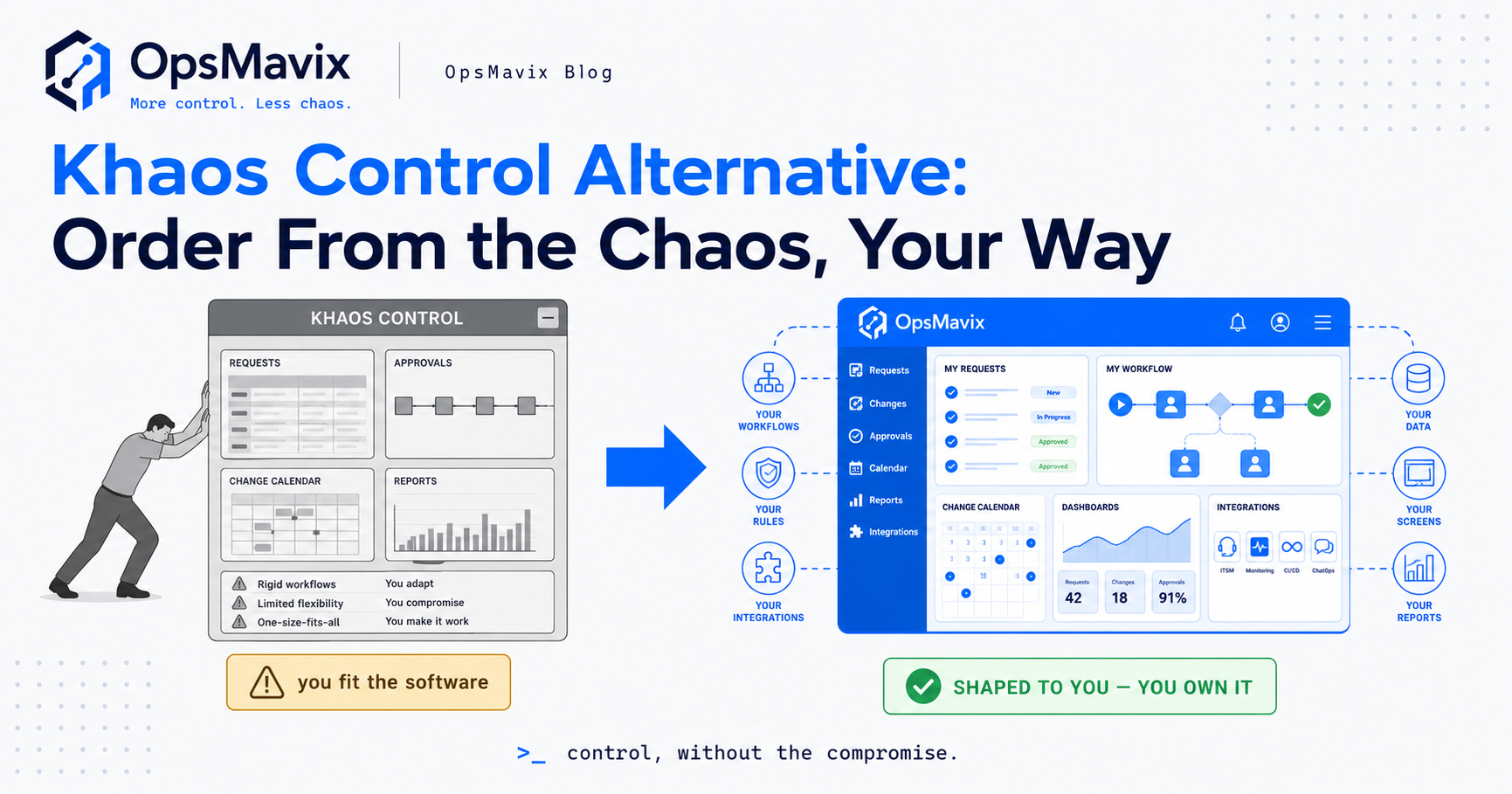
The best Khaos Control alternative is usually not another all-in-one retail suite; it is one owned operations system shaped to how your multichannel business actually runs. Khaos Control is a genuinely capable British product that folds inventory, order management, CRM and accounting into a single application, and for a busy multichannel retailer that is real value. But its strength and its ceiling are the same fact: it decides in advance how an operation should look, and past a point you find yourself working the way its screens want rather than the way your business does.
Most people searching for a Khaos Control alternative are not unhappy with its feature list. They are tired of bending their operation to fit dense, dated screens, paying for modules they half-use, and still dropping into a spreadsheet to answer the one question the software will not shape their way. This is an honest look at where Khaos Control earns its place, where it hits a ceiling, and what the right-sized middle looks like.
Key Takeaways
- Khaos Control is a real all-in-one, not a toy. It covers inventory, order management, CRM, purchasing and accounting for multichannel retailers and wholesalers in one place — more than most single-purpose tools do.
- It is British software with a long track record. Khaos Control Solutions Ltd is based in Grantham, Lincolnshire, founded in 2000 by Mike Cockfield and now an employee-owned British business, with a desktop application and a browser-based product, Khaos Control Cloud.
- The ceiling is fit, not capability. The friction is the dense, dated interface and the assumption that your process matches its mould; when it doesn’t, you build workarounds.
- Pricing is user-based, not order-based. Khaos Control Cloud is quoted per active user (published from around £63 per month, per user); the desktop product is quote-based.
- Swapping one box for another rarely fixes a fit problem. It resets the same friction 18 months later against a different vendor’s assumptions.
- The middle option is a system you own: not an ERP, not a cheaper clone, but software built around your actual multichannel flow, between a spreadsheet and a full ERP.
What Khaos Control Actually Is
Khaos Control is business management software for multichannel retailers and wholesalers, built and owned by Khaos Control Solutions Ltd, a UK company based in Grantham, Lincolnshire. It was founded in 2000 by Mike Cockfield and is now an employee-owned British business — a long-established British product, not a recycled US import with the currency swapped over. It comes in two main forms: the original Khaos Control, an installed desktop application for established, higher-volume retailers, and Khaos Control Cloud, the browser-based product aimed at younger, smaller operations.
What it covers is genuinely broad. In one application you get stock control across locations, order management pulling from marketplaces and webstores, purchasing and supplier management, CRM, despatch and shipping, and integrated accounting, with connectors to channels such as Amazon, eBay and Magento. Plenty of growing retailers run their entire back office inside it, and for a conventional multichannel operation that wants one system rather than five stitched together, it does a real job.
This is not a hit piece; the question is only ever whether “capable all-in-one” is what your operation is actually short of.
Where Khaos Control Hits Its Ceiling
The ceiling on any packaged suite is the same: it is built around an assumed shape of business, and it runs smoothly right up to the point where your shape is different. With Khaos Control the friction shows in two places.
The first is the interface. The desktop product is powerful, but it is dense and dated — a lot of tabs, grids and fields designed for someone who lives in it all day and has learned where everything hides. New staff take real time to become useful in it, a cost the invoice never shows. A heavy interface also shapes behaviour: when a screen is awkward for a step, people invent a side process to avoid it, and that side process becomes a place the numbers drift. The operation ends up organised around what the screens make easy rather than what the business needs.
The second is the standard-process assumption baked into any all-in-one: Khaos Control expects a particular way of receiving, allocating, picking, invoicing and reporting. When your operation matches that, it is smooth. When it does not — a consignment arrangement, an unusual backorder priority across sites, a bespoke price tier, a bundle drawn from several SKUs, an order that arrives by phone rather than a clean feed — you reach for a workaround, and the workarounds are the tell. When the step the software fights you on is a routine part of your day, you have not outgrown the category; you have outgrown the mould. This is the wall behind almost every multichannel Linnworks alternative search: the tool does its job, and the operation is quietly held together by the spreadsheets bolted either side of it.
The Pricing Reality
To its credit, Khaos Control does not price the way a marketplace tool does. Khaos Control Cloud is quoted per active user rather than per order, and the vendor states it does not charge on the number of orders you process, the channels you connect or the SKUs you store. Published pricing starts from around £63 per month, per user, with volume discounts above a handful of seats and no long-term contract. The full desktop product is not published as a simple tier; it is quote-based, sold against your setup and requirements.
Everything here is already in sterling, which makes the sums cleaner than most. But per-user pricing scales with headcount, and warehouse operations add heads exactly when margins are tightest, so every login you hand out adds to the bill — and you are still renting software you cannot reshape. Over three or four years the total, plus implementation and training, often lands in the same postcode as owning a system built around your process, except at the end you still own nothing.
When Khaos Control Is Genuinely the Right Choice
Sometimes buying it is the correct call. If you are a conventional multichannel retailer or wholesaler with a fairly ordinary receive-allocate-pick-invoice flow, and you want inventory, orders, CRM and accounting under one roof rather than a stack of separate tools, Khaos Control is a serious, credible answer. An established British product with integrated accounting is a real advantage over stitching a marketplace tool to a separate finance package and reconciling the boundary every month-end.
If that describes you, and your only friction is that the interface takes some learning, staying put is a perfectly good decision — replacing working software that fits your operation is its own kind of leak. The honest question is never “is Khaos Control good”; it is whether your operation is standard enough to live inside its mould without a drawer of workarounds.
The Right-Sized Middle: One Operations System
There is a gap between “another all-in-one box” and “a full ERP” where a lot of growing multichannel operations actually belong: the practical layer between a spreadsheet and an ERP, one system that models your inventory, orders, purchasing, CRM and reporting the way your operation genuinely runs, not the way a packaged suite assumes it should.
This is the OpsMavix position, and it is deliberately not “a cheaper Khaos Control”. We do not sell an ERP and we do not sell a clone. We build the operations system you own, shaped to the non-standard steps that break packaged suites — the consignment arrangement, the two-site allocation rule, the report that has to be right first time. The point is not more modules or busier screens; it is zero workarounds: orders entered once off whatever they arrive on, one true stock figure every channel reads from, and the fields and reports your decisions need built in rather than exported. For businesses outgrowing spreadsheets but not looking for the weight, cost and screens of a full ERP, this middle is usually the honest answer — the same choice we lay out in operational systems vs ERP, and the wall a broader suite like Brightpearl runs into in our Brightpearl alternative piece.
The Honest Build-vs-Buy Take
Here is the straight version. Buy Khaos Control if your operation is genuinely conventional, you want inventory, orders, CRM and accounting in one British-built package, and your only real complaint is that the screens take some getting used to. Switching to a marginally different all-in-one will not fix a fit problem; it just moves it to a new interface and resets the learning curve for nothing.
Own a system when the workarounds are the operation — when a spreadsheet beside the software is the real source of truth, when you pay per seat for access people ration, when the report you need never comes out the shape you need it. At that point you are not short of features; you are short of fit, and no amount of shopping for another box fixes that. The right move is not the suite with the longest feature list; it is the one that ends the specific leak you are living with — and the cheapest first step is simply finding out where that leak actually is.
Keep reading
Getting value from OpsMavix? Add us as a preferred source on Google — you'll see more of our operations content in your AI Overviews, AI Mode and Search.