
Looking for a Brightpearl Alternative? How to Choose the Right Fit
The best Brightpearl alternative depends on where the platform is straining for you — cost, implementation length, or being sized for retailers larger than you are. This guide covers who Brightpearl genuinely suits, where the ceiling shows, and how to choose without over-buying an enterprise platform you'll only half-use.
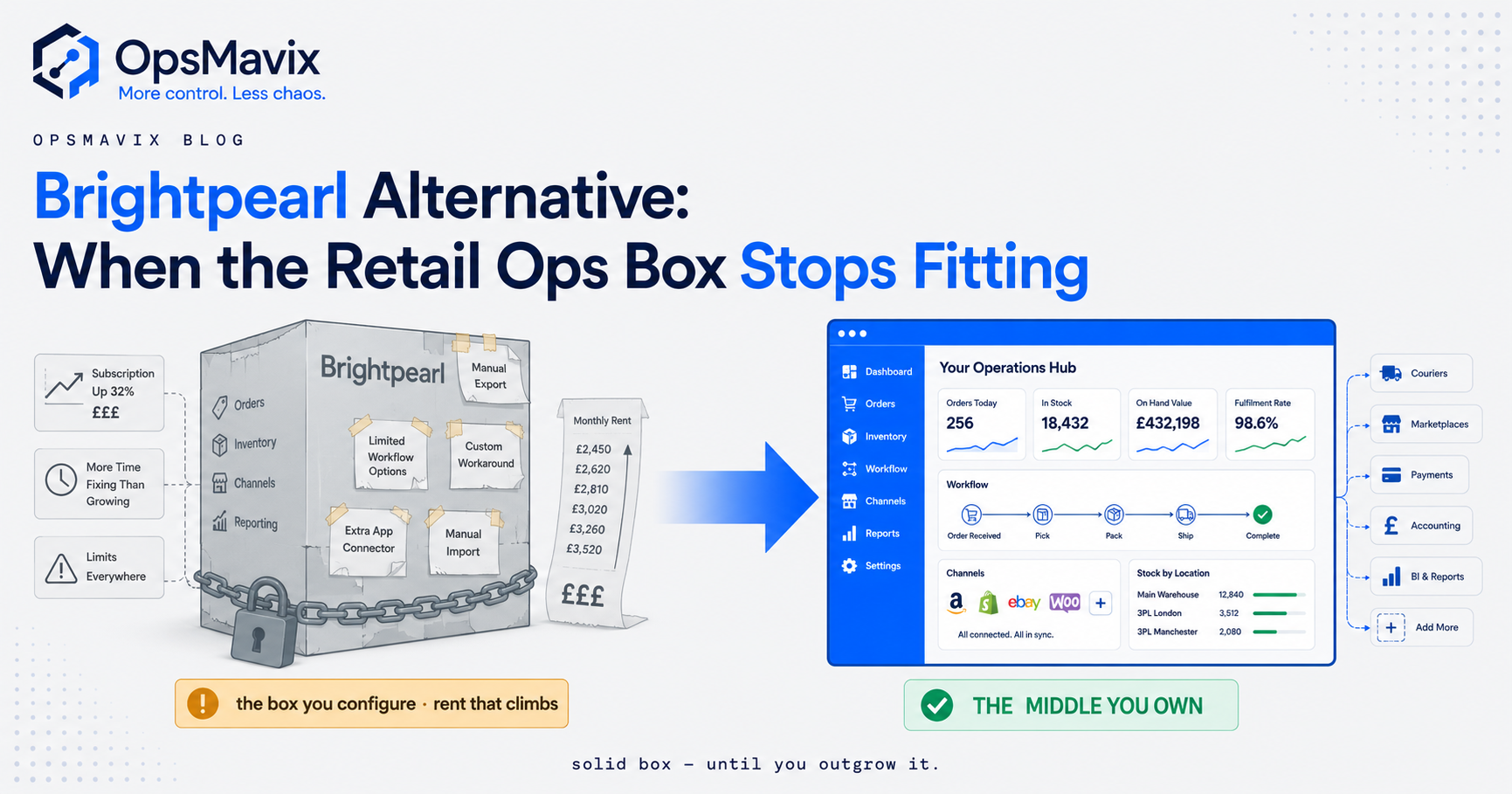
The right Brightpearl alternative is the one sized to how you actually run, not the biggest platform you can afford. Brightpearl, now Brightpearl by Sage, is a genuinely capable retail operations platform: it ties multichannel orders, inventory, purchasing, fulfilment and accounting into one back office, and for mid-market retail brands turning over several million a year across DTC, wholesale and physical retail, it earns its place. The reason people search for an alternative is rarely that Brightpearl is bad. It’s that they’ve outgrown their spreadsheets but haven’t grown into an enterprise platform yet, and Brightpearl is priced, scoped and implemented for the tier above them.
So the useful question isn’t “what’s better than Brightpearl?” It’s “what’s the right size for a business at my stage, with my order volume and my specific mess?” Below is how to answer that honestly, including where Brightpearl is the right answer and where it quietly isn’t.
Key Takeaways
- Brightpearl is a real retail operations platform, owned by Sage since its 2022 acquisition, built for multichannel retailers and wholesalers consolidating orders, stock, purchasing and accounting.
- It’s quote-only and configuration-heavy. Pricing is bespoke, with implementation typically running eight to sixteen weeks, which is why smaller operators feel the cost and time before they feel the benefit.
- The real trigger for an alternative is fit, not quality. Most people looking are sized below Brightpearl’s mid-market sweet spot.
- Over-buying an enterprise platform is its own leak. You pay for modules you never switch on and configuration you can’t maintain.
- The gap most people are actually in sits between a spreadsheet and a full retail ERP, and that gap has its own right-sized answer.
- Choose on your actual workflow, not the feature grid. The platform that maps to how your team already works wins.
Where Brightpearl Genuinely Fits
Brightpearl is strong when your problem is genuinely multichannel and genuinely at scale. If you’re selling across Shopify, Amazon, eBay, wholesale accounts and a physical shop, and you need stock to reconcile across all of them in near real time, Brightpearl does that well. Its inventory sync is fast, its demand-planning suggests reorder points off real sales velocity, and its accounting is baked in rather than bolted on.
The platform’s own positioning tells you who it’s for. Post-Sage, Brightpearl is aimed at retail brands doing several million to tens of millions in revenue, running finance, warehouse and operations teams that need one back office instead of five disconnected tools. If that’s you, Brightpearl is a serious, defensible choice and you should take it seriously.
Where the Ceiling Shows
The ceiling isn’t a missing feature. It’s the shape of the commitment. Three things tend to push people toward a Brightpearl alternative.
First, cost. Brightpearl is quote-only, and publicly reported estimates put the platform in the four-figures-a-month range before user seats and implementation, with implementation itself frequently a five-figure project. For a business doing a few million in revenue, that’s affordable but not casual — and if you’re using a third of the modules, the maths stops working.
Second, time to value. Implementations commonly run eight to sixteen weeks. That’s not a criticism of Brightpearl — configuring a real operations platform properly takes time. But an operator bleeding two hours a day re-keying orders wants the leak stopped this quarter, not staffed as a project into next one.
Third, fit. Brightpearl is a retail operations platform. If your operation is more warehouse-and-wholesale, or production-and-assembly, or “we sell online but the real chaos is in purchasing and supplier lead times,” you’ll find yourself bending a retail-shaped tool around a non-retail-shaped problem. Picture a components wholesaler doing four million a year: most of the pain isn’t order sync across shops, it’s supplier lead times slipping and stock being promised twice. A retail platform will happily manage the orders it can already see and do very little about the purchasing chaos underneath, which is where the money is actually leaking.
The Trap of Over-Buying
Here’s the OpsMavix view, and it’s a contrarian one: the most expensive software mistake isn’t buying something too cheap. It’s buying something too big.
When you buy an enterprise platform for a mid-stage problem, you pay three times. You pay the licence for modules you never switch on. You pay the implementation cost to configure workflows you don’t run. And you pay the ongoing tax of a system too complex for your team to change without a consultant every time the business shifts.
It’s a common enough pattern: a business spends a full quarter and a five-figure implementation budget to end up with a system that technically covers everything and practically solves the one thing they cared about badly. The feature grid goes green. The daily reality doesn’t. Picking a right-sized system in the first place is what avoids paying that tax twice.
The Middle You Actually Own
Between a spreadsheet and a full retail ERP like Brightpearl there’s a real, unglamorous gap. It’s where a lot of growing operators actually live: outgrowing spreadsheets and manual admin, not yet complex enough to justify (or maintain) an enterprise platform.
This is the layer OpsMavix builds in. Instead of buying a platform sized for a business two stages ahead of you and configuring it down, you get one operations system built up around the workflows that are actually leaking — inventory, orders, purchasing, production, reporting — and nothing you don’t run.
The distinction matters. This isn’t a cheaper Brightpearl clone, and it isn’t an ERP. It’s the right-sized middle: the practical system layer that stops the specific leak, maps to how your team already works, and stays simple enough that you can change it as the business changes. If your problem is one or two workflows that are genuinely bleeding time and money, you don’t need forty modules. You need those two done properly and wired to each other.
How to Choose Without Over-Buying
Work backwards from the leak, not forwards from the feature list. A few honest questions sort most of it:
Where does the time actually go? If your team loses hours to re-keying orders between channels, chasing stock that doesn’t reconcile, or rebuilding the same report by hand, name those specifically. That’s your real spec — not “we need an inventory system.”
How multichannel are you, really? Genuinely selling across five channels with a physical store and wholesale accounts pushes you toward a platform like Brightpearl. Mostly one or two channels with a purchasing or production headache underneath pushes you toward something narrower and cheaper to own.
What can your team maintain? A platform you need a consultant to touch is a dependency, not an asset. The best fit is the one your own people can adjust when the business moves.
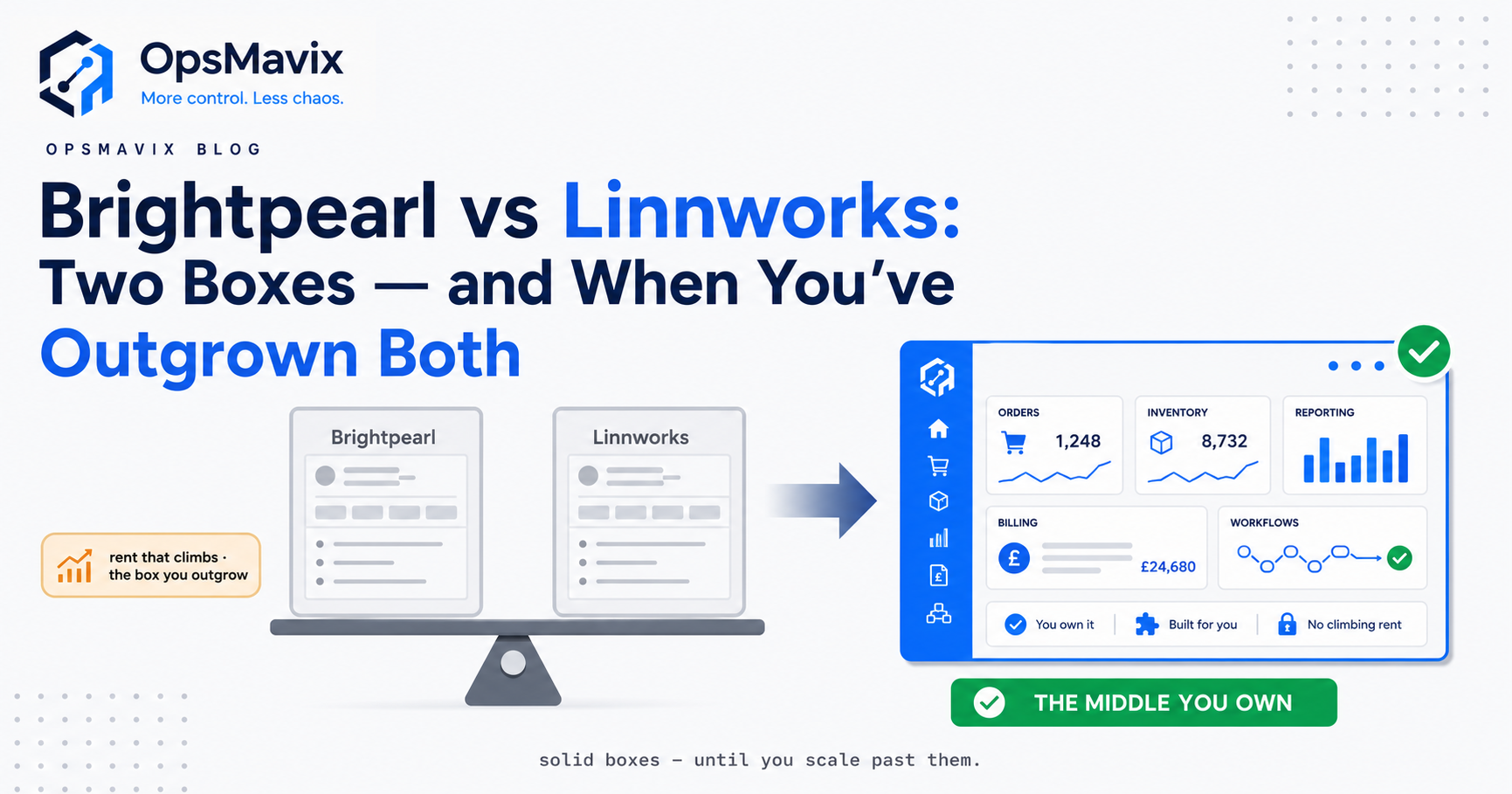
If you’re comparing options in this space, it’s worth reading the head-to-head on Brightpearl vs Linnworks to see how two platforms in the same category actually differ, and the broader guide on choosing a Linnworks alternative for how the same “right-sizing” logic applies across the category.
Build, Buy, or Own the Middle
The honest take: sometimes you should just buy Brightpearl. If you’re a genuine mid-market multichannel retailer and you want one integrated back office off the shelf, backed by Sage, it’s a sound choice and building something bespoke would be a waste of money.
Buying an off-the-shelf platform is fastest when your operation looks like the average the platform was built for. It strains when it doesn’t — when you spend the implementation budget bending the tool around the twenty percent of your workflow that makes you money and doesn’t fit the template.
Owning a right-sized operations system makes sense when your leak is specific, your workflows are a bit non-standard, and you want something that maps to your business rather than the reverse — without the cost and lock-in of an enterprise platform you’ll half-use. That’s the middle we build. If that sounds like the shape of your problem, and you’re not sure whether you’re a platform buyer or a right-size-the-middle case, the fastest way to find out is to look at where the time actually goes first. People who’ve already made the call and want out can read leaving Linnworks for how a switch actually plays out in practice.
Pick the size that matches your stage. The best system is the one you’ll actually use every day, not the one with the longest feature list.
Keep reading
Getting value from OpsMavix? Add us as a preferred source on Google — you'll see more of our operations content in your AI Overviews, AI Mode and Search.