
The Job Cost Sheet Explained: Line Items, Layout and a Worked Example
A job cost sheet is the single document that gathers every direct material, direct labour hour and overhead cost charged to one specific job. This guide shows the exact line items, a worked layout you can copy, and where the numbers usually go wrong.
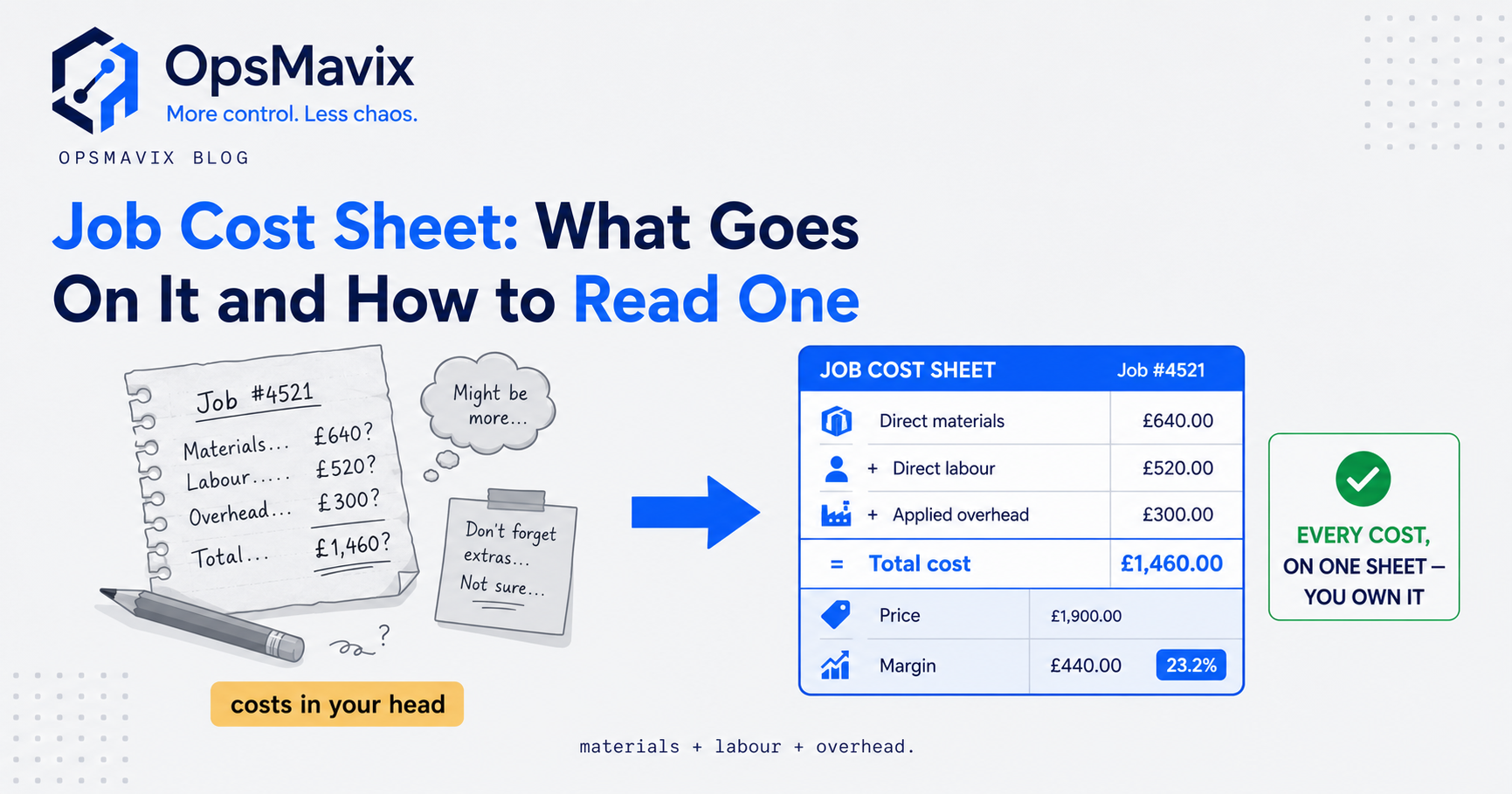
A job cost sheet is a single document that records every cost charged to one specific job: the direct materials it consumed, the direct labour hours worked on it, and the applied overhead allocated to it. It is the running total for one job number, and when the job closes it becomes the record you compare against the price you quoted.
Think of it as the ledger for a single order rather than for the whole business. A manufacturer building a batch of 200 brackets, a fabricator welding a bespoke frame, a print shop running a job for a client — each of those gets its own sheet, its own job number, and its own final figure. Get the sheet right and you know whether the job made money. Get it wrong, or fill it in a week late from memory, and you are guessing.
Key Takeaways
- A job cost sheet tracks one job, not the whole period. One job number, one sheet, one final cost.
- Three line-item groups make up the total: direct materials, direct labour, and applied overhead.
- Overhead is applied, not measured: it is charged to the job using a predetermined rate, because you cannot meter electricity or a supervisor’s time per job.
- The sheet is a live document, updated as materials are drawn and hours are booked, then totalled when the job closes.
- The real value is the comparison: quoted price versus actual cost, per job, so you learn which work is worth taking.
- Sheets kept in scattered spreadsheets rarely reconcile with the stores ledger or the timesheets, which is where most costing errors hide.
What a Job Cost Sheet Actually Is
A job cost sheet sits between two things: the concept of job costing as a whole, and the individual transactions on the shop floor. Job costing as a method says “assign costs to discrete jobs instead of averaging them across everything.” The sheet is where that method physically happens; it is the container that catches those costs one job at a time.
Every job cost sheet carries a header and a body. The header identifies the job: job number, customer, description, date started, date completed, and the quoted or estimated price. The body is three cost sections stacked on top of each other, then a total.
The sheet is opened when the job is authorised and closed when the job is delivered. In between, it is added to continuously as materials leave the stores and workers book time against the job number.
The Three Line-Item Groups
Every job cost sheet, whatever the industry, is built from the same three groups. Everything else is presentation.
Direct materials are the physical inputs you can trace directly to this job: the steel, the timber, the components, the ink. Each material line comes from a materials requisition: the slip (paper or digital) that records stock being drawn from stores against a specific job number. The sheet lists each requisition, the quantity, the unit cost and the line total.
Direct labour is the time people spend working directly on the job. Each labour line comes from a timesheet or a job clock entry: employee, hours, the rate per hour, and the line total. The rate here is the labour cost rate, which is usually more than the wage: it can include employer’s NI, holiday cover and pension. Firms that book only the bare wage understate every job.
Applied overhead is the share of indirect cost the job has to carry: factory rent, machine depreciation, supervision, power, consumables too small to trace. You cannot measure these per job, so you apply them using a predetermined overhead rate. For example, a set amount per direct labour hour or per machine hour. The sheet multiplies the job’s hours by that rate and charges the result.
If you want the full mechanics of choosing and applying that overhead rate, the detail lives in how to calculate job costing. On the sheet itself, overhead is just one more section with a subtotal.
A Worked Layout You Can Copy
Here is a job cost sheet for a fictional job — Job 4471, a batch of 50 steel display stands.
Header
- Job number: 4471
- Customer: Northgate Retail
- Description: 50 x steel display stands, powder-coated
- Started: 6 July · Completed: 14 July
- Quoted price: £6,200
Direct materials
| Requisition | Item | Qty | Unit cost | Total |
|---|---|---|---|---|
| MR-201 | Steel tube 25mm | 120 m | £4.10 | £492 |
| MR-202 | Sheet steel 2mm | 14 sheets | £38.00 | £532 |
| MR-208 | Powder coat, black | 9 kg | £11.00 | £99 |
| MR-211 | Fixings pack | 50 | £2.40 | £120 |
Materials subtotal: £1,243
Direct labour
| Timesheet | Operation | Hours | Rate | Total |
|---|---|---|---|---|
| Cutting | Saw + prep | 18 | £26 | £468 |
| Welding | Frame assembly | 42 | £29 | £1,218 |
| Finishing | Coat + pack | 16 | £24 | £384 |
Labour subtotal: £2,070 (76 direct labour hours)
Applied overhead
Overhead rate: £18 per direct labour hour × 76 hours = £1,368
Job total
- Materials £1,243 + Labour £2,070 + Overhead £1,368 = £4,681
- Quoted price £6,200 − actual cost £4,681 = gross margin £1,519 (24.5%)
That last block is the point of the whole exercise. On its own, “£6,200 job” tells you nothing. The sheet turns it into a number you can act on: this job made 24.5%, so more work like it is worth chasing. Do the same across a quarter of sheets and you can see which customers, which product lines and which operations quietly drag your margin down.
Where the Numbers Go Wrong
The layout above is simple. Keeping it accurate across dozens of live jobs is where firms come unstuck. One inventory manager told us the sheets always looked fine until you tried to reconcile the materials column against what had actually left the stores — and the two never agreed, because half the requisitions were written on scraps and keyed in days later.
Three failures show up again and again:
- Late booking. Hours and materials logged from memory at week-end are rounded, guessed, or missed entirely. The job looks cheaper than it was.
- Missing overhead. Firms bill materials and labour, forget to apply overhead, and think a 10% job is healthy when it is actually breaking even.
- No link to stock. The sheet says 120 metres of tube; the stores ledger says 140 left the rack. The 20-metre gap is real money, sitting in an unreconciled sheet nobody checks.
None of these are accounting problems. They are operations problems: the requisition, the timesheet and the sheet live in three different places, so they never line up. The fix is not a smarter formula. It is one place where a material drawn against Job 4471 lands on Job 4471’s sheet the moment it happens.
From Sheet to Live Picture
A paper or spreadsheet job cost sheet is a snapshot filled in after the fact. The moment you run more than a handful of jobs at once, the after-the-fact filling becomes the bottleneck, and the sheets stop matching reality.
The alternative is to make the sheet a by-product of work already being recorded. When stock is issued, it books to the job automatically. When someone clocks onto the job, the hours and the loaded rate land on the sheet. Overhead applies itself against those hours using your set rate. The sheet is never “written up” — it is always current, and it always reconciles, because it is drawing from the same stock and time records as everything else.
That is the difference between a costing document and a costing system. A job costing system does not just store the sheet; it feeds it from the operations happening anyway, so the quote-versus-actual comparison is live on every open job rather than reconstructed at month-end.
Build, Buy, or Own the Sheet
If you run a handful of jobs a month, a clean spreadsheet template with the three sections above is genuinely fine; do not over-engineer it. The trouble starts when the number of live jobs outgrows one person’s ability to keep the sheets current, and reconciliation becomes a weekly argument instead of a glance.
Off-the-shelf ERP will give you job costing, but usually bundled with a hundred modules you did not ask for and a configuration project to match. A pile of spreadsheets gives you total control and zero reconciliation. The practical middle is a system that owns the flow from requisition and timesheet through to the finished sheet, sized to how you actually work — not a full ERP, not a folder of workbooks.
The job cost sheet has not changed in a century because the logic is sound: materials, labour, overhead, total, compared to price. What changes is whether filling it in steals your week or happens on its own. Get that part right and the sheet stops being a chore and starts being the clearest read you have on which work is worth doing.
Keep reading

Getting value from OpsMavix? Add us as a preferred source on Google — you'll see more of our operations content in your AI Overviews, AI Mode and Search.