
Fulfillor Pricing Explained: What It Really Costs to Scale
Fulfillor pricing is quote-based, with no public price list — tiers scale on monthly order volume, warehouse setup, users and client count. This breaks down how the model actually works and where the cost climbs as you grow.
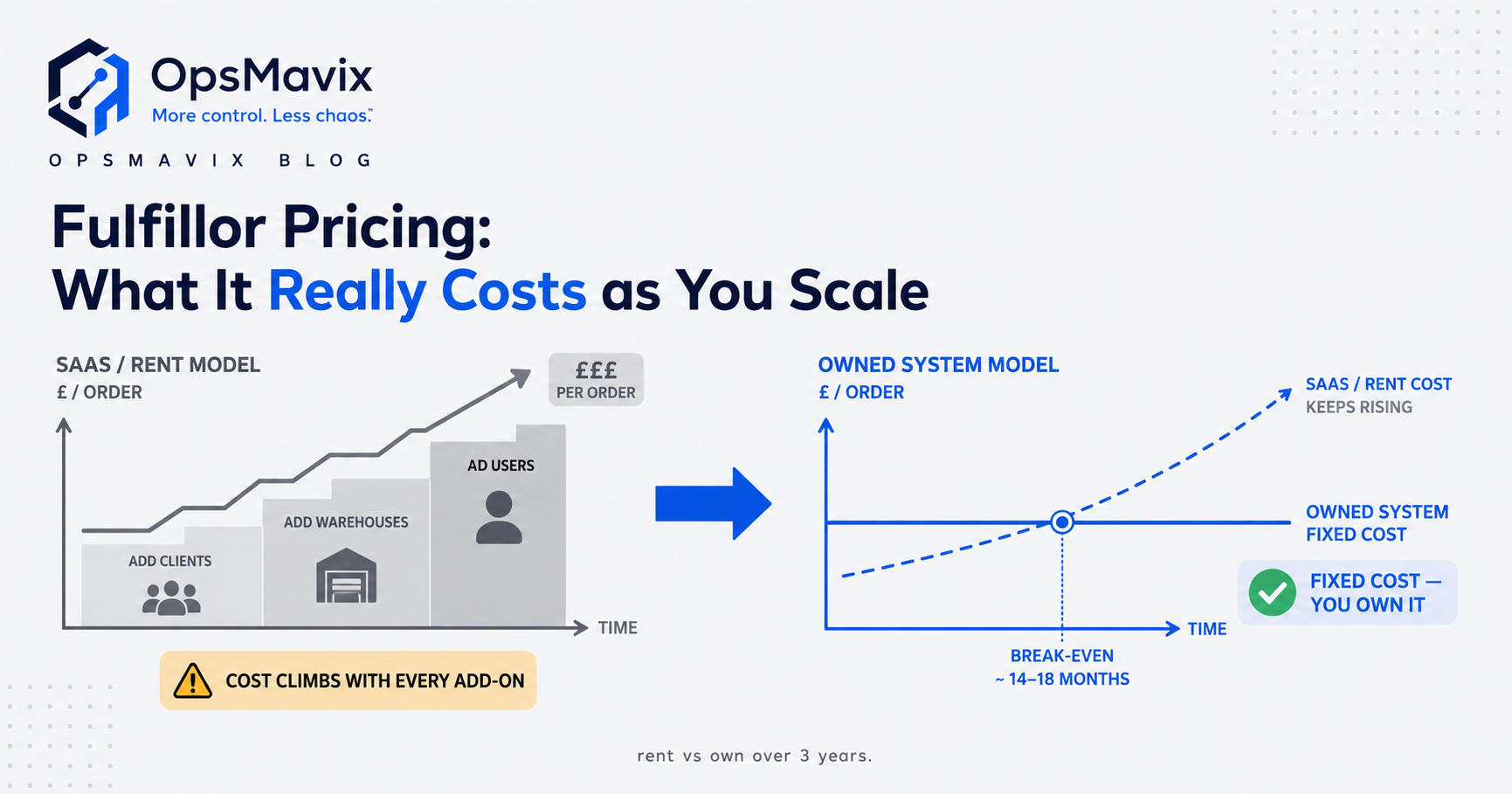
Fulfillor pricing is not published as a price list: when we checked Fulfillor’s own pricing pages in October 2026, every plan was sold through an enquiry and a written quote, with no monthly figures shown. What Fulfillor does publish is the shape of the price: three product lines, four order-volume bands for its 3PL plans, and a list of the factors that move a quote.
That leaves a practical problem. You cannot budget from a headline number, so you have to budget from your own volumes, users, clients and integrations, then test the quote against them. This guide sets out what Fulfillor publishes, the cost drivers to ask about, and clearly labelled hypothetical calculations for three-year total cost of ownership and cost per order.

Fulfilment software cost tracks order volume, locations and the people working the aisles. Illustrative photograph, not an OpsMavix project.
Image credit: Jacques Dillies, Unsplash License. No edits.
Key Takeaways
- Fulfillor did not publish prices on its pricing pages when checked in October 2026; every plan is quoted.
- Its 3PL plans are banded by monthly orders: up to 3,000, up to 5,000, up to 10,000 and over 10,000.
- Users, client accounts, warehouse locations, integrations and onboarding all feed the quote.
- Fulfillor says implementation, onboarding, integration and extra warehouse costs are defined in the quote before implementation.
- Model three years of cost, including hardware and internal time, not just the subscription.
- Divide the total by your real order count to compare options on cost per order.
In this guide:
- 1. What Fulfillor Publishes About Pricing
- 2. How the Three Plans Differ
- 3. The Cost Drivers to Ask About
- 4. How Order Bands Affect Seasonal Costs
- 5. A Hypothetical Three Year Total Cost
- 6. Working Out Cost per Order
- 7. Questions to Ask Before You Sign
- 8. When Fulfillor Fits and When to Look Further
- Frequently Asked Questions
- How OpsMavix Can Help
1. What Fulfillor Publishes About Pricing
The short answer, checked October 2026
Fulfillor is a cloud warehouse management system for 3PLs, fulfilment businesses, ecommerce brands and warehouse operators. Its pricing page names NOI Technologies LLC, with an address in Wilmington, Delaware, USA. At the time of writing (October 2026), that page describes pricing as based on usage, workflows and complexity, and it shows no monthly prices, currency amounts or setup fees.
The 3PL pricing page goes further on structure but still lists no amounts. Each plan has an enquiry form rather than a price.
What the pages do confirm
| Item | What Fulfillor’s pages state (checked October 2026) |
|---|---|
| Published prices | None; every plan is quoted |
| 3PL plan bands | Starter up to 3,000 orders a month, Medium up to 5,000, Large up to 10,000, Enterprise over 10,000 |
| Included in all 3PL plans | Order, inventory, warehouse and shipping management, client portal, client billing and standard integrations |
| Mobile use | Mobile app included, but user licences are required |
| Inbound shipments | Included at no extra cost |
| Setup and onboarding | No fixed fee; implementation, onboarding, integration or extra warehouse costs appear in the quote |
| Contract | No minimum term stated; “flexible engagement options” discussed per customer |
| Quote process | Review of your operation, a 30-minute walkthrough of relevant modules, then a written quote |
When we checked, the pricing pages also carried a time-limited introductory discount banner. Offers like this change often, so ask for any discount, its duration and the price that follows it in the written quote.
What is not published
Neither page states per-user prices, user or client limits, overage rules for exceeding a band, or the currency a UK buyer will be quoted in. Third-party software directories sometimes show estimated starting prices; we have not repeated them here because they could not be confirmed on Fulfillor’s own site.
2. How the Three Plans Differ
Multichannel, 3PL and Custom
Fulfillor’s pricing page groups its offer into three product lines. Each has a different set of pricing factors, so the same order volume can produce a different quote depending on which line you are in.
| Product line | Who it is aimed at | Pricing factors Fulfillor lists |
|---|---|---|
| Multichannel WMS | Ecommerce brands selling across several channels | Connected sales channels, fulfilment volume, inventory locations, automation needs |
| 3PL WMS | Multi-client fulfilment operations | Multi-client operations, order volume, warehouse locations, users, billing workflows, integrations |
| Custom WMS | Complex operations needing bespoke workflows | Development scope, integrations, deployment requirements, ongoing support |
What the 3PL bands describe
The 3PL bands are described by fit as well as volume. Starter is pitched at single-site operations with core workflows. Medium adds multi-client billing and client portal workflows. Large covers multiple warehouse locations, advanced reporting and broader integrations. Enterprise covers high-volume networks with custom workflows.
Read those descriptions as signals of where the quote may move. A single-site operation that needs several client billing rules may not sit neatly in the band its volume alone suggests.
Features you are paying for
Fulfillor’s 3PL billing page describes client-specific rate cards, storage rates by location, pallet, bin, carton or time period, minimum fees and export-ready invoice data. Its handheld operations page describes picking on Android-based handheld devices, RF scanners and rugged terminals. Its integrations page lists ecommerce platforms, marketplaces, carriers and accounting tools. Confirm which of the integrations you need are “standard” under your quote.
3. The Cost Drivers to Ask About
Six drivers that move the number
Because there is no list price, your quote is built from your answers. Prepare the numbers before the walkthrough so you can compare like with like.
| Cost driver | What to bring | What to ask |
|---|---|---|
| Orders | Monthly orders for the last 12 months, including peak | Which band applies, and what happens in a month above it? |
| Clients | Number of client accounts now and planned | Is there a charge per client account or client portal user? |
| Users | Office users and handheld users by shift | What counts as a user, and are licences named or concurrent? |
| Integrations | Every sales channel, carrier and accounting tool | Which are standard, and what does a non-standard connection cost? |
| Onboarding | Data to migrate, sites to configure, training needed | What is the one-off implementation fee, and what does it include? |
| Support | Hours you operate and response you need | What support level is included, and what costs extra? |
Costs outside the quote
The subscription is not the whole cost. Handheld scanners and label printers, your own staff time during implementation, data cleaning, and the time spent maintaining client rate cards all sit with you. Include them, or every option will look cheaper on paper than it is in practice.
Practical preparation checklist
- Export 12 months of order counts by month and by client.
- Count users by role: admin, office, picker, packer, receiver.
- List every integration, marking which ones carry orders and which carry money.
- Write down your client billing rules, including minimums and special handling.
- Note the sites, zones and locations the system must model.
- Decide the support hours you actually need, including peak weekends.
4. How Order Bands Affect Seasonal Costs
Why peaks matter in a banded model
Fulfillor’s published 3PL bands are set on monthly orders. If your volume swings with the seasons, the band you are charged for, and how often it is reassessed, matters as much as the band itself. That is a contract question, not a feature question.
Hypothetical worked example: seasonal band cost
The figures below are hypothetical. They are not Fulfillor prices, which are not published. They only show how to test a quote.
Assume a 3PL ships 3,500 orders a month for nine months (Medium band, up to 5,000) and 7,000 orders a month for three peak months (Large band, up to 10,000). Assume a quote of £1,400 a month for Medium and £2,200 a month for Large.
| Billing arrangement (hypothetical) | Calculation | Annual subscription |
|---|---|---|
| Charged at peak band all year | 12 × £2,200 | £26,400 |
| Band follows actual monthly volume | (9 × £1,400) + (3 × £2,200) = £12,600 + £6,600 | £19,200 |
| Difference | £26,400 minus £19,200 | £7,200 |
Over three years, the difference is 3 × £7,200 = £21,600. The software has not changed; only the billing rule has. Ask in writing how a band is chosen, how often it is reviewed and whether a short peak moves you permanently.
5. A Hypothetical Three Year Total Cost
Build the full picture
Total cost of ownership (TCO) adds every cost of running the system over a fixed period. Three years is a common horizon because it spans more than one peak season and usually includes at least one renewal.

User numbers, handheld devices and training time all belong in a three-year cost model. Illustrative photograph, not an OpsMavix project.
Image credit: Centre for Ageing Better, Unsplash License. No edits.
Hypothetical worked example: three-year TCO
Every figure below is hypothetical and chosen for easy arithmetic. None of them is a Fulfillor price. Replace each line with the numbers from your own written quote and your own costs.
Assume the same 3PL as section 4, with the band following actual volume, 8 handheld users and a small set of integrations.
| Cost line (hypothetical) | Calculation | Three-year cost |
|---|---|---|
| Subscription, band follows volume | 3 × £19,200 | £57,600 |
| Handheld user licences | 8 users × £30 × 36 months | £8,640 |
| One-off implementation and onboarding | Quoted fee | £6,000 |
| Non-standard integration setup | Quoted fee | £2,500 |
| Handheld scanners | 8 × £600 | £4,800 |
| Internal staff time during implementation | 120 hours × £25 | £3,000 |
| Ongoing admin, rate cards and training | 4 hours × £25 × 36 months | £3,600 |
| Total three-year cost | Sum of the lines above | £86,140 |
The subscription is £57,600 of £86,140, about 67%. The other third is easy to leave out of a comparison, and it is often where options really differ.
Check what the model leaves out
The example excludes VAT, currency movements, price rises at renewal and any extra warehouse. Ask whether the quote includes an annual increase, and add it as a separate line if it does. If a second site is planned within three years, cost it now, because Fulfillor lists warehouse locations as a pricing factor.
6. Working Out Cost per Order
Divide total cost by real orders
Cost per order turns a quote into a number you can compare with other systems and with what you charge clients. Use real orders shipped, not band ceilings.
Hypothetical worked example: cost per order
Using the same hypothetical 3PL: annual orders are (9 × 3,500) + (3 × 7,000) = 31,500 + 21,000 = 52,500. Over three years that is 3 × 52,500 = 157,500 orders.
| Measure (hypothetical) | Calculation | Result |
|---|---|---|
| Three-year TCO, band follows volume | From section 5 | £86,140 |
| Orders over three years | 3 × 52,500 | 157,500 |
| Cost per order | £86,140 ÷ 157,500 | £0.55 |
| Three-year TCO, peak band all year | £86,140 + £21,600 | £107,740 |
| Cost per order, peak band all year | £107,740 ÷ 157,500 | £0.68 |
The same operation costs about 13p more per order purely because of the billing rule (£0.68 minus £0.55, after rounding each figure to the nearest penny).
Use it with client pricing
If your client rate cards include a per-order fee, compare it with your software cost per order. A thin margin on low-volume clients is a reason to check how client accounts and users are charged before you add more of them.
7. Questions to Ask Before You Sign
Commercial questions
- Which band applies to us, and how often is it reviewed?
- What happens in a month above the band: an overage, an upgrade or nothing?
- What counts as a user, and is the mobile licence charged separately?
- Is there a charge per client account or per warehouse location?
- Which of our integrations are standard, and what does each other one cost?
- What does the one-off implementation fee include, item by item?
- What is the contract term, notice period and price at renewal?
- Which currency is the quote in, and is VAT added on top?
Operational questions
Ask the supplier to demonstrate your own scenario during the walkthrough: one client with a minimum fee, one storage charge by pallet, a short pick and a return. Mark each requirement as demonstrated, configurable, requiring development or unsupported. That list tells you more about future cost than the subscription does.
Data and exit questions
Confirm how you export orders, inventory, client billing history and change logs if you leave. A low entry price is less attractive if data migration out is slow or charged.
8. When Fulfillor Fits and When to Look Further
Where a packaged 3PL WMS fits well
Fulfillor’s published scope covers multi-client inventory, client billing, a client portal, handheld picking and a broad set of integrations. For a 3PL whose processes match that scope, buying a packaged WMS is usually faster and lower risk than building one, and a volume-based price lines up cost with throughput.
Compare the approaches fairly
| Approach | When it fits | What to check |
|---|---|---|
| Configure a packaged WMS such as Fulfillor | Your workflows match its standard modules | Band rules, user licences and integration scope |
| Connect existing tools | Systems work but handoffs between them fail | Record ownership, error handling and reconciliation |
| Focused custom application | One gap, such as unusual client billing, is costly | Integration with the WMS, support and maintenance |
| Full ERP | Finance, purchasing and warehouse need one data model | Fit, migration effort and delivery capacity |
Signs to look further
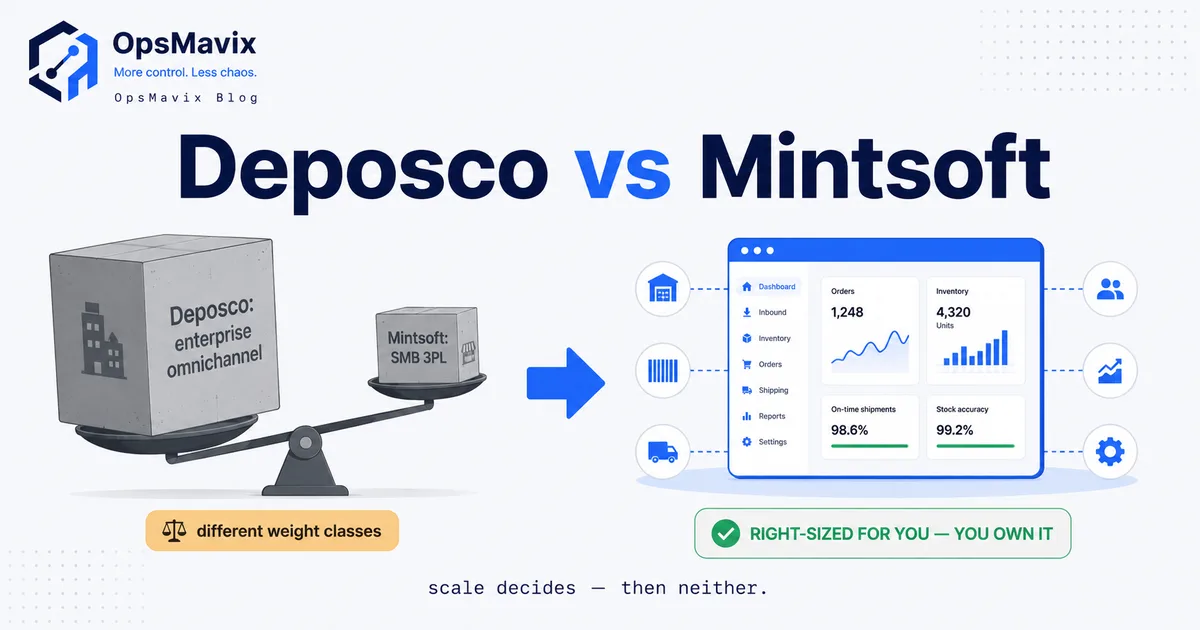
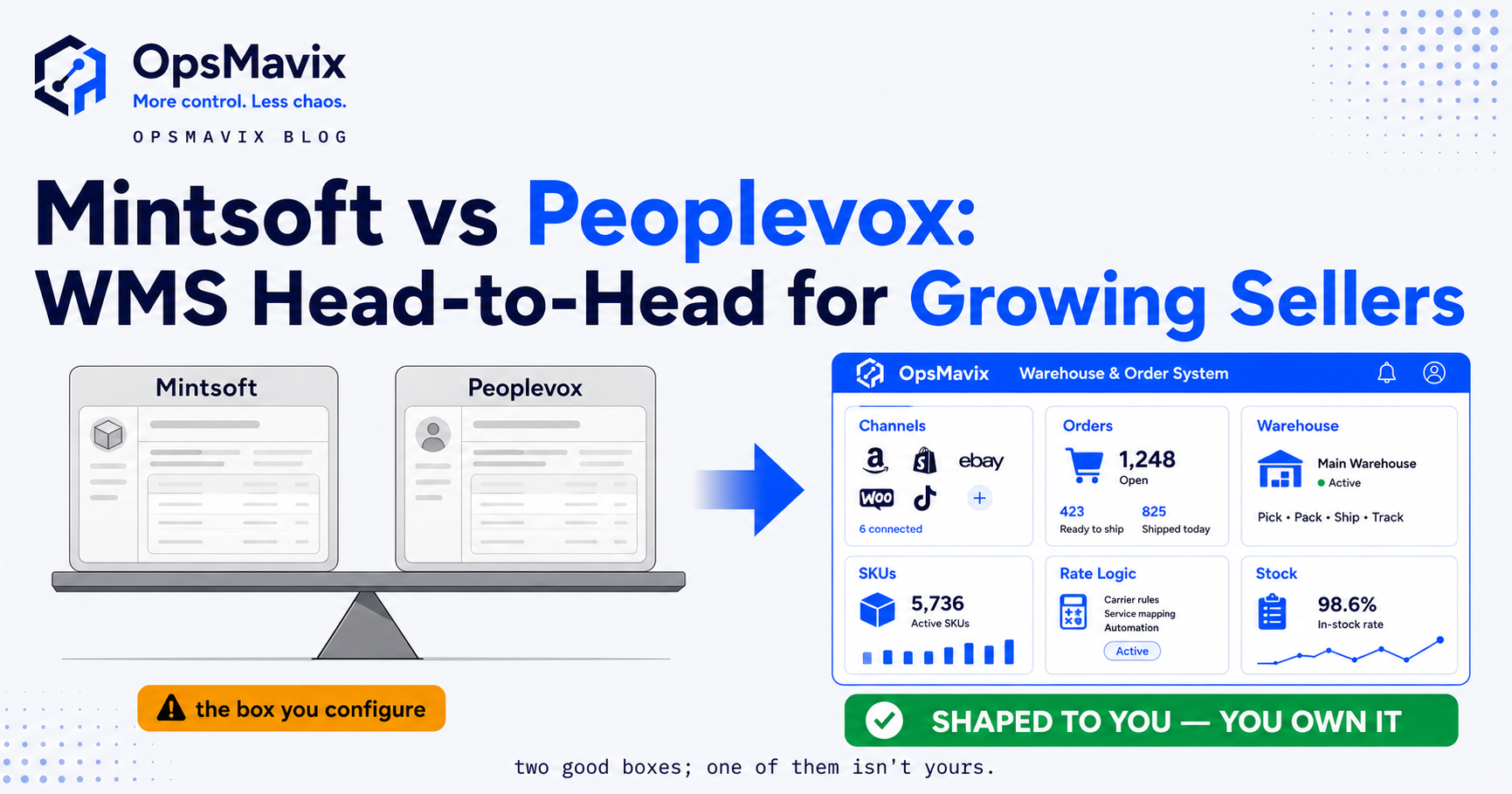
Look further if your client billing rules need workarounds outside the system, if the quote rises faster than your margin as you add clients, or if the same manual reconciliation happens every month. Our Fulfillor alternative guide covers those options, and Fulfillor vs Mintsoft compares two packaged platforms. For a second pricing model to compare against, see Mintsoft pricing, and for the features that matter when you hold stock for clients, see 3PL inventory management software.
Frequently Asked Questions
How much does Fulfillor cost?
Fulfillor did not publish prices when we checked its pricing pages in October 2026. Every plan is quoted after a review of your operation and a walkthrough. Budget from your own volumes and cost drivers, then test the written quote.
Does Fulfillor charge per order?
Its 3PL plans are banded by monthly order volume: up to 3,000, up to 5,000, up to 10,000 and over 10,000. The pricing pages do not state a per-order fee, so ask how the band is set and reviewed.
Is there a setup fee?
There is no fixed published fee. Fulfillor’s 3PL pricing page says implementation, onboarding, integration or extra warehouse costs appear in the quote and are defined before implementation begins.
Are mobile users charged separately?
Fulfillor’s 3PL pricing page says the mobile app is included but user licences are required. Ask how many licences your quote assumes and the cost of adding more.
Is there a minimum contract?
The 3PL pricing page states no minimum contract and refers to flexible engagement options. Get the term, notice period and renewal price in writing.
How do I compare Fulfillor with another WMS?
Use one shared scenario: the same order volumes, users, clients, integrations and three-year horizon. Calculate total cost of ownership and cost per order for each, including hardware and internal time.
Are the figures in this guide Fulfillor prices?
No. Every pound figure in sections 4 to 6 is hypothetical and exists only to show the method. Fulfillor’s published bands are real; the prices attached to them are not.
Can OpsMavix build a custom 3PL billing or warehouse system?
Yes. OpsMavix can build focused applications, such as a client billing engine or an operations dashboard that connects to a packaged WMS, or a full custom system where that fits the requirements better.
How OpsMavix Can Help
OpsMavix can help you turn a quote-based WMS price into a three-year cost model, using your own order history, user counts, clients and integrations.
Where a packaged WMS fits, that may mean connecting it cleanly to your channels and finance. Where it does not, it may mean ecommerce inventory automation, an inventory automation system or a wholesale order management system built around how you actually operate.
Contact OpsMavix with 12 months of order volumes by client, the quote you have received and the billing rule that causes the most manual work. We can use that evidence to define requirements and a practical pilot.
Keep reading
Getting value from OpsMavix? Add us as a preferred source on Google — you'll see more of our operations content in your AI Overviews, AI Mode and Search.