Why Own Your Operations System? The Real Cost of Software Lock-In
Software you rent but cannot control. Here is what owning your operational system really means, the risks it removes, and the responsibilities that come with it.
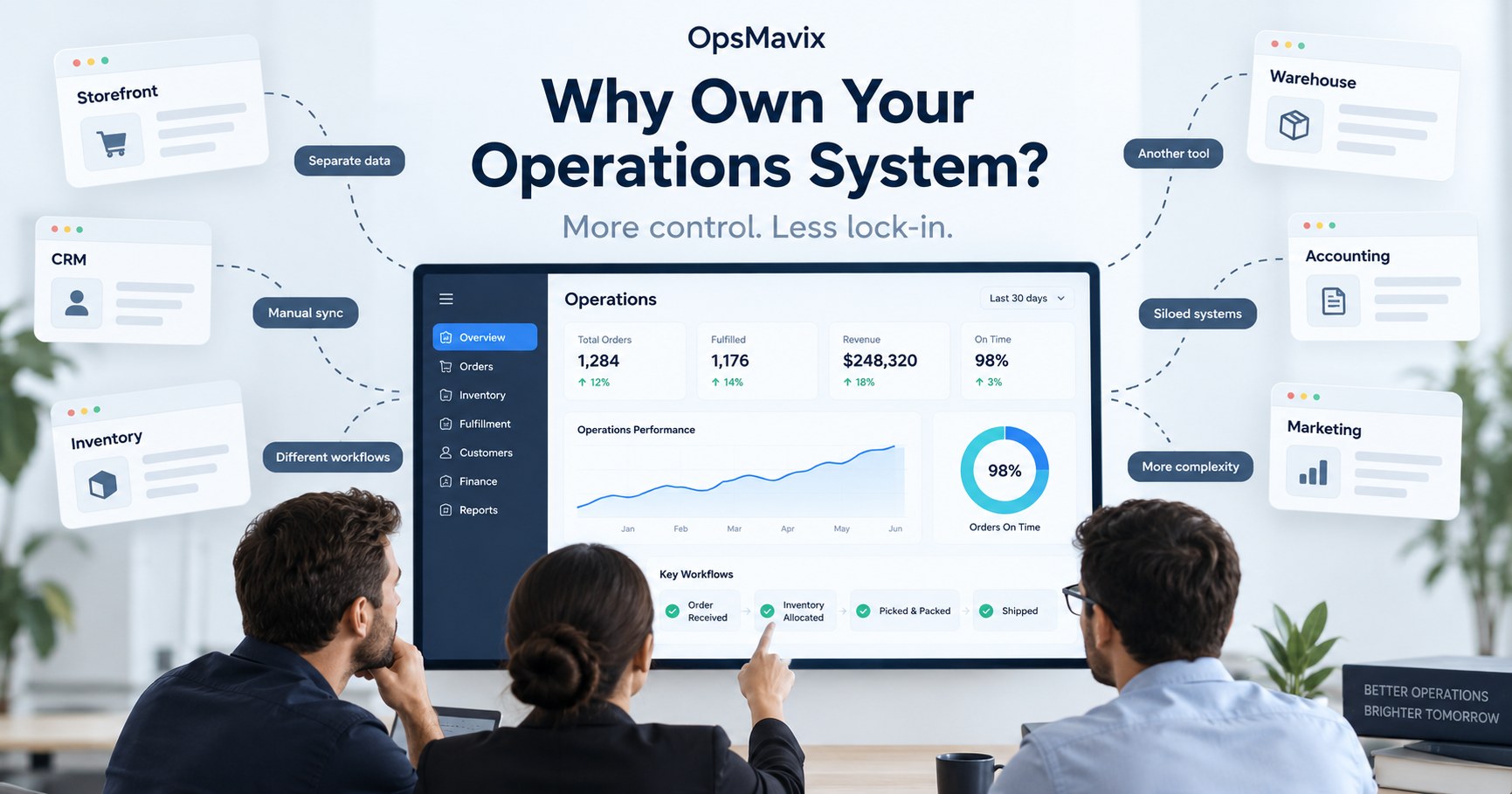
Why Own Your Operations System? The Real Cost of Software Lock-In
Most businesses do not deliberately choose software lock-in.
It happens one decision at a time.
You buy an ecommerce platform because you need to sell online.
Then inventory software.
Then a CRM.
Then an automation tool to connect the CRM to the ecommerce platform.
Then another application for the warehouse.
Each decision makes sense on its own.
A few years later, your operations depend on a collection of platforms you rent, integrations you do not fully control and pricing models that can change independently of your business.
Leaving any one of them suddenly feels difficult.
That is vendor lock-in.
And for a system responsible for running orders, stock, purchasing and fulfilment every day, it is worth understanding exactly what you are becoming dependent on.
What Does Software Ownership Actually Mean?
“Own your software” can easily become a marketing slogan.
That is not particularly useful.
For an operations system, the more important question is:
How much control does your business have over something it depends on every day?
That includes questions such as:
- Can you access your operational data?
- Can you export it in a usable format?
- Can your workflows be changed as the company evolves?
- Is your system documented?
- Do you understand which other systems it depends on?
- Can integrations be changed or replaced?
- Are you forced to keep buying licences simply to let more employees use the system?
- What happens if you want another technical team involved?
- What happens if your relationship with the original supplier ends?
Ownership is therefore not simply about possessing some code.
It is about operational control.
A business should understand how the system works, where its information lives and what options it has if circumstances change.
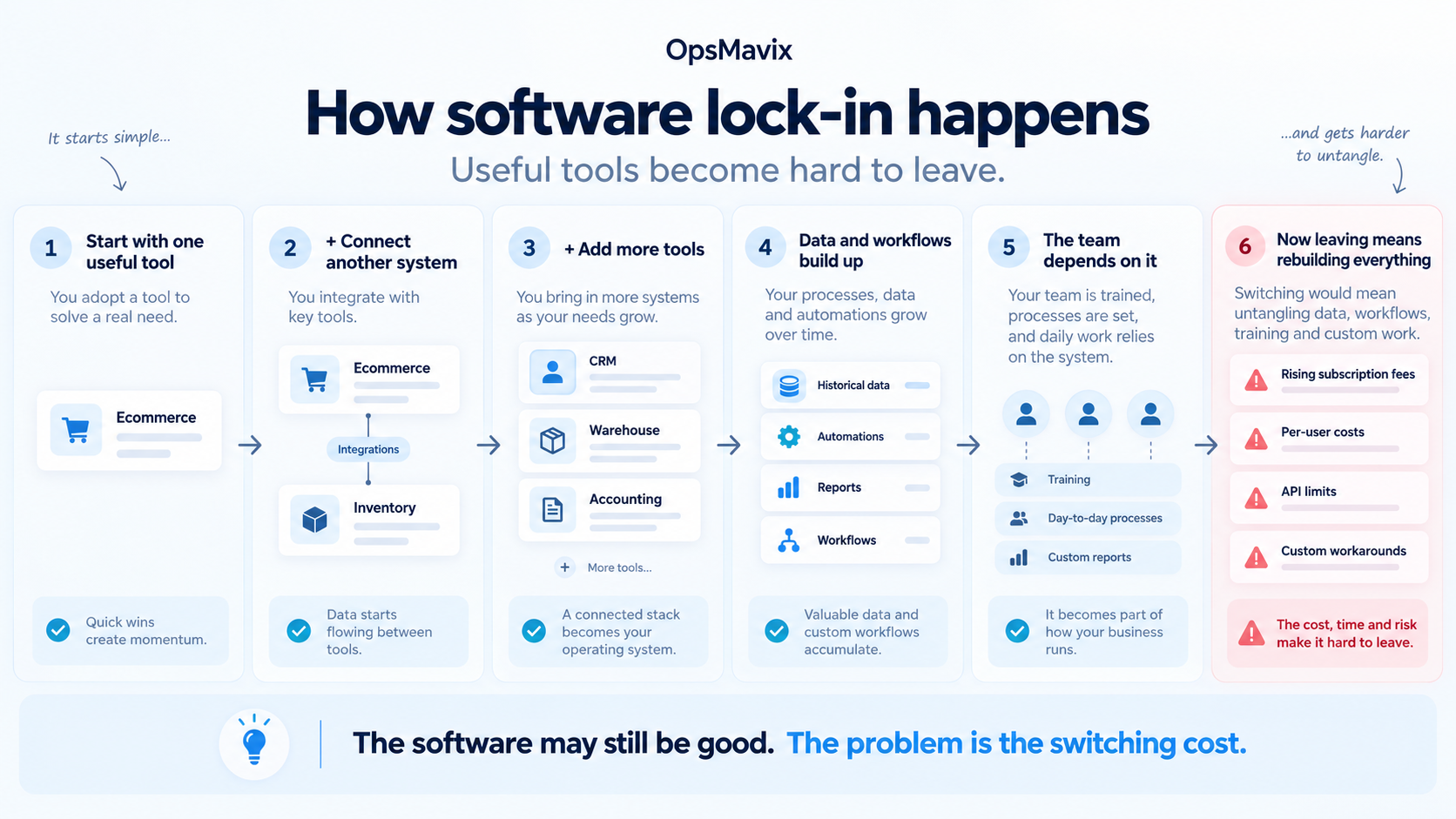
How Vendor Lock-In Happens
Lock-in is rarely dramatic.
Usually, it is useful software becoming increasingly difficult to leave.
Imagine your business starts with an inventory platform.
At first, it solves the problem perfectly.
Then you connect Shopify.
Then Amazon.
Then your warehouse.
Then Xero.
Your team learns the platform.
You create custom processes around it.
Historical operational data accumulates inside it.
Five years later, replacing it does not mean replacing one application.
It means potentially rebuilding:
- Integrations
- Processes
- Reports
- Staff training
- Automations
- Historical data
- Operational knowledge
That creates switching cost.
And switching cost gives the vendor leverage.
You may then tolerate things you would not have accepted at the beginning:
- Increasing subscription fees
- Per-user charges
- Features moving into higher pricing tiers
- Limited customisation
- Integration restrictions
- API limits
- Processes that do not quite fit your operation
Not because the software is necessarily bad.
Because leaving has become expensive.
The Six Questions Every Business Should Ask
Before making any platform central to your operations, ask six questions.
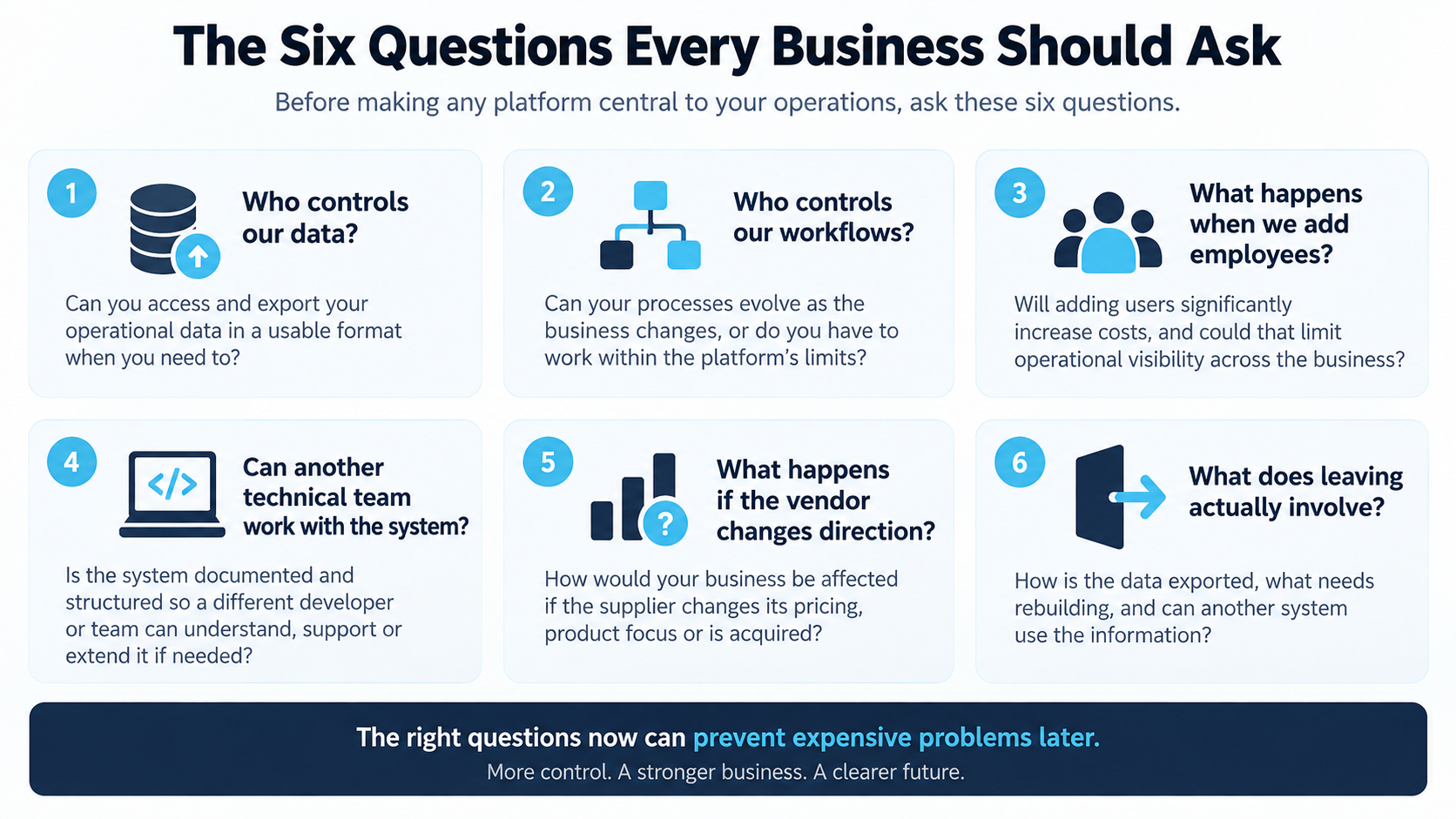
1. Who controls our data?
Your business may generate years of valuable information:
- Orders
- Customers
- Suppliers
- Stock history
- Product information
- Purchasing history
- Operational performance
- Workflow records
You should know whether that information can be exported and what form it will be in when it leaves the system.
A database dump nobody can practically use is very different from portable, structured business data.
2. Who controls our workflows?
Your processes will change.
A five-person warehouse does not operate like a twenty-person warehouse.
One sales channel becomes four.
One stock location becomes three.
Wholesale gets added.
A 3PL gets involved.
The important question is whether your software can evolve with those changes or whether your processes have to remain inside the boundaries set by the platform.
3. What happens when we add employees?
Many subscription platforms charge per user.
Again, there is nothing inherently wrong with that.
But it can create an unusual incentive.
You want better operational visibility across the company.
Yet every person you give access to increases the software bill.
That may lead businesses to restrict access, share accounts or keep parts of a process outside the system.
The commercial model begins influencing the operational design.
4. Can another technical team work with the system?
This is one of the most important questions and one of the least frequently asked.
A system should not become an unexplained black box.
If another competent team eventually needs to understand, support or extend it, there should be enough structure and documentation for that conversation to be realistic.
Dependence on undocumented knowledge is simply another form of lock-in.
5. What happens if the vendor changes direction?
Software companies change.
Prices change.
Products get repositioned.
Features get removed.
Companies are acquired.
A supplier that is perfect for your business today may have different priorities five years from now.
The more important the platform becomes to your operation, the more important your exit options become.
6. What does leaving actually involve?
Do not ask this after deciding to leave.
Ask it before buying.
How is the data exported?
What needs rebuilding?
Who owns the integrations?
What documentation exists?
Can another system consume the information?
Your exit path is part of your system architecture, even if you never use it.
Ownership Does Not Mean Replacing Every SaaS Tool
This distinction matters.
OpsMavix is not based on the idea that every subscription platform is bad and every company should custom-build everything.
That would make little sense.
Shopify is extremely good at ecommerce.
Xero is built for accounting.
Courier platforms perform specialist logistics functions.
Marketplaces bring customers.
The goal should not be:
Own everything.
It should be:
Own the part of your technology stack where your unique operational processes live.
For example:
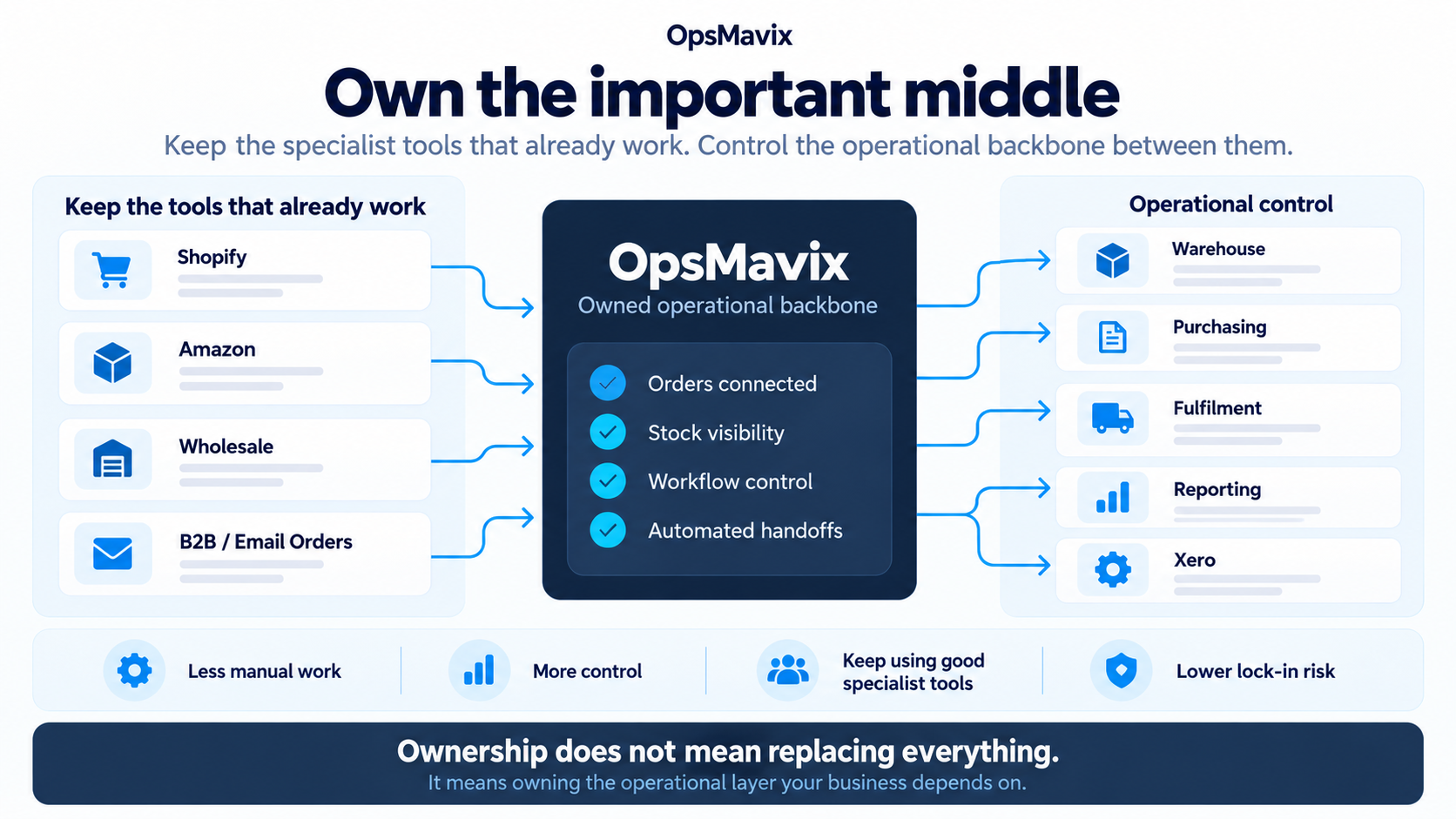
Shopify → OpsMavix → Warehouse
Amazon → OpsMavix → Purchasing
Wholesale → OpsMavix → Fulfilment
OpsMavix → Xero
Shopify can remain Shopify.
Xero can remain Xero.
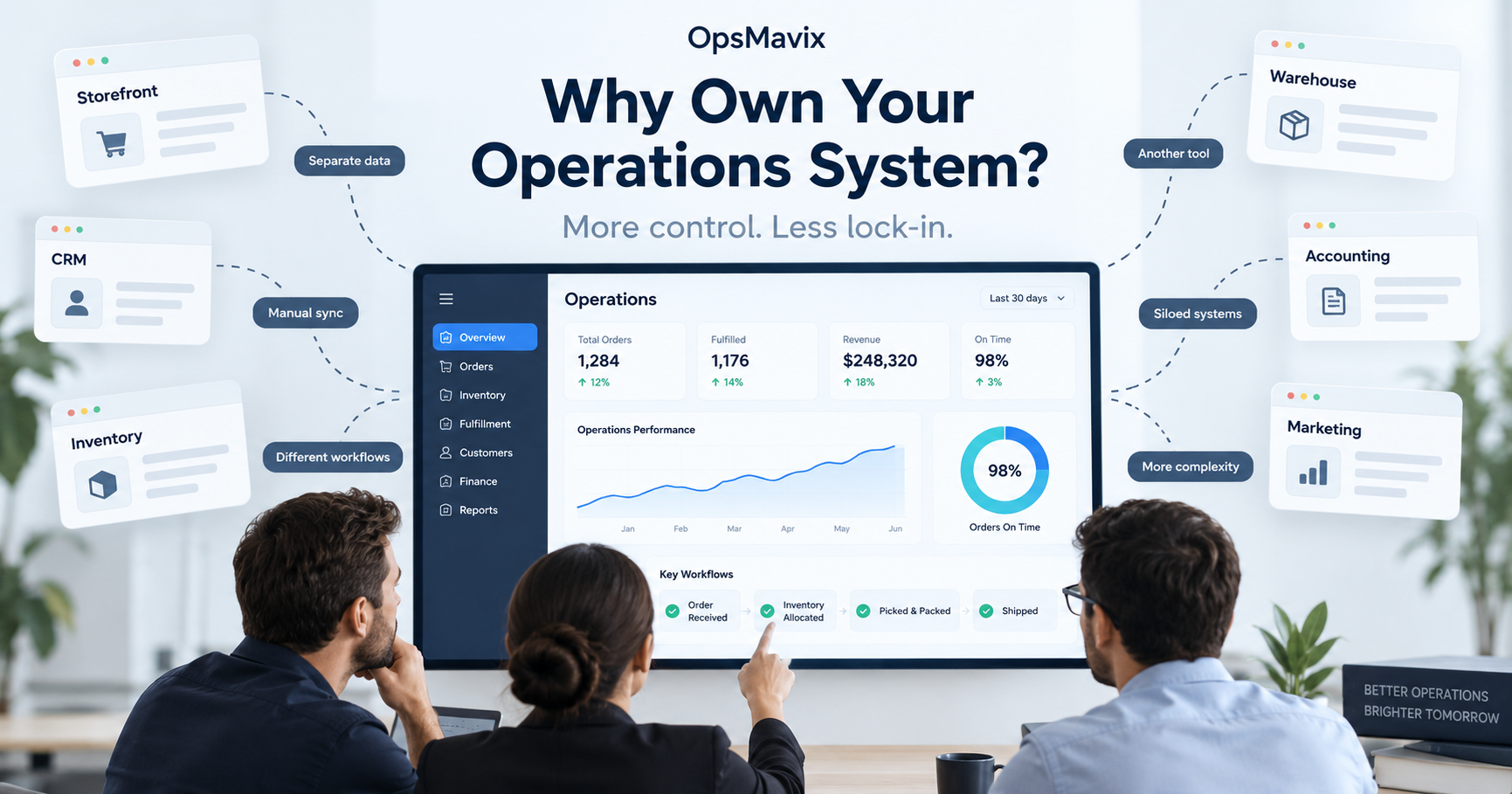
The difference is that your central operational workflow does not have to exist as a fragile collection of spreadsheets and SaaS automations between them.
OpsMavix becomes the operational backbone.
The Hidden Cost of Per-User SaaS
Subscription software often appears inexpensive at the beginning.
£50 per user per month may not sound significant.
With five users:
£250/month
With twenty:
£1,000/month
With forty:
£2,000/month
That becomes £24,000 per year before considering implementation, integrations, premium modules or other applications in the stack.
That does not automatically make it poor value.
If the software produces more than £24,000 of value, it may be an excellent investment.
The important issue is how the economics change as the organisation grows.
A system that is inexpensive with five users can become a significant permanent operating expense with fifty.
And once your entire operation depends on it, switching becomes considerably harder.
That is why businesses should evaluate total cost of ownership, not simply the monthly starting price.
What About Support and Maintenance?
This is the strongest legitimate argument against owned or custom systems.
A buyer may reasonably ask:
“If we don’t use a huge SaaS platform, who looks after this thing?”
That question deserves a proper answer.
Ownership should not mean being handed a system and abandoned.
A maintainable operational system needs:
- Clear documentation
- Controlled changes
- Backups
- Security maintenance
- Monitoring
- Defined integrations
- A clear understanding of infrastructure
- People capable of supporting it
There is always a maintenance requirement.
SaaS hides much of that inside the monthly subscription.
An owned system makes the relationship more visible.
Neither model eliminates maintenance.
They distribute responsibility differently.
What Happens If You Leave OpsMavix?
This question should not be uncomfortable.
It is exactly the type of question a responsible buyer should ask.
Our objective is to build systems that create operational independence, not artificial dependence.
That means the design of an OpsMavix system should consider:
- How your business data is stored
- How that information can be retrieved
- What integrations exist
- How workflows have been configured
- What documentation is required
- What another competent technical team would need to understand
The exact arrangements depend on the system and project scope, so these should be clearly agreed as part of the project rather than hidden behind vague claims about “ownership.”
The principle is simple:
Leaving OpsMavix should not mean losing control of your own operation.
When SaaS Is Actually the Better Choice
There are plenty of situations where buying existing SaaS is smarter than building or owning a specialised system.
If your process is standard and a mature platform already handles it extremely well, building your own version may be a waste of money.
Examples may include:
- Accounting
- Ecommerce storefronts
- Basic CRM
- Payroll
- Commodity communication tools
The value of an owned operations system appears where your competitive or operational reality no longer fits comfortably inside generic applications.
That may involve:
- Unusual order flows
- Multiple channels
- Bespoke warehouse processes
- Complex stock locations
- Production
- 3PL relationships
- Specialist purchasing rules
- Customer-specific workflows
- Exception management
- Bespoke operational reporting
That is the part worth evaluating.
The right question is not:
“SaaS or custom?”
It is:
“Which parts of our business are generic, and which parts are operationally unique?”
Buy the generic parts.
Own the important middle.
Owned System vs Subscription SaaS
Subscription SaaS
Best suited to: Standardised business requirements
Starting cost: Often low
Payment model: Recurring subscription
User growth: Often increases licence cost
Customisation: Defined by platform capabilities
Infrastructure: Managed by vendor
Updates: Controlled by vendor
Data access: Depends on platform
Switching: Can become difficult as integrations and data accumulate
Support: Included or purchased from vendor/partners
Owned Operations System
Best suited to: Processes specific to how the business actually operates
Starting cost: Project investment
Payment model: Build cost plus any agreed hosting/support
User growth: Architecture-dependent rather than automatically tied to per-seat licensing
Customisation: Designed around required workflows
Infrastructure: Defined as part of the solution
Updates: Controlled according to business requirements
Data access: Should be explicitly defined from the start
Switching: Exit and portability can be designed into the system
Support: Can be structured around the organisation’s requirements
Neither model wins automatically.
A good technology stack often contains both.
The Real Question Is Control
The cheapest piece of software is not necessarily the least expensive system to operate.
The most customisable platform is not automatically the safest.
And “ownership” does not mean much unless it gives the business practical control.
What matters is whether your operational technology allows you to answer:
Where is our information?
Who controls it?
Can our processes evolve?
Can somebody else understand the system?
What happens if we want to leave?
What will this cost us as we grow?
If those questions have good answers, you probably have a healthy technology relationship.
If nobody knows the answers because the business has slowly become dependent on a stack of subscriptions and spreadsheets, it may be time to look at the architecture underneath the operation.
FAQ
What is software vendor lock-in?
Vendor lock-in happens when changing software providers becomes difficult or expensive because your data, workflows, integrations, training and processes have become heavily dependent on one platform.
Is SaaS vendor lock-in always bad?
No. Switching costs exist with almost any important business system. The problem is uncontrolled lock-in where the business has poor data portability, limited alternatives or no realistic exit plan.
Does owning an operations system mean we should stop using SaaS?
No. Specialist SaaS platforms can remain extremely valuable. OpsMavix is designed to connect systems that already work rather than replacing software purely for the sake of ownership.
What data should we be able to export?
At minimum, businesses should understand how critical operational records such as products, customers, suppliers, orders, inventory and workflow data can be retrieved. The exact requirement depends on the system.
Is custom software riskier than established SaaS?
It can be if it is poorly documented, badly maintained or dependent on one developer. That is why maintainability, documentation, infrastructure, data access and support need to be considered as part of the system design rather than after launch.
Can another developer support an OpsMavix system?
That depends on the architecture and agreed project deliverables. Where third-party maintainability is important, it should be made an explicit requirement of the project rather than assumed.
What happens if we eventually need ERP?
An operational system should not prevent that move. Structured workflows, cleaner operational data and defined integrations can make eventual migration to ERP easier.
How OpsMavix Can Help
If your operation now depends on spreadsheets, subscriptions and integrations that nobody fully understands, adding another application may not solve the underlying problem.
Sometimes the issue is the architecture itself.
OpsMavix builds right-sized operations systems for growing product businesses — connecting orders, stock, purchasing, fulfilment and reporting while allowing the specialist systems that already work to stay in place.
The goal is not simply to give you more software.
It is to give your business more control over the system it depends on.
Want to see what an owned operational backbone could look like for your business?
Getting value from OpsMavix? Add us as a preferred source on Google — you'll see more of our operations content in your AI Overviews, AI Mode and Search.